Why Optimizing Your Sales Process is Your Greatest Competitive Advantage

Optimize sales processes is the difference between a sales team that consistently hits targets and one that struggles with stalled deals and missed forecasts. Here's what you need to know:
Quick Answer: How to Optimize Your Sales Process
- Shift from rep-centric to buyer-centric - Align stages with buyer milestones, not internal tasks
- Audit your current process - Identify bottlenecks by reviewing recent deals and interviewing reps
- Leverage content strategically - Use explainer videos, case studies, and pricing pages to educate buyers earlier
- Automate repetitive tasks - Eliminate manual data entry and streamline scheduling
- Train and coach consistently - Ensure adoption through role-playing and call reviews
- Track key metrics - Monitor conversion rates, sales cycle length, and deal velocity
- Iterate continuously - Review and refine quarterly based on data and feedback
Your pipeline is clunky. Deals stall after demos. Reps skip steps to "save time." Forecasts feel like dart throws. Sound familiar?
You're not alone. Most sales processes are built around what the rep does, not what the buyer decides. This creates friction at every stage—from unclear qualification criteria to manual data entry eating up 20% of your team's time.
The cost of a broken sales process is staggering. Deals take longer to close. Win rates drop. Customer churn increases. And your best reps burn out chasing their tails instead of building relationships.
But here's the good news: companies that get sales process optimization right see 7% higher revenue, 11% more reps meeting target, and 25% more deals closed. They also lose 26% fewer customers.
The difference? They've shifted from reactive, rep-focused workflows to proactive, buyer-first systems. They use data to identify bottlenecks. They automate the busywork. And they treat optimization as an ongoing discipline, not a one-time project.
I'm Ryan T. Murphy, founder of Upfront Operations, and over the past 12 years, I've helped 32 companies optimize sales processes that cut sales cycles by up to 28% and open up millions in new revenue. Whether you need on-demand CRM management, sales playbooks, or fractional sales operations support, we help you build a predictable engine for growth without the overhead of a full-time hire.
Quick Optimize sales processes definitions:
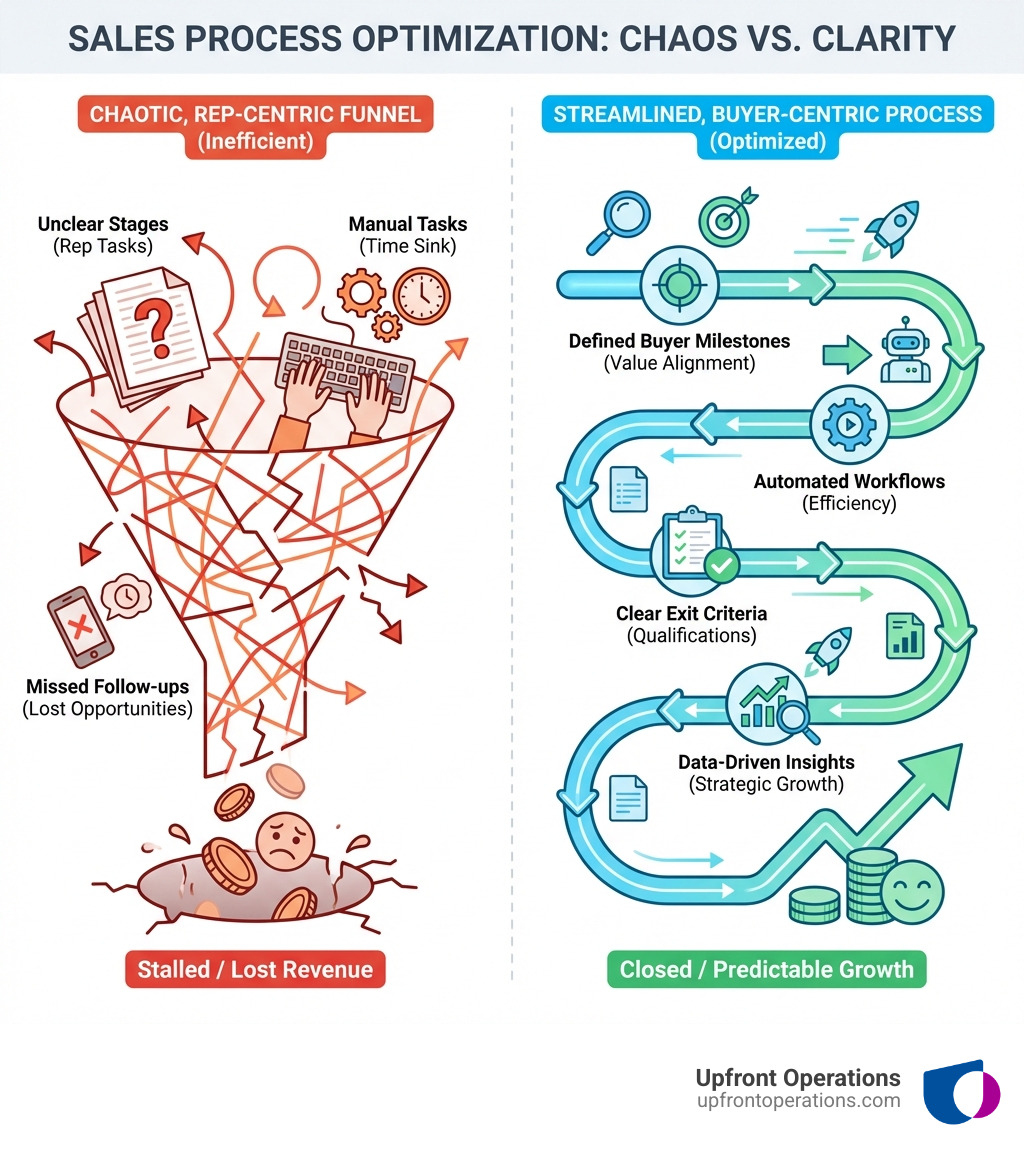
Sales optimization means changing your process from disjointed actions into a finely tuned, revenue-generating machine. It's about making predictable sales. The core difference between a traditional and an optimized process lies in its philosophy and execution.
Let's look at how they stack up:
| Feature | Traditional Sales Process | Optimized Sales Process |
|---|
| Focus | Rep-centric, internal tasks, closing the sale | Buyer-centric, buyer milestones, solving pain points |
| Structure | Linear, often rigid, informal | Flexible frameworks, clear stages, data-driven |
| Lead Qualification | Often inconsistent, based on rep judgment | Standardized rules (BANT, MEDDICC), AI-driven scoring |
| Communication | Ad-hoc, unstructured, feature-focused | Value-driven, personalized, outcome-focused, consistent |
| Technology Use | CRM for record-keeping, manual tasks | Automation, AI, sales enablement, real-time data |
| Alignment (S&M) | Often siloed, conflicting definitions | Shared goals, SLAs, unified data, continuous feedback |
| Feedback & Iteration | Reactive, infrequent, based on intuition | Proactive, data-driven, continuous improvement |
| Goal | Hit individual quotas | Predictable revenue, customer success, scalable growth |
From Rep-Centric to Buyer-Centric: The Modern Imperative
The most profound shift in sales optimization is moving from a "seller-first" to a "buyer-first" mindset. For too long, processes focused on what sellers do (call, demo, close) instead of what buyers need to make an informed decision. This is a critical mistake, as 96% of buyers research extensively before engaging a sales team.
What role does buyer-centricity play in optimizing sales stages? It's everything. Instead of defining stages by internal actions (e.g., "demo given"), we redefine them by verifiable buyer milestones (e.g., "Confirmed Problem Exists," "Validated Solution Fit"). This means mapping the buyer's journey and understanding their needs at each step.
Understanding buyer pain points and their decision process builds trust. Personalization is key: high-performing sales teams are 60% more likely to frame their offering as a solution. By focusing on solving their problems and guiding them through their journey, we accelerate our sales cycle. Our role shifts from product pusher to trusted advisor.
Core Components of a Winning Sales Machine
An optimized sales process is an interconnected system designed for efficiency and predictability. Its core components include:
- Ideal Customer Profile (ICP) & Buyer Personas: Know who you're selling to. A clear ICP defines the ideal company, while buyer personas detail the roles, challenges, and motivations of individuals within them. This ensures your efforts are targeted and relevant.
- Clearly Defined Sales Stages with Verifiable Exit Criteria: Each stage must have clear objectives and verifiable exit criteria based on buyer actions, not seller activities. This brings accuracy to your pipeline and forecasting. For example, an exit criterion might be the buyer confirming their top pain points.
- Sales Playbooks: This comprehensive guide outlines strategies, processes, and best practices for every stage. It includes messaging, objection handling, and content recommendations to empower reps for consistent success.
- Standardized Qualification Rules: Use frameworks like BANT or MEDDICC to evaluate every lead consistently. This focuses your energy on prospects most likely to convert and avoids wasting time on unqualified ones.
- Post-Sale Relationship Building: The process extends beyond the signed contract to build long-term relationships, ensure customer success, and identify upsell/cross-sell opportunities. This is where customer lifetime value (LTV) soars.
The Critical Role of Sales and Marketing Alignment
Misaligned sales and marketing teams are frustrating and unproductive. While 82% of C-suite executives believe their teams are aligned, 65% of the professionals on those teams disagree.
How can sales and marketing teams align to create a more cohesive and effective sales process? It starts with shared goals and a common understanding of our ideal customer.
- Shared Goals & Accountability: Both teams must work towards the same revenue targets, with a clear understanding of how their individual contributions feed into the larger picture.
- Service Level Agreement (SLA): This formal agreement defines expectations between sales and marketing, particularly around lead quantity, quality, and follow-up times. For example, marketing commits to delivering X qualified leads, and sales commits to contacting them within Y hours.
- Unified Lead Definitions: What does "qualified" mean? It must be the same for both teams. This prevents sales from complaining about "bad leads" and marketing from feeling their efforts are wasted.
- Consistent Messaging: From the first marketing touchpoint to the final sales presentation, your brand message, value proposition, and solution narrative must be consistent. This builds trust and avoids confusion.
The benefits are undeniable: companies that align their sales and marketing teams experience 36% higher customer retention rates and 38% higher sales win rates.
To truly open up this synergy, ensure your sales and marketing data are unified and accessible. Our on-demand services can help, providing expert support to unify sales and marketing data for a single source of truth.
A Step-by-Step Guide to Optimize Your Sales Process
Optimizing your sales process doesn't have to mean tearing everything down and starting from scratch. Often, it's about making smart, targeted tweaks that yield significant results. Let's explore a practical framework.

Step 1: Audit Your Process to Identify Friction Points
Before we can fix anything, we need to understand what's actually happening. This is where our detective hats come on!
How can businesses identify and address friction points in their current sales process?
- Map the Current Process: Get it all down. Every step, every handoff, every tool used from initial contact to post-sale follow-up. Who owns what? What are the typical timelines? This visual representation often reveals inefficiencies we didn't even know existed.
- Review Recent Deals (Won and Lost): Pull 5-10 deals from the last quarter – both successful and unsuccessful ones. Trace their journey through your mapped process. Where did they slow down? Where did they get stuck? What signals did the buyer give at each stage?
- Interview Sales Reps: Our reps are on the front lines, and they know where the shoes pinch. Ask them: What are the biggest frustrations? What steps do they often skip and why? What questions do they find themselves answering repeatedly? What causes deals to stall?
- Analyze Pipeline Data: Dive into your CRM. Look for stages with high drop-off rates or unusually long "time in stage." These are red flags indicating potential friction points. Are there specific points where leads disappear, or where reps consistently fail to move deals forward?
- Uncover Repetitive Questions: If your reps are constantly explaining the same basic concepts (e.g., your pricing structure, core features, or implementation process), it's a sign that information isn't being delivered effectively earlier in the process.
By systematically auditing, we can pinpoint exactly where our sales process is creating unnecessary resistance, causing deals to stall, and frustrating our team.
Step 2: Strategically Use Content to Accelerate Deals
Once we identify those repetitive questions and information gaps, content becomes our secret weapon. How can content be strategically used to accelerate the sales cycle? By adopting a practice we call "Assignment Selling."
Instead of waiting for a prospect to ask a question, or for our reps to deliver the same information over and over, we proactively assign relevant content before meetings. This means:
- Educational Content: Instead of spending the first 15 minutes of a findy call explaining basic concepts, we send a short explainer video or blog post in advance. This educates the buyer on their own time, making our conversations more meaningful and focused.
- Comparison Guides & Pricing Pages: Often, prospects want to understand how we stack up against competitors or what our pricing looks like. Providing clear comparison guides and transparent pricing pages before a proposal meeting can address these concerns early, reducing friction and building trust.
- Case Studies: Social proof is powerful. Sharing relevant case studies that highlight how we've solved similar problems for other clients can build confidence and validate our solution, often before our reps even need to pitch.
The goal is to turn content into a sales tool, not just marketing collateral. By building a well-organized content library, segmented by buyer stage and common questions, our reps can easily assign the right piece of content at the right time. This educates buyers earlier, reduces meeting time, and builds trust faster, ultimately accelerating the sales cycle.
Step 3: Leverage Technology and Automation
In today's environment, trying to optimize sales processes without technology is like trying to win a car race on a bicycle. It's just not going to happen. Technology and automation tools are not just nice-to-haves; they are essential.
How can technology and automation tools support sales process optimization?
- CRM as the Foundation: Our Customer Relationship Management (CRM) system is the beating heart of our sales process. It's where all customer interactions, data, and deal progress live. But it's only as good as the data we put into it. Ensuring our CRM is properly configured and our team is trained on its use is paramount.
- Eliminating Manual Data Entry: This is a huge productivity killer. Over 20% of sales professionals cited manual data entry as their top CRM challenge. Imagine how much more time our reps would have for selling if they weren't bogged down by administrative tasks! Automation tools can automatically log calls, update deal stages, and sync information, freeing up valuable selling time.
- Workflow Automation: Beyond data entry, automation can streamline entire workflows. This includes automated lead routing (ensuring the right lead goes to the right rep instantly), automated follow-up sequences (for nurturing leads or post-meeting reminders), and automated task creation (e.g., "follow-up in 3 days" after a demo).
- Automated Scheduling Tools: The back-and-forth of scheduling meetings can add days to a sales cycle. Tools like Calendly or Chili Piper allow prospects to book time directly on our reps' calendars, eliminating friction and speeding up the process.
- AI for Sales: Artificial Intelligence is no longer a futuristic concept; it's a present-day superpower. AI tools can record and summarize calls, identify deal risks (e.g., a prospect's sudden disengagement), and even draft personalized follow-up emails. This allows our reps to focus on building relationships and strategic thinking, while the AI handles the heavy lifting of analysis and routine communication. Sales teams that leverage personalization alongside AI are 1.7 times more likely to increase market share. You can learn more about this in scientific research on AI in sales.
At Upfront Operations, we specialize in leveraging these technologies. Our on-demand CRM management services ensure your systems are clean, efficient, and fully optimized, while our fractional sales operations experts can design and implement custom automation workflows custom to your unique sales process.
Embedding and Sustaining Optimization
Optimizing our sales process isn't a one-and-done project; it's a continuous journey. To truly embed and sustain these improvements, we need to focus on our people, our data, and our culture.

How to optimize sales processes with effective training and coaching
Even the most perfectly designed sales process will fail without proper adoption from our team. What are the most effective methods for training and coaching sales teams on a new or optimized process?
- Communicate the 'Why': Before rolling out any changes, we must clearly explain why we're making them. How will this new process benefit the reps? How will it help them close more deals, reduce their workload, or improve their success? Without understanding the "why," adoption will be an uphill battle.
- Role-Playing Scenarios: Practical application is crucial. Conduct regular role-playing sessions where reps can practice navigating new stages, using new content, or handling objections within the optimized framework. This builds confidence and competence in a safe environment.
- Using Call Recordings for Coaching: This is invaluable. Instead of generic advice, managers can review actual sales calls, identify specific areas for improvement, and provide personalized, actionable feedback. This makes coaching much more impactful than theoretical discussions.
- Creating a Feedback Culture: Encourage reps to provide feedback on the new process. What's working? What's still clunky? Their insights are vital for continuous refinement. We want to foster an environment where our team feels heard and contributes to the evolution of the process.
- Celebrating Process Adherence, Not Just Closes: While closing deals is the ultimate goal, we also need to recognize and celebrate reps who consistently follow the optimized process. This reinforces the desired behaviors and shows that we value how they sell, not just the outcome.
For businesses looking to implement robust training and coaching programs without increasing headcount, our fractional sales operations support can be a game-changer. We provide expert guidance and hands-on assistance to embed these practices within your team. Learn more about Upfront Operations and how we help businesses like yours.
"What gets measured, gets managed," right? To truly optimize sales processes, we need to track the right metrics. How can data and analytics be leveraged to track and improve sales performance?
Here's a list of essential KPIs we should be monitoring:
- Sales Cycle Length: The average time it takes to move a deal from initial contact to close. A shorter cycle often indicates a more efficient process.
- Conversion Rate by Stage: The percentage of deals that move from one stage to the next. High drop-off rates at specific stages point directly to friction points.
- Average Deal Size: The average revenue generated per closed deal. This helps us understand the value of our sales efforts and identify opportunities for upselling or cross-selling.
- Deal Velocity: How quickly deals are progressing through the pipeline. This is a strong indicator of overall pipeline health and efficiency.
- Win/Loss Ratio: The percentage of opportunities won versus lost. Analyzing why deals are won or lost provides invaluable insights for process refinement.
- Forecast Accuracy: How close our sales forecasts are to actual results. Improved forecast accuracy is a direct benefit of a well-defined and data-driven sales process.
- CRM Data Hygiene: The quality and completeness of data in our CRM. Clean data is the foundation for accurate reporting and effective decision-making.
By regularly reviewing these metrics, we can get a clear picture of our sales performance, identify trends, and make data-informed adjustments to our process.
How to optimize sales processes using data and analytics
Data and analytics aren't just for reporting; they're for continuous improvement.
- Creating Operational Dashboards: We need real-time visibility into our sales process. Operational dashboards, customized to display our key KPIs, allow us to quickly see what's working and what's not. These dashboards should be accessible and easy to interpret for both sales leadership and individual reps.
- Running Weekly Review Loops: Data is useless without action. Establish weekly review sessions where sales managers and reps discuss pipeline health, analyze recent wins and losses, and identify specific actions to improve performance based on the dashboard insights.
- Analyzing Win/Loss Data for Patterns: Beyond just the ratio, we need to dig into the reasons for wins and losses. Are we losing deals at a specific stage? Is there a common objection we're failing to overcome? Are we consistently winning against certain competitors? This qualitative data, combined with quantitative metrics, provides a powerful feedback loop.
- Using Predictive Analytics: Advanced tools can analyze historical sales data to predict future buying behaviors, identify at-risk deals, and suggest optimal next steps. This allows us to be proactive rather than reactive, guiding our reps to focus on the highest-potential opportunities.
- Making Data-Informed Decisions: Every change to our sales process, every new training initiative, should be rooted in data. This takes the guesswork out of optimization and ensures our efforts are always impactful.
By embracing data and analytics, we transform our sales process from a static set of rules into a dynamic, intelligent system that continuously learns and improves, driving consistent revenue growth.
Frequently Asked Questions about Sales Process Optimization
We often hear similar questions from businesses looking to boost their sales engine. Let's tackle some of the most common ones.
What’s the difference between a sales process and a sales methodology?
This is a great question, and the terms are often used interchangeably, leading to confusion.
- A sales process is the "what"—it's the structured, repeatable sequence of stages your sales team follows to move a buyer from an initial lead to a closed customer. It defines what steps to take and when. For example, your process might include "Lead Generation," "Qualification," "Findy," "Proposal," and "Closing."
- A sales methodology is the "how"—it's the tactical framework or philosophy that guides how your reps execute those steps. Methodologies like SPIN Selling, Challenger Sale, or MEDDIC provide techniques for questioning, handling objections, or understanding buyer needs.
Think of it this way: the sales process is the road map, and the sales methodology is the driving technique. An optimized sales process incorporates a consistent methodology to ensure your sales reps approach each stage with the right mindset and techniques, leading to more predictable and successful outcomes.
How often should we optimize our sales process?
Sales process optimization is not a one-time project; it's an ongoing discipline, much like nurturing a garden. You should conduct a major, in-depth review annually, or whenever you notice significant shifts in the market, changes in buyer behavior, or major product updates. These larger reviews ensure your process remains strategically aligned.
However, minor tweaks and refinements based on KPI analysis should happen much more frequently—quarterly, or even monthly. This continuous feedback loop allows us to make small, iterative improvements that keep our process sharp and responsive. As a rule of thumb, if your sales process hasn't been updated in two or more years, you're likely losing deals without knowing why.
What are the most common pitfalls to avoid?
Even with the best intentions, it's easy to stumble when trying to optimize sales processes. Here are the common pitfalls we see and how to avoid them:
- Treating Optimization as a One-Time Fix: This is perhaps the biggest mistake. Sales process optimization is a journey, not a destination. Market conditions, buyer preferences, and our own offerings constantly evolve. We need to accept a culture of continuous improvement.
- Ignoring Feedback from the Sales Team: Our reps are on the front lines; they experience the process daily. Dismissing their insights, frustrations, and suggestions means we're optimizing in a vacuum. Always involve them in the feedback loop.
- Overcomplicating the Process with Too Many Stages: More stages don't necessarily mean more control. Adding too many pipeline stages without clear purpose or distinct exit criteria can create unnecessary bureaucracy, slow down deals, and make forecasting even harder. Simplicity and clarity are key.
- Failing to Train the Team on Changes: Rolling out a new process or tool without comprehensive training and ongoing coaching is a recipe for disaster. Our team needs to understand the "why," "what," and "how" to effectively adopt new ways of working.
- Not Measuring the Impact of Your Adjustments: If we make changes but don't track the relevant KPIs, how do we know if our optimization efforts are actually working? Measurement is crucial to validate our efforts and inform future iterations.
By being aware of these common missteps, we can steer our optimization journey more smoothly and effectively.
Conclusion
Optimizing your sales process transforms it from a source of friction into your company's greatest superpower. By auditing your current state, rebuilding around the buyer, aligning your teams, and leveraging technology and data, you create a predictable engine for growth. This is how we move from reactive selling to proactive, scalable revenue generation.
Avoid common pitfalls by treating it as a continuous discipline, always listening to your team and your data. The goal is not just to close more deals, but to build lasting relationships and achieve sustainable growth.
Ready to build an unstoppable sales machine without the overhead of a full-time hire? Upfront Operations provides on-demand, fractional sales operations expertise to streamline your process and accelerate your growth. From setting up robust CRM management to developing custom sales playbooks and providing fractional sales operations support, we're here to help New York businesses open up their full sales potential.
Explore our services