February 6, 2026

10
min read
Stacking Success: A Guide to Optimizing Your Sales Technology
Boost sales & revenue! Discover how to optimize your sales technology stack for efficiency, growth, and team performance.
Boost sales & revenue! Discover how to optimize your sales technology stack for efficiency, growth, and team performance.

A sales technology stack is the collection of software tools your sales team uses to manage the entire sales process. A well-designed stack integrates your CRM, prospecting tools, engagement platforms, and analytics to streamline workflows, automate tasks, and provide actionable insights. The result? Reps spend more time selling, and managers get the data they need to coach effectively and forecast accurately.
The numbers tell a stark story. Sales reps spend only 28% of their time actually selling, while 82% of top-performing reps credit their success to having the right tools. With bad data wasting 30% of a rep's time and 82% of customers expecting a response within 24 hours, an integrated sales technology stack isn't optional—it's essential for survival and growth.
I'm Ryan T. Murphy, founder of Upfront Operations, and I've spent over 12 years helping 32 companies optimize their sales technology stack to cut wasted time, fix broken processes, and open up millions in new revenue. I've seen how the right tools, properly implemented, can transform sales performance.
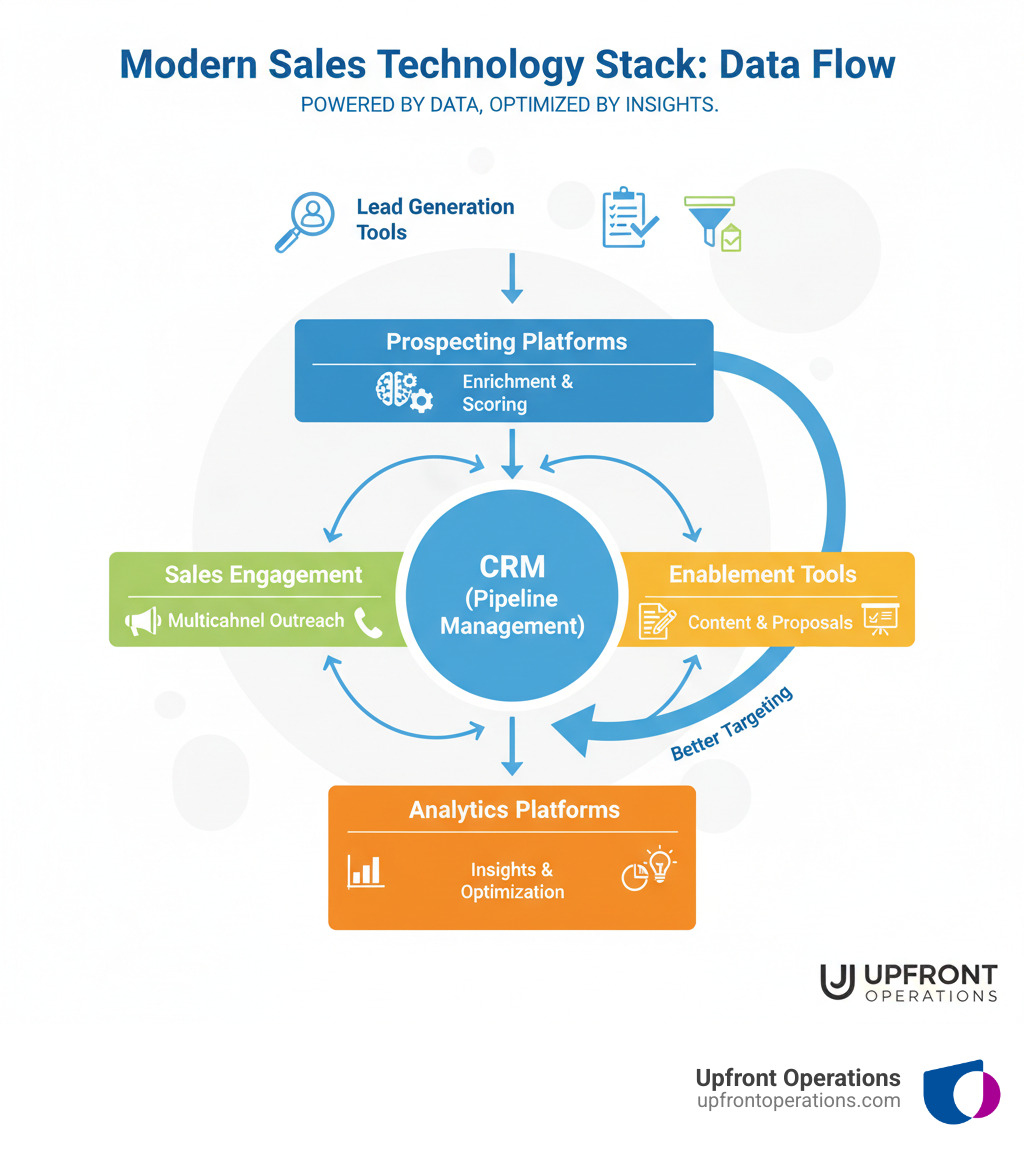
Your sales technology stack isn't just a collection of software licenses; it's the engine that powers predictable revenue. When it's working right, reps stop drowning in busywork and start closing deals. Managers gain the visibility to coach effectively, and the entire business runs more smoothly, delivering a better experience for your team and customers.
Sales reps typically spend only 16% of their day in front of customers, with the rest lost to administrative tasks. A well-designed stack automates data entry, scheduling, and follow-ups, giving reps hours back to focus on revenue-generating activities. Instead of wasting 20% of their time researching prospects or chasing bad data, they get instant access to accurate contact details and interaction history. This speed is critical when 82% of customers expect a response within 24 hours.
When a CRM provides a 360-degree view of customer interactions, conversations become meaningful. It's no surprise that 82% of top-performing reps credit their success to having the right tools. By automating the mundane tasks that consume nearly 65% of a rep's day, job satisfaction soars, and your team can focus on what they were hired to do: sell.
For sales managers, a robust stack transforms guesswork into strategy. Real-time performance dashboards provide instant visibility into team performance and pipeline health. Conversation intelligence tools like Gong or Clari analyze sales calls, offering targeted coaching insights based on real interactions. This data-driven approach makes revenue forecasting more of a science than a guessing game.
By capturing the habits of top performers, managers can coach the entire team to adopt winning behaviors. This leads to better strategic decisions about resource allocation, training, and overall sales strategy. A well-optimized sales technology stack is the foundation for predictable revenue, efficient GTM execution, and an improved customer experience.
Building an effective sales technology stack is like assembling a high-performance engine—each component must work in harmony. A successful stack supports every stage of the sales funnel, ensuring data flows seamlessly to create a smooth journey for both reps and prospects.
Your CRM is the heart of your stack, serving as the central data hub for all prospect and customer information. Platforms like Salesforce and HubSpot provide a single source of truth for your entire GTM team. A CRM is essential for pipeline management, tracking contact history, and automating routine tasks like lead assignment and follow-up reminders. However, simply installing a CRM isn't enough. Expert CRM management and optimization ensures your foundation is configured to support your unique sales process and drive real results.
Prospecting tools keep your funnel full of qualified opportunities. Modern tools identify potential customers using intent signals, while data enrichment tools provide accurate contact details, preventing reps from wasting 30% of their time on bad data. Visitor identification tools reveal which companies are browsing your website, and platforms like LinkedIn Sales Navigator help reps connect with key decision-makers. Finally, lead scoring prioritizes the warmest leads, so your team can focus its efforts where it counts.
Once you have leads, engagement platforms automate outreach without losing the personal touch. Email automation handles multi-step sequences, while sales dialers dramatically increase call volume. These platforms orchestrate multichannel outreach across email, social media, and phone from a single interface. Top platforms like Outreach.io, Salesloft, and Groove move prospects through your funnel with a precision that manual efforts can't match.
In the final stages, enablement and analytics tools are critical. Content management platforms (e.g., Highspot) give reps instant access to the right case studies and presentations. Proposal software (e.g., PandaDoc) and e-signature tools like DocuSign streamline the creation and signing of contracts, eliminating delays. Meanwhile, conversation intelligence tools such as Gong analyze sales calls to provide data-driven coaching. All this data feeds into performance analytics and sales dashboards, giving leaders a real-time view of what's working and where deals are getting stuck.
Assembling a sales technology stack is an ongoing process of strategic selection, implementation, and optimization. The goal is to create a dynamic ecosystem that supports your sales team and aligns with your business objectives.
Selecting the right tools requires careful thought. Before you look at demos, consider these factors:
For a deeper dive into how we help businesses make these choices, visit our About Us page.
Many businesses suffer from "tool sprawl"—a bloated sales technology stack with redundant, disconnected systems. Sales stack consolidation simplifies your tools to create a more cohesive and efficient system, often by using unified platforms that combine multiple features.
The benefits are clear: reduced costs, improved efficiency, better data accuracy, and streamlined onboarding for new hires.
| Feature | Bloated Stack (Many Tools) | Consolidated Stack (Fewer, Integrated Tools) |
|---|---|---|
| Cost | Higher (multiple subscriptions, hidden integration costs) | Lower (fewer subscriptions, optimized integrations) |
| Efficiency | Lower (tool switching, manual data entry, silos) | Higher (seamless workflows, automation, unified data) |
| Data Accuracy | Lower (inconsistent data, errors, incomplete views) | Higher (single source of truth, real-time updates) |
| Onboarding | Complex (steep learning curve for many systems) | Simpler (fewer platforms, intuitive interfaces) |
| Management | High overhead (managing multiple vendors, updates) | Lower overhead (centralized management, fewer vendor relationships) |
A sales technology stack is only effective if it's aligned with your sales strategy. Your tool choices should depend on whether you have an inbound or outbound focus. It's also crucial to map tools to your existing sales process, ensuring the technology adapts to your proven methods, not the other way around.
Your stack must also support your broader GTM alignment, with sales and marketing sharing data and platforms for a unified view of the pipeline. Finally, audit your stack twice a year to identify redundant tools, check adoption, and ensure it still supports your revenue goals. If you're struggling to connect technology to business goals, it's time to reassess. Our experts can help you define and track these metrics through our CRM management and optimization services, ensuring your tech supports your business goals and pricing strategy.
The sales technology stack is being revolutionized by artificial intelligence. These are not incremental improvements but fundamental changes in how sales teams operate.
AI is already here, and it's changing the game. Generative AI helps reps draft personalized emails and content in minutes, amplifying the human touch. In fact, 58% of salespeople report that generative AI increases their productivity. Predictive AI is making revenue forecasting more accurate by analyzing thousands of data points to spot at-risk deals and identify high-potential prospects.
Conversation intelligence platforms like Gong analyze sales calls to deliver actionable coaching insights, while AI sales assistants handle administrative work like updating your CRM and prioritizing follow-ups. The economic impact of these technologies is staggering, promising a new frontier of productivity, as highlighted by McKinsey's research on generative AI.
Beyond today's AI, several other trends are reshaping the sales tech stack:
The pace of change can be overwhelming, but you don't have to steer it alone. Expert guidance is more valuable than ever to implement and optimize these powerful new technologies.
To eliminate silos and create a single source of truth, sales and marketing should share several key tools. A shared CRM (like HubSpot or Salesforce) is the most critical, ensuring both teams work from the same customer data. Shared analytics platforms are also vital for tracking the entire customer journey and understanding what drives revenue. Finally, a unified content management system ensures messaging is consistent across all touchpoints, creating a professional and coherent buyer experience.
We recommend auditing your stack at least twice a year. The tech landscape, especially with AI, evolves rapidly. Regular audits help you identify redundant tools, measure user adoption, assess ROI, and ensure your stack still aligns with your business strategy. If your team isn't using a tool, it's wasted budget. If you're feeling overwhelmed, Upfront Operations provides on-demand sales operations support to manage this process, giving you expert help without the need for a full-time hire.
While the entire stack is important, three categories have the most direct impact on revenue. First, your CRM is where deals live and die; a well-optimized CRM accelerates sales velocity. Second, sales engagement platforms directly impact a rep's productivity and ability to execute outreach consistently. Third, pipeline management and analytics software gives leaders the visibility to forecast accurately and coach effectively. If you're struggling to get a clear ROI from your tools, our CRM management and optimization microservices can ensure your most critical software is driving tangible results.
Optimizing your sales technology stack isn't just a technical task—it's a strategic imperative. A well-designed stack is the engine that powers predictable revenue, freeing your team from administrative work to focus on what they do best: closing deals. From the CRM foundation to AI-powered analytics, the right tools give your team the leverage to succeed.
But building and managing this stack can be complex. Many businesses struggle with tool sprawl, poor integration, and a lack of internal expertise, preventing them from realizing the full value of their investment.
You don't need to hire a full-time sales ops team to solve this. Upfront Operations provides elite fractional sales operations support through on-demand microservices. Whether you need expert CRM management and optimization, workflow automation, or a complete stack audit, we provide precisely the support you need, when you need it.
Our team has helped dozens of companies cut wasted time, fix broken processes, and open up new revenue by getting their sales technology stack working correctly. Ready to give your team the tools they need to win? Discover our on-demand sales operations services and start scaling with unstoppable momentum.