Why Your CRM Data Is Making or Breaking Your Business

CRM data management services are professional solutions that clean, organize, standardize, and maintain your customer data to ensure accuracy, eliminate duplicates, and improve the reliability of your CRM system. These services range from one-time data cleansing projects to ongoing data stewardship that keeps your customer information accurate and actionable.
What CRM Data Management Services Include:
- Data Cleansing - Removing duplicates, fixing formatting errors, and correcting invalid entries
- Data Standardization - Creating consistent formats for names, addresses, phone numbers, and other fields
- Data Enrichment - Appending missing information like demographics, credentials, and contact preferences
- Data Validation - Fact-checking and verifying records to ensure accuracy
- Ongoing Maintenance - Implementing automations and guardrails to keep data clean long-term
Your CRM promised to be a single source of truth—a centralized platform where every customer interaction, lead status, and sales opportunity lives in one organized place. But here's the reality: 25 to 60 percent of CRM projects fail to meet expectations.
Why? Because dirty data clogs up the system.
Duplicate contacts. Missing phone numbers. Outdated addresses. Inconsistent formatting. These aren't just minor annoyances—they're expensive problems that break automations, derail decision-making, and cause your sales team to lose trust in the system entirely.
When your CRM is filled with messy, unreliable data, everything suffers. Sales reps waste time tracking down correct information. Marketing campaigns target the wrong people. Forecasts become guesswork. And your team starts keeping their own spreadsheets because they can't trust what's in the CRM.
But companies that invest in proper data management see dramatic returns. Research shows that companies can get a return of $5.60 for every $1.00 spent on CRM—but only when the data inside is actually usable.
Clean, well-managed CRM data improves reporting accuracy, enables smarter automation, and drives better business decisions. It means your dashboards tell the truth, your workflows actually work, and your teams can execute with confidence.
I'm Ryan T. Murphy, founder of Upfront Operations, and over the past 12 years, I've helped 32 companies fix broken CRM systems by implementing smart CRM data management services that turn messy databases into reliable growth engines. Whether you need a one-time data cleanup, ongoing maintenance, or expert support to unify data across platforms, we provide on-demand services that get your CRM working the way it should.
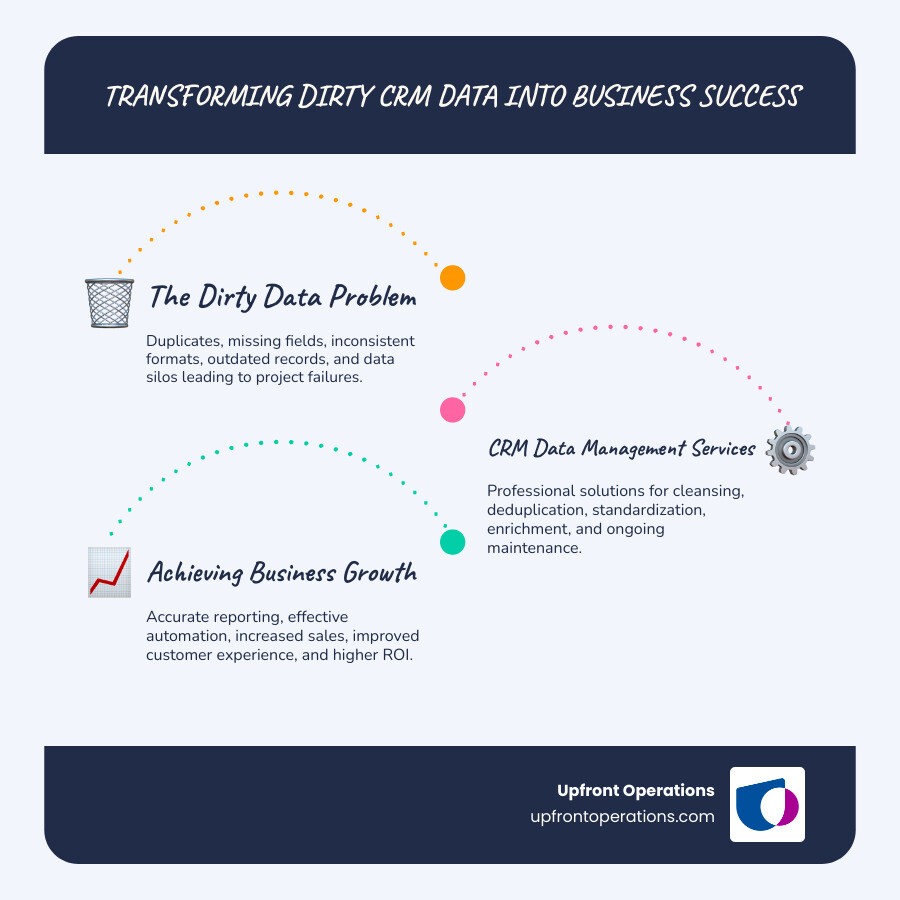
The High Cost of "Dirty Data": Common CRM Challenges
Imagine trying to steer the busy streets of New York City with an outdated map filled with incorrect street names, closed roads, and phantom buildings. That's what it feels like for your business when your CRM is riddled with "dirty data." It’s not just an inconvenience; it's a significant impediment to growth, costing businesses time, money, and missed opportunities.
One of the primary reasons CRM projects fail to meet expectations is the pervasive issue of poor data quality. Without strong data management, teams lose trust in their CRM, leading to low user adoption and a cascade of negative consequences. This includes inaccurate reporting, where your dashboards lie to you, painting a misleading picture of your business performance. Broken automations mean your carefully crafted workflows fail, leading to dropped leads or missed customer follow-ups. Wasted marketing spend becomes the norm as campaigns target outdated contacts or irrelevant segments. This all culminates in a poor customer experience, as personalization efforts fall flat and your team can't provide the seamless interactions customers expect. As Gartner research highlights, improving data quality is crucial for business success.
Duplicate, Incomplete, and Outdated Records
The culprits behind dirty CRM data are often insidious and multiply quickly if left unchecked.
- Duplicate contacts: These are common issues, leading to multiple records for the same individual or company. This wastes storage space, confuses sales reps, and can result in multiple outreach attempts to the same person, which is annoying for the customer and inefficient for your team.
- Missing phone numbers, email addresses, or key demographic information: Incomplete records mean your teams lack the full picture needed to engage effectively. How can you personalize an email if you don't know their industry, or reach out to a lead if their contact information is missing?
- Inconsistent formatting: Imagine having phone numbers entered as "(XXX) XXX-XXXX", "XXX-XXX-XXXX", and "XXXXXXXXXX" all within the same system. Inconsistent formatting makes data hard to query, segment, and analyze, hindering automation and reporting efforts.
- Old addresses and outdated information: Businesses move, people change roles, and contact details evolve. Without a process to update this information, your CRM quickly becomes a graveyard of irrelevant data.
- Data silos between teams: When different departments (sales, marketing, customer service) maintain their own separate databases or don't consistently update a shared CRM, critical information gets fragmented. This prevents a "single source of truth" and makes it impossible to have a unified view of the customer journey.
These issues aren't just theoretical; they're daily frustrations that sap productivity and undermine your CRM's value.
The Impact on Sales and Marketing
The direct impact of dirty data hits your sales and marketing teams hardest.
- Sales reps distrusting data: When reps constantly encounter incorrect or incomplete information, they stop relying on the CRM. They might revert to personal spreadsheets or notes, defeating the purpose of a centralized system and making company-wide reporting impossible. This struggle is real; "companies are still struggling to get their reps to enter data in their CRM" because the systems aren't always user-friendly or reliable.
- Ineffective lead scoring: How can you accurately score a lead if their company size, industry, or engagement history is missing or incorrect? Dirty data leads to wasted efforts chasing unqualified leads or missing opportunities with high-potential prospects.
- Failed email campaigns: Sending emails to outdated addresses results in high bounce rates, damaging your sender reputation and wasting valuable marketing resources. Poor personalization due to inaccurate data means your messages resonate less with recipients, leading to lower engagement and conversion rates.
- Poor personalization: In an age where customers expect custom experiences, inaccurate data makes genuine personalization impossible. Generic messaging alienates customers and diminishes the effectiveness of your marketing efforts.
- Damaged brand reputation: Repeatedly contacting a customer with irrelevant offers, using an incorrect name, or sending multiple communications due to duplicate records can frustrate customers and erode trust in your brand.
Dirty data isn't just a nuisance; it's expensive. It clogs up your CRM, breaks automations, confuses your sales team, and derails decision-making. We've seen how these challenges can prevent businesses from reaching their full potential, even those with fantastic products or services.
What Are CRM Data Management Services and How Do They Help?
So, what's the solution to this data dilemma? Enter CRM data management services. These are the unsung heroes that transform your messy CRM into a streamlined, reliable asset. They're not just about fixing problems; they're about proactively ensuring your data is a strategic advantage, not a liability.
At its core, CRM data management services are designed to improve data quality, accuracy, and reliability. This means ensuring your customer records are precise, up-to-date, and consistent across your entire system. When your data is clean, you can trust it, and when you trust your data, you can make smarter decisions, run more effective campaigns, and build stronger customer relationships. This is all about establishing robust data governance—the overall management of the availability, usability, integrity, and security of data used in an enterprise.

Core Service Components
Our CRM data management services, like those you can find more information about on our services page, are built on several key components:
- Data Cleansing: This is the foundational step. It involves identifying and removing duplicates, correcting typos, fixing formatting errors (like standardizing phone numbers or addresses), and eliminating incomplete or irrelevant records. The goal is to ensure your CRM is free of errors, inconsistencies, and outdated information.
- Deduplication: A specific but crucial part of cleansing, deduplication focuses on identifying and merging duplicate records for the same contact or company. This prevents multiple team members from contacting the same person, ensures accurate reporting, and streamlines customer interactions.
- Data Standardization: This component establishes consistent rules for how data is entered and stored. For example, ensuring all states are abbreviated uniformly (e.g., "NY" instead of "New York") or all job titles follow a specific format. Standardization makes data easier to search, segment, and analyze.
- Data Enrichment: Often, your CRM has basic contact information, but lacks crucial details that could improve personalization or segmentation. Data enrichment involves appending missing information from external sources, such as demographics, company size, industry, credentials, affiliations, or contact preferences. This provides a more comprehensive 360-degree view of your customer.
- Data Validation: This is the process of fact-checking and verifying existing records. It might involve cross-referencing data with external sources, confirming email addresses are active, or ensuring phone numbers are still in service. Validation ensures the data you have is not just consistent, but truly accurate.
- Data Migration: Whether you're moving to a new CRM system or integrating data from various sources, data migration ensures a smooth, clean transfer of information. This often involves cleansing and standardizing data before it moves to the new system, preventing the transfer of old problems into your new environment.
When it comes to addressing CRM data challenges, businesses often face a choice: invest in DIY tools and platforms or opt for done-for-you expert services.
- DIY Tools & No-Code Platforms: Solutions like Insycle offer powerful no-code platforms that allow operations teams to manage, clean, and maintain high-quality CRM data at scale. These tools automate tedious cleaning tasks, identify duplicates, correct formatting, and fill blanks, empowering businesses to keep data quality high without relying on IT or custom scripts. They provide step-by-step workflows and reusable templates, making data management more accessible. For many small businesses and solopreneurs in New York, these platforms can be a great starting point, offering a hands-on approach to data hygiene.
- On-Demand Expert Services: While platforms offer control, they still require internal resources and expertise to configure and manage effectively. This is where on-demand expert CRM data management services like ours come in. We provide the specialized knowledge and dedicated resources to tackle complex data challenges, offering on-demand microservices for small businesses and elite fractional experts for larger companies. You can purchase a one-time Data Cleansing or Deduplication project to fix immediate problems, or engage our fractional sales operations experts for advanced Data Stewardship. This proactive, hands-on approach ensures best-in-class data quality, freeing up your internal teams to focus on revenue-generating activities. For instance, expert data stewardship services like those from Veeva resolve 99% of data change requests within one business day—a level of proactive support our fractional experts provide to ensure your CRM is always optimized and reliable. We can handle everything from a one-time data purge to ongoing data maintenance, acting as an extension of your team.
The benefits of automation, whether through platforms or expert services, are undeniable. Automating data cleaning and deduplication saves countless hours, reduces manual errors, and ensures continuous data quality. This allows your team to spend more time acting on insights rather than fixing spreadsheets, making clean data your default.
The change from dirty to clean CRM data isn't just about tidiness; it's about open uping significant business growth. When your data is accurate, reliable, and well-managed, it directly translates into improved performance across sales, marketing, and customer service. As we've seen, companies can get a return of $5.60 for every $1.00 spent on CRM, but only if that CRM is powered by trustworthy data.

Clean data leads to increased revenue by enabling more effective strategies. It fosters better team communication because everyone is working from the same, accurate information. And crucially, it drives improved customer retention as your teams can provide personalized, relevant experiences that build loyalty.
Boosting Sales and Marketing Effectiveness
With clean data, your sales and marketing teams become precision instruments.
- Accurate forecasting: No more guessing games. With reliable data on lead status, deal stages, and customer activity, your sales forecasts become far more accurate, allowing for better resource allocation and strategic planning.
- Hyper-targeted segmentation: Clean data allows for granular segmentation of your customer base. This means marketing campaigns can be precisely custom to specific customer needs and behaviors, leading to higher engagement and conversion rates.
- Higher campaign ROI: When you're targeting the right people with the right message at the right time, your marketing spend goes further. Failed email campaigns become a rarity, and your personalization efforts genuinely resonate.
- Increased rep productivity: Sales reps spend less time cleaning up data or verifying contact details and more time selling. As Kaitlynn Sirotkin, a digital marketing manager, shared, managing data across both HubSpot and Salesforce from one platform saved her "hours and hours of time." This efficiency boost means reps can focus on building relationships and closing deals. "Having quality data enables our team to focus on execution," noted a CRM Project Manager at Bayer France, emphasizing that trusted data increases CRM adoption and leads to improved customer experience.
The Role of CRM Data Management Services in Smarter Automation and Reporting
Clean data is the fuel for smarter automation and insightful reporting.
- Trustworthy dashboards: Your dashboards will reflect the truth, providing an accurate, real-time pulse on your business. This enables leadership to make informed, data-driven decisions rather than relying on gut feelings or incomplete information.
- Reliable workflows: From lead assignment to automated follow-up sequences, clean data ensures your workflows execute flawlessly. This means no more leads falling through the cracks or customers receiving irrelevant communications.
- Unifying data across tools: Many businesses, especially in New York, use a diverse tech stack. CRM data management services facilitate data unification by syncing and standardizing records across your CRM (be it HubSpot, Salesforce, or another platform), marketing automation, and other business tools. This creates a cohesive data ecosystem, enabling aligned, cross-functional execution. For example, HubSpot's Smart CRM is designed to integrate seamlessly with its marketing, sales, customer service, and operations tools, optimizing campaigns with unified data.
- Data-driven decisions: The goal is to empower your teams to make better decisions. With a trusted dataset, your sales and marketing strategies are backed by solid evidence, leading to more effective outcomes and sustained growth.
These services help streamline your data cleaning processes, ensuring your CRM records are always ready to support growth and empower your teams.
Choosing the Right Partner: From Basic Cleanup to Advanced Stewardship
Selecting the right partner for your CRM data management services is a critical decision, much like choosing the right co-pilot for a complex flight. It's not a one-size-fits-all scenario; what works for a small business in New York might be different from the needs of a large enterprise. You need to consider the supported platforms, the scope of work, your long-term data strategy, and crucial aspects like data privacy.
Key Considerations When Choosing CRM Data Management Services
When evaluating potential providers or solutions, ask yourself these questions:
- Methodology: How do they approach data cleaning? Do they use a combination of automated tools and manual review? Our approach, for instance, involves a full audit to flag problem areas, followed by a blend of automation and expert manual review to catch edge cases and apply business logic.
- Automated tools vs. manual review: While automation is crucial for efficiency, some complex data issues or unique business logic require human intervention. A good service provider will offer both, ensuring comprehensive data quality.
- Platform expertise: Do they specialize in your CRM (e.g., HubSpot, Salesforce, Dynamics)? We work across various platforms, including HubSpot, Salesforce, Dynamics, ERPs, and even spreadsheets, meaning we can clean data in-place or as part of a migration project.
- Scalability: Can their services grow with your business? As your company expands and your data volume increases, your data management needs will evolve.
- Future-proofing data: Beyond just cleaning, do they help set up guardrails to keep your data clean? This includes implementing field validations, dedupe automations, and providing team training to reduce input errors moving forward.
Basic Data Management vs. Advanced Data Stewardship
Understanding the difference between basic data management and advanced data stewardship is key to choosing the right level of support.
- Basic Data Management: This often involves reactive cleanup projects—addressing existing dirty data through deduplication, formatting, and validation. It's about getting your CRM to a usable state. While essential, it's typically a one-time or infrequent intervention.
- Advanced Data Stewardship: This is a proactive, ongoing management approach. It involves dedicated expert data stewards who continuously monitor, maintain, and enrich your data. Services like Veeva's OpenData stewardship exemplify this, where experts proactively fact-check data change requests and resolve them rapidly (often within one business day). This ensures your data remains high-quality, up-to-date, and aligned with industry standards, improving sales effectiveness and territory planning. For larger organizations, our fractional RevOps experts offer this kind of continuous, high-level support, acting as an embedded team to ensure your data foundation is always rock-solid. This is particularly valuable for businesses in markets like New York, where quick data turnaround is crucial.
How Services Help with Data Privacy Regulations
In today's regulatory landscape, data privacy is paramount. CRM data management services play a vital role in helping businesses comply with regulations like GDPR and CCPA.
- Managing consent: Services can help ensure that customer consent for data collection and usage is properly recorded and respected within the CRM.
- Suppressing records: They can assist in suppressing records based on commercial objectives or explicit customer requests (e.g., "do not contact" lists), which is crucial for compliance.
- Ensuring data accuracy: Many privacy regulations emphasize the right to accurate data. By maintaining clean and validated records, these services help businesses meet this requirement, reducing legal risks and building customer trust.
By partnering with the right provider, you can not only clean up your data but also establish processes that ensure long-term data health and compliance.
The Future of CRM Data Management
The world of CRM data management is constantly evolving, driven by technological advancements and the ever-increasing volume and complexity of customer data. Businesses in New York and beyond need to be aware of emerging trends to stay competitive and ensure their CRM remains a powerful asset.
One of the most significant trends is the rise of AI-powered cleansing and predictive data enrichment. Artificial intelligence and machine learning are becoming increasingly sophisticated at identifying patterns in dirty data, automating complex cleaning tasks, and even predicting missing information. Imagine an AI that can not only detect duplicates but also suggest the most accurate version of a record based on multiple data points, or one that can enrich a contact profile by intelligently inferring their industry or job function. The ChatGPT blog post even suggests that future CRM features will include more advanced AI and better integrations.
We can also expect to see deeper integrations across the entire business tech stack. As businesses adopt more specialized tools for marketing, sales, customer service, and operations, the need for seamless data flow between these systems will only intensify. CRM data management services will play a crucial role in orchestrating these integrations, ensuring data consistency and enabling a truly unified view of the customer across all touchpoints.
Finally, improved security protocols will continue to be a major focus. As data breaches become more common and regulations tighten, CRMs will need to incorporate advanced encryption, access controls, and anomaly detection to protect sensitive customer information. Data management services will help businesses implement and maintain these robust security measures, safeguarding both their data and their reputation.
These trends point towards a future where CRM data management is even more automated, intelligent, and integrated, making it easier for businesses to leverage their customer data for growth.
Conclusion
Your CRM should be your secret weapon for customer success, not a source of frustration. The journey to a high-performing CRM begins and ends with clean, reliable data. We've seen how dirty data—duplicates, inaccuracies, and inconsistencies—can cripple sales and marketing efforts, erode trust, and lead to significant financial losses. Conversely, investing in CRM data management services dramatically improves data quality, accuracy, and reliability, leading to increased revenue, better team communication, and improved customer retention.
It's clear that effective data management is not a one-time fix but an ongoing strategy. Whether through robust data cleansing, continuous data stewardship, or the intelligent application of automation, maintaining a healthy CRM data foundation is paramount. By unifying data across different teams and tools, and enabling smarter automation and reporting, these services allow your business to open up the full potential of your CRM.
At Upfront Operations, we understand these challenges intimately. That's why we offer on-demand CRM data management services, from one-time data cleanup to ongoing fractional RevOps support for larger companies. We're here to ensure your CRM is a true single source of truth, empowering your teams to make data-driven decisions and scale with unstoppable momentum. Don't let dirty data hold your business back.
Ready to transform your CRM into a powerful growth engine? View our services and let us help you achieve customer success.