February 5, 2026

10
min read
Mastering the Digital Battlefield: Setting Up Your Marketing Campaign
Learn how to set up a digital marketing campaign. Master strategy, execution, measurement, and optimization for success.
Learn how to set up a digital marketing campaign. Master strategy, execution, measurement, and optimization for success.

Success in digital marketing isn't about luck—it's about strategy. How to set up a digital marketing campaign starts with a clear roadmap:
A strong online presence is essential for survival, yet only 17% of businesses clearly define their digital marketing strategies. The other 83% are essentially throwing darts in the dark.
A digital marketing campaign is a coordinated, strategic effort to guide prospects on a journey from awareness to loyalty. It requires clear goals, a defined timeline, and measurable results. Without this structure, you're left with "random acts of marketing"—disconnected efforts that burn budget without building momentum. With it, you build brand awareness, generate qualified leads, and drive revenue.
The difference between success and failure is planning. Do you know who you're targeting? Have you mapped the customer journey? Can you measure conversions? These are the foundations of campaigns that work.
I'm Ryan T. Murphy, and over 12 years, I've helped 32 companies streamline their sales and marketing, building campaigns that cut waste and opened millions in new revenue. Whether you're launching your first campaign or fixing an underperforming one, understanding how to set up a digital marketing campaign correctly can transform your results.
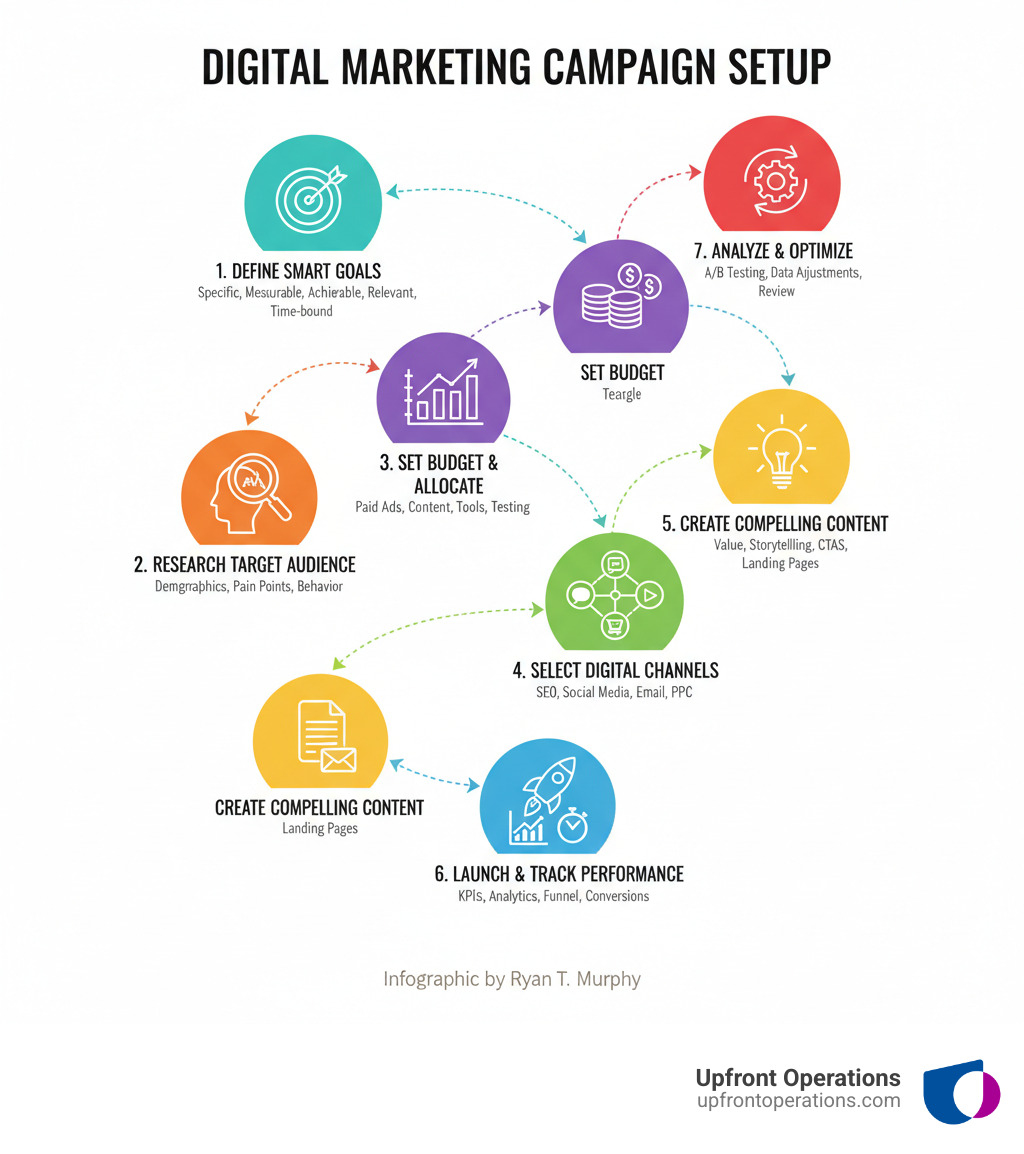
Just as you wouldn't build a house without blueprints, you shouldn't launch a campaign without a solid plan. This strategic blueprinting phase is where campaigns succeed or fail, turning an overwhelming task into a clear, step-by-step process. It's where you map out your destination, your audience, and your resources. Skipping these steps is like burning money with a smile.
"Getting more customers" is a wish, not a goal. Effective campaigns start with SMART goals: Specific, Measurable, Achievable, Relevant, and Time-bound. This framework turns vague hopes into concrete targets.
Your marketing goals must connect to business objectives. For instance, if your company wants to increase market share, a SMART goal would be: "Increase organic website traffic by 20% in six months to generate 500 new qualified leads." This defines success, a timeline, and the metrics.
Common goals include increasing brand awareness, generating leads (e.g., 500 new email subscribers in 30 days), driving sales (e.g., 50% more e-commerce conversions in Q4), or boosting engagement. To track progress, you'll use Key Performance Indicators (KPIs) like click-through rates or cost per acquisition. Breaking a large goal into smaller micro-objectives (e.g., publish 10 blog posts, optimize 5 pages) makes it manageable.
If you're talking to "everyone," you're connecting with no one. Successful campaigns begin with detailed buyer personas—semi-fictional profiles of your ideal customers based on real data, not guesses.
A solid persona includes demographics (job title, income), psychographics (values, interests), pain points (problems your product solves), goals, and online behavior (where they get information). To build these, use Google Analytics to understand current visitors, survey existing customers, and explore social media insights and industry forums where your audience is active.
This detail makes a huge difference. Targeting "35-45-year-old software engineers who listen to technical podcasts" requires different tactics than targeting "new mothers on Instagram interested in organic baby products." Understanding their customer journey allows you to deliver the right message at the right time.
Budgeting isn't just about what you can spend; it's about allocating dollars for the biggest return. A well-planned budget separates campaigns that generate revenue from those that drain it.
Your budget must cover key areas: paid advertising (Google, Facebook, LinkedIn ads), content creation (writers, designers), and tools/software (analytics, CRM, email marketing). If you're using external support, like our fractional experts for CRM management, factor that in too.
Match your allocation to your goals. A brand awareness campaign might put more into social media ads and video, while a lead generation campaign would focus on PPC and content like ebooks.
| Category | Brand Awareness Campaign | Lead Generation Campaign |
|---|---|---|
| Paid Ads | 40% (Social, Display) | 50% (PPC, LinkedIn Ads) |
| Content Creation | 30% (Video, Infographics) | 20% (Ebooks, Case Studies) |
| Social Media Mgmt. | 15% | 5% |
| Email Marketing | 5% | 15% |
| Tools/Software | 5% | 5% |
| Testing/Contingency | 5% | 5% |
Tracking ROI is non-negotiable. The numbers tell you what's working and what's wasting money. At Upfront Operations, we help businesses streamline these processes. Our services provide on-demand support for setting up tracking or fractional expertise for managing budgets, keeping your marketing efficient without the overhead of a full-time hire.
With your blueprint ready, it's time for execution. This phase covers the active process of building your campaign, from selecting channels to creating content that converts.
Selecting the right channels means going where your target audience is and where your message will be most effective. It's about being in the right places, not everywhere.
Search Engine Optimization (SEO) aims to rank your website higher in organic search results. Since the first spot on Google gets 35% of traffic and most people ignore paid ads, organic rankings are gold. SEO is a long-term play that builds sustainable traffic by providing relevant content that answers user queries.
Content Marketing fuels your other channels. By creating valuable blogs, videos, or infographics, you build trust and authority. It's about creating resources your audience wants to consume and share, which in turn supports your SEO and social media efforts.
Social Media Marketing (SMM) allows for direct engagement on platforms like Facebook, Instagram, and LinkedIn. It's great for brand awareness and community building, but requires continuous adaptation as platforms change. Influencer marketing is a powerful SMM component for tapping into trusted audiences.
Email Marketing remains a highly cost-effective channel. It allows you to speak directly to an interested audience, making it ideal for lead nurturing and direct sales. A key advantage is that you own your email list, unlike social media followers.
Pay-Per-Click (PPC) advertising on platforms like Google Ads offers immediate visibility. While SEO takes time, PPC can drive traffic today, allowing for precise targeting and quick performance-based adjustments. It's perfect for getting fast results or testing messages.
Your professional website is the central hub where all channels lead and conversions happen. Paired with a reliable business email, it builds credibility. At Upfront Operations, we offer on-demand microservices to get your website and business email setup quickly and professionally, without complex agency contracts.
Content is king, but user experience is the kingdom. Great content will fail if it's hard to access or act upon. This step is where strategy meets creativity.
Great content uses storytelling. People connect with narratives, not just facts. Your value proposition must be clear and immediate: why should someone choose you? Every piece of content needs a clear Call-to-Action (CTA), telling the audience what to do next (e.g., "Download the Guide," "Shop Now").
Use multimedia elements like images and videos to keep users engaged, but optimize them for each channel. A snappy social post differs from a detailed blog article. When writing for search, incorporate keywords naturally to avoid sounding robotic.
A seamless user experience (UX) is critical. Your landing page must be fast, clear, and aligned with the ad that brought the user there. It should feature a unique value proposition, a hero image/video, clear benefits, social proof, and a prominent CTA.
Mobile-first design is mandatory, as a huge portion of traffic comes from mobile devices. If your page is broken or slow on a phone, you're losing conversions. A/B testing helps you move from guessing to knowing what works. Test headlines, CTAs, and visuals to see what resonates with your audience, as results can vary widely across industries.
Building a professional online presence can be overwhelming for a small business. That's why we created our on-demand microservices at Upfront Operations. Whether you need a captivating website that converts or a reliable business email, our services page offers simple solutions without long-term commitments.
Launching your campaign isn't the finish line; it's the starting gun. This phase is about tracking performance, making data-driven adjustments, and turning insights into future wins. You must constantly check your data and adjust course to stay on target.
"You can't manage what you don't measure." Without measurement, you're flying blind. Tracking proves whether your campaign is a success or a fizzled-out firework.
Track multiple Key Performance Indicators (KPIs) for a holistic view. Start with website traffic using Google Analytics to see where visitors come from and what they do. Local searches are powerful: 76% of mobile visitors visit a store within a day, and 28% of those visits lead to a purchase.
Setting up funnel analysis reveals where users drop off, giving you clear targets for optimization. At Upfront Operations, our fractional sales operations experts specialize in CRM management, ensuring data flows smoothly from marketing to sales for accurate attribution and a full view of the customer journey.
A "set and forget" approach is a recipe for failure. The digital landscape is always changing, so your campaign must be continuously nurtured and fine-tuned.
A/B testing is essential. We constantly test headlines, images, CTAs, and ad copy to see what resonates best. Small changes can lead to significant improvements over time.
Data analysis should be a regular habit, not an afterthought. We dive into analytics to identify what's working, what's not, and where opportunities lie. For example, a high click-through rate but low conversions points to a problem with the landing page, not the ad.
Based on the data, we adjust budgets and targeting in real-time, reallocating resources to what works and refining audiences to cut waste. After a campaign, a post-campaign analysis is crucial for learning. We review successes, shortcomings, and unexpected insights to improve future efforts. There is no perfect campaign, only opportunities for iteration.
We stay current with the latest research on marketing attribution models to ensure accurate impact measurement. This continuous optimization is essential for any campaign that aims to deliver real results.
Even experienced marketers make mistakes. Success often comes from recognizing common traps before falling into them. This is your guide to sidestepping the pitfalls that can derail a digital marketing campaign.
Undefined goals: This is the number one campaign killer. Without a clear answer to "What are we trying to achieve?" you can't measure success. The fix: Always start with SMART goals. If you can't measure it, you can't manage it.
Poor audience targeting: Shouting into a crowded stadium and hoping the right person hears you is a waste of money. The fix: Invest time in building detailed buyer personas to understand your ideal customer's pain points, demographics, and online behavior.
Inconsistent messaging: A professional tone on LinkedIn and a casual, meme-filled voice on Instagram confuses your audience and dilutes your brand. The fix: Create a simple brand guide to ensure your voice is consistent across all channels. Our on-demand services can help establish this professional presence quickly.
Ignoring data: Launching a campaign and never checking the analytics is like flying a plane with your eyes closed. The fix: Make it a habit to regularly check your KPIs. Your data tells you what's working and what's not. Our fractional sales ops experts turn this raw data into actionable insights.
Neglecting mobile users: With over half of web traffic coming from mobile, a non-mobile-friendly site is like hanging a "Closed" sign on your digital door. The fix: Ensure every landing page, email, and piece of content is designed for a flawless mobile experience.
The "set-it-and-forget-it" mentality: The digital world is constantly changing. A campaign that works today might fail tomorrow if left unattended. The fix: Understand that how to set up a digital marketing campaign includes continuous optimization. Treat every campaign as a living project that needs constant care.
You now have the complete roadmap for how to set up a digital marketing campaign, from planning to optimization. Following these steps methodically delivers results. The key is adopting a "campaign mentality": treating every marketing activity as a distinct, measurable effort.
Success comes from embracing the cycle: plan, execute, measure, optimize, and repeat. Each campaign provides lessons about your audience and messaging, making the next one stronger. Over time, this iterative approach builds a marketing machine that consistently delivers.
Most businesses struggle not with the concepts, but with the bandwidth and systems to execute them. Leads slip through cracks in a half-empty CRM, campaigns launch without proper tracking, and follow-up sequences are never built.
This is exactly why Upfront Operations was created.
For small businesses and solopreneurs, our on-demand microservices provide essentials like a professional website or business email setup quickly and affordably. No massive contracts, just the specific service you need, when you need it.
For growing companies, our fractional sales operations experts integrate with your team to boost CRM management, optimize your pipeline, and build the nurturing systems that turn campaigns into revenue.
The difference between a campaign that fizzles and one that scales your business is execution. We handle the operational heavy lifting so you can focus on growth.
Your next winning campaign is waiting. Are you ready to build it the right way?
Learn more about our services and find how we can help you turn your digital marketing campaigns into unstoppable growth engines.