February 2, 2026

10
min read
Sales Territory Management: Defining Your Path to Revenue
Unlock predictable revenue with expert Sales territory management. This guide helps you design, optimize, and scale your s...
Unlock predictable revenue with expert Sales territory management. This guide helps you design, optimize, and scale your s...


Sales territory management is the strategic process of dividing your market into defined segments, assigning ownership to specific sales representatives, and continuously optimizing these assignments to maximize revenue, efficiency, and customer coverage.
Quick Answer: What You Need to Know
Most sales leaders know territory management matters, but many miss a key point: it's not just about drawing lines on a map. It's about building a system that empowers reps and generates quality data. Poorly designed territories lead to duplicate outreach, uneven workloads, and stalled deals. One rep might drown in accounts while another has too few, resulting in frustrated reps, confused customers, and lost productivity.
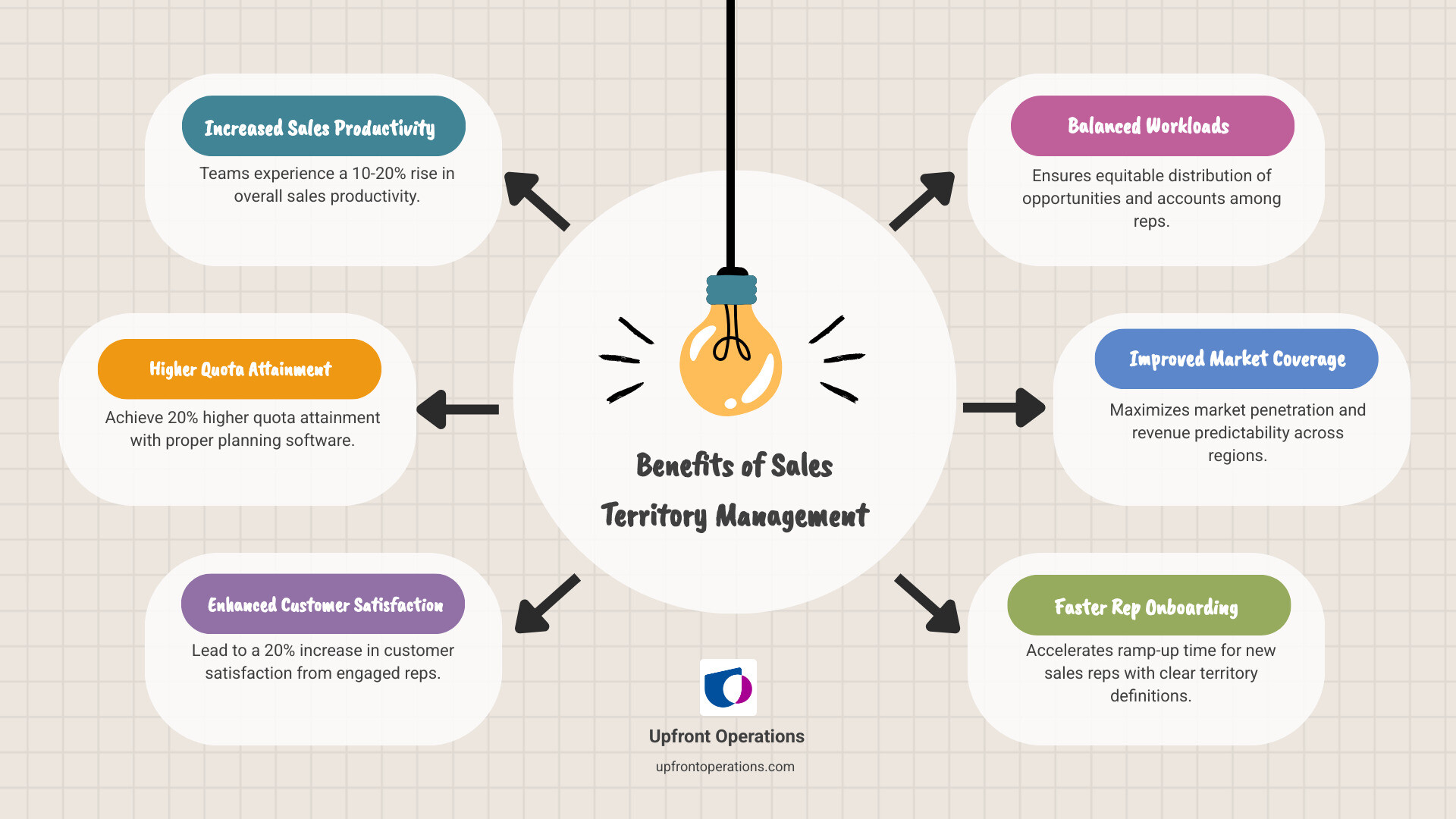
When done right, it transforms chaos into clarity. Organizations see a 10-20% increase in sales productivity, and those using planning software achieve 20% higher quota attainment. Well-structured territories also lead to better customer experiences and a 20% increase in customer satisfaction.
I'm Ryan T. Murphy, founder of UpfrontOps. Over the past 12 years, I've helped dozens of companies streamline their sales operations with data-driven territory management, cutting wasted time and open uping new revenue. Whether you're using spreadsheets or looking to rebalance workloads, I've seen what works—and what doesn't.
Important Sales territory management terms:
At its core, sales territory management is the strategic division of your target market into manageable segments assigned to specific reps. It’s more than drawing lines on a map; it’s about optimizing resources, ensuring fair opportunities, and driving predictable revenue. A well-executed plan prevents reps from competing for accounts, balances workloads, and eliminates missed opportunities. By defining ownership, you empower reps to focus on what they do best: selling.
Optimized territories consistently yield a 10-20% increase in sales productivity. This boost comes from complete market coverage, more predictable revenue forecasting, and an improved customer experience. When reps are experts in their territory, they build stronger relationships, leading to a 20% increase in customer satisfaction. It also boosts productivity by reducing administrative tasks, and companies using territory planning software see 20% higher quota attainment.
Simply put, effective sales territory management creates structure around how your teams engage prospects and accounts, which directly translates to predictable revenue and improved sales performance.
While often used interchangeably, there's a subtle but important distinction between sales territory planning and sales territory management. Think of it like building a house:
Sales territory planning is the architectural blueprint. It's the strategic, periodic process of analyzing your market, identifying ideal customer profiles, and designing the optimal structure for your sales territories. This involves big-picture decisions about how to carve up the market based on various criteria. It sets the baseline for everything that follows, from quota allocation to incentive compensation.
Sales territory management, on the other hand, is the ongoing construction and maintenance. It's the continuous, tactical execution of that plan. This involves the day-to-day operations: assigning leads, resolving ownership questions, tracking performance, and making real-time adjustments to ensure territories remain balanced and effective as market conditions or team dynamics shift.
Here's a quick comparison:
| Feature | Territory Planning | Territory Management |
|---|---|---|
| Nature | Strategic, Big-picture | Tactical, Day-to-day |
| Frequency | Periodic (e.g., annually, bi-annually) | Continuous, Ongoing |
| Focus | Design, Market Analysis, Resource Allocation | Execution, Performance Tracking, Adjustment |
| Goal | Optimal structure, fair opportunity | Maximize daily sales, adapt to changes |
| Key Activities | Market segmentation, boundary definition, rule creation | Lead assignment, ownership resolution, performance review |
The benefits of strategic sales territory management extend beyond revenue, deeply impacting team morale and your bottom line.
A successful sales territory management strategy isn't built on guesswork; it's built on a solid foundation of data, clear objectives, and a deep understanding of our market. It's about empowering our reps, not just assigning them a region.
No single territory model fits every business. The best approach depends on your products, market, and sales process, with hybrid models often proving most effective.
Here are the main types of sales territories:
Data is the lifeblood of effective territory management. Without it, you're just guessing. A scientific, data-driven approach is essential for territory and quota planning.
Here's how various data points play a critical role:
By consolidating these data points, we can balance territory potential and make informed decisions. For businesses leveraging our CRM management and pipeline optimization services, we streamline this data collection and analysis, ensuring you always have the insights needed for smart territory design.
A well-defined territory structure is a secret weapon for accelerating new rep onboarding. A new rep joining our New York team with a chaotic territory will spend months just figuring out who to call, leading to frustration and a long ramp-up time.
Conversely, a clear, well-structured territory provides:
At Upfront Operations, we understand that nurturing new talent is critical. Our approach emphasizes clear processes and data-driven insights to ensure every new hire has the best possible start. More info about our approach.
Creating and implementing an effective sales territory management plan is a continuous journey, not a one-time destination. It requires a systematic approach, ongoing analysis, and a willingness to adapt. Here’s our 5-step framework to guide you:

Before drawing any lines, understand your market and goals. Analyze historical performance, define your Ideal Customer Profile (ICP), research your Total Addressable Market (TAM), and conduct a SWOT analysis. Most importantly, set SMART goals (Specific, Measurable, Achievable, Relevant, Time-bound), like "Increase market share by 5% in the New York metropolitan area in 12 months."
With clear objectives, you can design territories. Segment your market based on your chosen model (geography, industry, etc.). Use data to draw clear boundaries, creating fair and balanced territories based on potential, not just account volume. Document all assignment rules for transparency.
Assign reps to territories that match their skills and experience. A rep skilled with long distances might suit a rural territory, while a New York native may thrive in a dense urban one. Create clear, automated lead routing rules to ensure leads go to the right rep instantly. Our on-demand CRM management and pipeline optimization services can build these robust systems for you. Clearly document ownership and rules of engagement to prevent conflicts.
Define how you'll measure success. Set territory-specific goals for revenue, new customer acquisition, and market penetration. Track Key Performance Indicators (KPIs) beyond revenue, such as quota attainment, win rate, sales cycle length, and pipeline health. These metrics provide a clear picture of performance.
Territory management is a continuous process. Conduct regular performance reviews—quarterly for growing teams, semi-annually for mature ones. Gather feedback from your reps on the front lines; their insights are invaluable. Stay agile and be ready to make data-informed adjustments as the market shifts or if a territory underperforms.
Effective sales territory management isn't just about initial setup; it's about continuous improvement, proactive management, and leveraging modern tools to future-proof our sales strategy.
To excel at territory management, follow these best practices:
Technology and AI are revolutionizing territory management, replacing manual planning on maps with dynamic, intelligent systems.

Organizations using this tech see up to 30% higher sales objective achievement and can reduce planning time by 75%. Leveraging these tools moves you from error-prone spreadsheets to dynamic, data-driven platforms.
Even the best plans can present challenges. Here’s how to tackle them:
The ideal frequency depends on your growth and market dynamics. We recommend quarterly reviews for fast-growing businesses or those in changing markets. More stable, mature teams can often move to semi-annual reviews. The key is to remain agile and make small adjustments as needed, rather than waiting for a major overhaul.
Territory management is a collaborative effort, but ownership usually lies with Sales Leadership and Revenue Operations (RevOps).
It significantly improves the customer experience by providing:
Sales territory management is not an administrative task—it's the strategic foundation for predictable revenue. A well-designed plan boosts productivity, increases quota attainment, and improves customer satisfaction. It empowers your team, ensures fairness, and provides a clear path to growth. In a competitive market like New York, a robust territory strategy is a necessity for adapting to market shifts and optimizing performance.
Ready to build a plan that drives predictable revenue? Upfront Operations delivers game-changing sales operations support. Whether you're a small business needing on-demand microservices for CRM management or a larger enterprise seeking elite fractional experts for pipeline optimization, we help you close deals faster and scale with momentum. Explore our sales operations services to define your path to revenue.