Why B2B Sales Teams Are Turning to Proven Playbook Examples

B2B sales playbook examples provide practical frameworks that translate sales strategy into action, helping teams close more deals consistently. The best playbooks—like SPIN Selling, Challenger Sale, MEDDIC, Sandler, Gap Selling, and Value Selling—offer specific plays, scripts, and qualification criteria that high-performing teams use to steer complex buyer journeys and achieve predictable revenue growth.
Top B2B Sales Playbook Examples:
- SPIN Selling Playbook - Uses Situation, Problem, Implication, and Need-Payoff questions to guide findy
- Challenger Sale Playbook - Teaches prospects something new, tailors the message, and takes control of the sale
- MEDDIC Playbook - Qualifies deals using Metrics, Economic Buyer, Decision Criteria, Decision Process, Identify Pain, and Champion
- Sandler Selling System Playbook - Establishes equal footing and qualifies hard upfront
- Gap Selling Playbook - Quantifies the gap between current state and desired future state
- Value Selling Framework Playbook - Builds business cases with clear ROI calculations
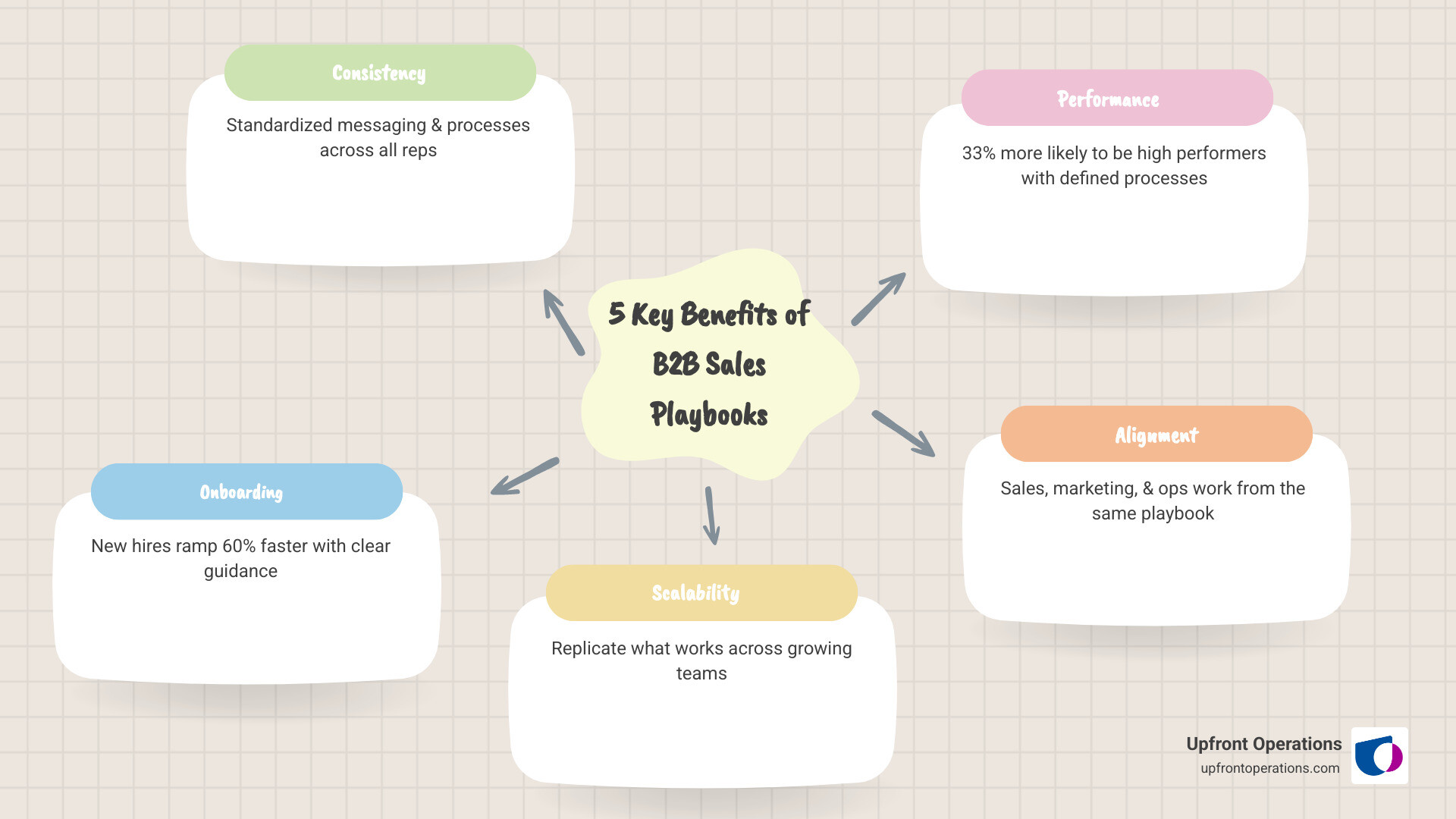
Not every job comes with a step-by-step guide, but your sales team should. The reality is stark: four out of every five B2B deals are lost in the sales process, and just 17% of sellers deliver 83% of the revenue. Without a unified game plan, sales teams face inconsistent messaging, stalled deals, and a few top performers carrying the entire quota.
A sales playbook changes this. It's not a dusty binder of scripts—it's the central nervous system of your sales engine. It standardizes best practices, aligns messaging across your team, and provides a clear framework for success at every stage of the buyer's journey.
The data backs this up. Companies that follow a well-defined sales process are 33% more likely to be high performers, and for those with a defined process, win rates exceed 50%. Yet most companies struggle with adoption: 87% of sales training is forgotten within weeks, and with the average salesperson tenure at just 1.5 years, the need for a repeatable, documented system has never been more critical.
The good news? You don't have to build your playbook from scratch. The most successful B2B sales organizations use proven methodologies as their foundation—whether that's SPIN Selling for consultative approaches, Challenger Sale for disruptive markets, or MEDDIC for enterprise qualification. The key is choosing the right framework for your product, market, and buyer, then customizing it to your specific needs.
I'm Ryan T. Murphy, founder of Upfront Operations, and over the past 12 years I've helped 32 companies build and implement B2B sales playbook examples that cut sales cycles by up to 28% and open up millions in new revenue. This guide will show you the exact playbook structures and plays that high-performing teams use to win consistently.
Anatomy of a High-Impact Sales Playbook: 12 Essential Components
Think of a sales playbook as your sales team's ultimate cheat sheet, but instead of cheating, it's about making everyone a top performer. It's a comprehensive, living document that clarifies "what to do, when to do it, and how to say it" at every stage of the sales cycle. To be truly impactful, a sales playbook needs to cover all the bases. Here are the 12 essential components we recommend including:
- Company & Team Overview: This section sets the stage. It includes your company's mission, vision, values, and an organizational chart. It also details the sales team structure, roles, and responsibilities, clarifying who does what and how different departments (like marketing and customer success) collaborate. For new hires, it's crucial for understanding how their role connects to the bigger picture.
- Market & Customer: Who are you selling to? This component dives deep into your Ideal Customer Profile (ICP) and detailed buyer personas. It outlines their challenges, pain points, goals, and even their preferred communication channels. Understanding your market positioning and how your solution fits within the competitive landscape is key here.
- Product & Pricing: This isn't just a list of features; it’s about how your product solves customer problems. We include a comprehensive product overview, highlighting key features, integrations, and services, always framed in terms of benefits. Your pricing structure and key differentiators—what makes you truly unique—are also clearly articulated.
- Sales Process & Methodology: This is the backbone of your playbook. We map out your entire sales process, from prospecting to closing and even renewals, defining each stage and its exit criteria. It also clearly outlines your chosen sales methodology (e.g., SPIN, Challenger) and how it applies to your specific sales cycle. A well-defined process leads to a win rate exceeding 50%.
- Plays & Messaging: This is where the rubber meets the road. Sales plays are step-by-step guides for specific scenarios, like handling inbound leads, cold outreach, or upsell opportunities. The messaging library provides proven scripts, email templates, social media messages, and effective objection handling techniques. This ensures consistent, high-quality communication across the team.
- Sales Enablement & Resources: Equipping your reps for success means providing easy access to all necessary tools. This includes organizing sales collateral (brochures, data sheets), compiling compelling case studies with quantifiable results, and developing competitor battlecards to help reps confidently address competitive comparisons.
- Technology & Tools: Your sales tech stack is critical. This section outlines all the sales tools and software your team uses (CRM, sales engagement platforms, etc.), detailing their purpose, best practices for usage, and how they integrate with your sales process. Clear guidelines on CRM usage, for instance, ensure accurate data recording and pipeline visibility.
- Metrics & Performance: What gets measured gets managed. We define Key Performance Indicators (KPIs) for each sales role, link to relevant dashboards, and explain how performance is measured. Transparency on the commission structure also motivates the team. This helps track progress, identify areas for improvement, and ensure alignment with business objectives.
6 Powerful B2B Sales Playbook Examples Based on Proven Methodologies
In B2B sales, there's no one-size-fits-all solution. The most effective sales teams often create a hybrid model, drawing strength from various proven methodologies. The common thread? Relentless customer-centricity. Modern selling isn't about pitching features; it's about understanding and solving customer problems.
Here are six powerful B2B sales playbook examples based on leading methodologies, along with their strategic breakdowns, ideal use cases, and actionable plays:
1. The SPIN Selling Playbook
- Strategic Breakdown: Developed by Neil Rackham, SPIN Selling focuses on asking the right questions to uncover customer needs. It's built around four types of questions: Situation (gathering facts about the buyer's current situation), Problem (uncovering the buyer's difficulties, dissatisfactions, or problems), Implication (exploring the effects or consequences of those problems), and Need-Payoff (focusing on the value or usefulness of solving the problem). The brilliance of SPIN is that it makes the buyer the hero, with the salesperson acting as a guide.
- Best For: Complex sales cycles, building deep trust, large accounts, and consultative selling where understanding the customer's world is paramount.
- Actionable Plays:
- Question Banks for Personas: Develop specific SPIN question sequences custom to different buyer personas and industries.
- Call Review Checklists: Use checklists during call reviews to ensure reps are effectively using each type of SPIN question.
- Transition Phrases: Provide examples of phrases to smoothly transition between question types (e.g., "And what impact does that have on...?" or "If we could solve that, what would that mean for...?").
2. The Challenger Sale Playbook
- Strategic Breakdown: Based on research by the CEB (now Gartner), the Challenger Sale identifies that the most successful reps "challenge" customers' assumptions, teach them new insights about their business, and take control of the sales conversation. The framework is "Teach, Tailor, Take Control." This approach moves the salesperson from a reactive vendor to a proactive partner, creating value before a product is discussed.
- Best For: Disruptive products, established markets where customers might not realize they have a problem, selling to C-suite and senior decision-makers.
- Actionable Plays:
- Commercial Insight Development: Train reps to develop unique, valuable insights that challenge a prospect's existing beliefs about their business.
- Constructive Tension Scripts: Provide guidance on how to respectfully introduce "constructive tension" by highlighting the risks of inaction or the benefits of a new approach.
- Stakeholder Mapping Guides: Help reps map all key stakeholders, their concerns, and tailor the insight to resonate with each.
3. The MEDDIC Sales Playbook
- Strategic Breakdown: MEDDIC is a qualification framework designed to remove guesswork from your sales process and create predictable forecasting. It focuses on six key areas of findy:
- Metrics: Quantifiable impact of the problem and solution.
- Economic Buyer: The person with ultimate budget authority.
- Decision Criteria: What the customer uses to evaluate solutions.
- Decision Process: How the customer makes purchasing decisions.
- Identify Pain: The root cause of the problem and its business impact.
- Champion: An internal advocate who sells on your behalf.MEDDIC's strength lies in its rigor, forcing reps to be honest about an opportunity's viability instead of relying on "happy ears."
- Best For: Enterprise sales, complex buying committees, improving forecast accuracy, and ensuring sales teams focus on winnable deals.
- Actionable Plays:
- CRM Qualification Fields: Integrate MEDDIC fields directly into your CRM for mandatory completion before advancing deal stages.
- Deal Review Checklists: Use the MEDDIC acronym as a mandatory checklist during weekly deal reviews.
- Champion-Building Questions: Provide questions designed to identify and nurture internal champions.
4. The Sandler Selling System Playbook
- Strategic Breakdown: The Sandler Selling System, developed by David Sandler, emphasizes mutual respect and an equal-power dynamic between buyer and seller. Its core philosophy is to "sell today, educate tomorrow," focusing on determining if there is a legitimate, fundable need. It encourages early, honest qualification to avoid wasting time on unqualified leads.
- Best For: Avoiding "unpaid consulting," qualifying hard, building long-term relationships, and situations where reps tend to chase deals that aren't a good fit.
- Actionable Plays:
- Upfront Contract Templates: Provide templates for establishing clear agendas and mutual expectations at the start of every interaction.
- 'Reversing' Question Examples: Train reps on using "reversing" techniques to turn customer questions back to them, encouraging deeper self-findy.
- Budget Qualification Scripts: Develop scripts for direct and honest conversations about financial capacity early in the sales process.
5. The Gap Selling Playbook
- Strategic Breakdown: Created by Keenan, Gap Selling posits that buyers don’t purchase products; they purchase a change from their current undesirable state to a better future state. The salesperson's job is to uncover and quantify the "gap" between these two states. The sale isn't made when you present your solution, but when the prospect acknowledges the existence and severity of the gap.
- Best For: Problem-aware prospects, outcome-focused sales, SaaS companies, and situations where emphasizing business outcomes over features is critical.
- Actionable Plays:
- "Findy" Questions to Quantify Pain: Provide question sets that help reps diagnose the prospect's current state and put numbers to their pain (e.g., "How much time/money is that costing you?").
- Future State Visualization Exercises: Train reps to help prospects visualize their ideal future state and articulate the benefits.
- Problem-Centric Pitch Decks: Design pitch decks that start by outlining the problem and the "gap" before introducing the solution.
6. The Value Selling Framework Playbook
- Strategic Breakdown: The Value Selling Framework is centered on quantifying and communicating the tangible value a prospect will gain from your solution. It transforms the sales rep from a product vendor into a financial consultant, aligning with the language of executive decision-makers: ROI, cost savings, and revenue growth.
- Best For: Selling to executives, premium-priced solutions, competitive markets, and situations requiring a strong business case.
- Actionable Plays:
- ROI Calculator Templates: Provide simple, customizable ROI calculators that reps can use with prospects to demonstrate potential savings or gains.
- Value-Based Case Studies: Arm your team with case studies that feature specific, hard numbers and proven customer outcomes.
- Business Case Creation Guides: Offer guidance on how to help a champion build a compelling internal business case for your solution. For example, instead of saying "our software saves time," we teach reps to quantify it: "our software will save your team 500 hours per quarter, which translates to a $25,000 productivity gain."
Activating Your Playbook: Implementation, Technology, and Maintenance
A sales playbook isn't meant to be a static document that gathers dust on a virtual shelf. It's a living, breathing tool that should be deeply integrated into your team's daily workflow. Activating your playbook means making it a dynamic resource that drives consistent execution and continuous improvement.
Building and Implementing Your First B2B Sales Playbook
Building an effective sales playbook is a strategic project, not a weekend task. It requires thoughtful planning and execution.
- Assemble the Taskforce: We've found that the most successful playbooks are built collaboratively. Involve sales leaders, top-performing reps, marketing, and sales operations. This ensures diverse perspectives and buy-in from the start.
- Audit & Document: Start by interviewing your top reps. What are their winning strategies? What common objections do they face, and how do they overcome them? Audit existing content and map your current sales processes. This helps identify replicable successes and areas for improvement.
- Rollout Strategy: A successful playbook needs a proper launch. Plan phased training sessions, secure leadership buy-in, and set clear expectations for its use. Frame the playbook as a vital resource for individual and team success.
- Overcoming Pitfalls: We often see playbooks fail due to overly generic content or lack of accessibility. The solution? Make it concise, relevant, and easy to find. Integrate it into your existing tools. This is where expert guidance can be a game-changer. Instead of hiring a full-time team, you can leverage our on-demand services. Our fractional sales ops experts can streamline this entire process, from a one-time CRM management setup to detailed process mapping, ensuring your playbook is built for adoption.
The Role of Technology and AI in Modern B2B Sales Playbook Examples
Technology isn't just an accessory to your sales playbook; it's becoming its central nervous system.
- CRM as the Hub: Your CRM (Customer Relationship Management) system should be the single source of truth for your sales team. We integrate playbook content directly into the CRM, making it accessible at every stage of the deal. This includes call scripts, email templates, objection handling guides, and even competitive battlecards—all available right when a rep needs them.
- AI-Powered Guidance: This is where things get really exciting. AI is changing how playbooks are used, moving beyond static documents to real-time, in-workflow guidance. Imagine a sales copilot offering next-best-action suggestions during a live call, or automating play recommendations based on prospect behavior. Gartner predicts that 75% of B2B sales organizations will augment traditional sales playbooks with AI-powered guided selling solutions by 2025. This means less guesswork and more precise execution. For a deeper dive into this revolution, you can explore insights on Generative AI and the future of B2B sales.
Keeping Your Playbook Dynamic and Up-to-Date
A sales playbook is a living document, not a museum piece. The market changes, your products evolve, and your sales team learns new tricks. To maximize its effectiveness, we ensure your playbook remains dynamic and relevant.
- Feedback Loops: Regular reviews with the sales team are essential. What's working? What's outdated? What new challenges are emerging? Creating an internal feedback loop encourages salespeople to contribute their best practices, which can then be incorporated into the playbook.
- Data-Driven Refinement: We don't just guess; we use data. Analyzing playbook usage data and correlating specific plays with win rates, deal velocity, and conversion rates helps us identify what’s truly effective. If a particular email sequence consistently leads to meetings, it gets highlighted. If another falls flat, we refine or remove it.
- Scheduled Updates: We recommend quarterly reviews as a minimum. This allows us to update the playbook for new product launches, messaging changes, or shifts in market conditions. This proactive approach ensures your team always has the most current and effective strategies at their fingertips.
Frequently Asked Questions about Sales Playbooks
What's the difference between a sales playbook and a sales play?
Think of it like a sports analogy. A sales playbook is the entire book of winning strategies for your team—it contains all the processes, methodologies, messaging, and resources. It’s the comprehensive guide. A sales play, on the other hand, is a specific, tactical set of actions designed for a particular situation or scenario within that larger playbook. For example, a playbook might outline your entire lead qualification process, while a "cold outreach play" would detail the exact sequence of emails, calls, and social touches for a new prospect.
What are common pitfalls when creating a sales playbook?
We've seen a few common traps companies fall into:
- Making it too complex or too long: If it's 80 pages of dense text, reps won't use it. It needs to be concise, actionable, and easy to steer.
- Not getting team buy-in: If your sales reps aren't involved in its creation, they won't feel ownership and are less likely to adopt it.
- Failing to update it: A static playbook quickly becomes irrelevant. The market, products, and buyer behaviors change, and your playbook must evolve with them.
- Treating it as a one-time project: A playbook is an ongoing commitment to continuous improvement, not a "set it and forget it" task.
How do you ensure sales reps actually use the playbook?
This is the million-dollar question! Here's what we've found works best:
- Integrate it into daily workflow: Don't make reps go searching. Embed playbook content directly into their CRM, sales engagement platforms, or other tools they use every day.
- Make it easy to access and use: It should be intuitively organized, searchable, and available on-demand. Digital formats are far superior to dusty binders.
- Train on it continuously: Initial training is just the start. Regularly reinforce playbook strategies through coaching sessions, role-playing, and team discussions.
- Show its link to success: Demonstrate how using the playbook leads to better performance—higher win rates, shorter sales cycles, and more commission. When reps see "what's in it for them," adoption soars.
- Lead by example: Sales leaders and managers must actively reference and coach to the playbook.
Conclusion: From Examples to Execution with On-Demand Sales Ops
In today's competitive B2B landscape, a great sales playbook is no longer a luxury; it's a necessity. It's a dynamic, data-driven tool that provides your team with a predictable path to growth, ensuring consistency, accelerating onboarding, and empowering every rep to perform at their best. From the strategic questioning of SPIN Selling to the rigorous qualification of MEDDIC, the B2B sales playbook examples we've explored offer powerful frameworks for success.
However, building and maintaining a truly effective sales playbook—one that your team actually uses and that evolves with your business—requires dedicated expertise and consistent effort. Many businesses, especially small to mid-sized teams, simply don't have the internal resources to dedicate to this complex, ongoing task.
That's where Upfront Operations comes in. We understand the challenges you face, and we're here to help. We provide game-changing, on-demand sales operations support, whether you need elite fractional sales operations experts to build and implement your entire playbook from scratch, or targeted microservices to optimize specific areas like pipeline optimization and lead nurturing. Our mission is to boost your sales engine, helping you close deals faster and scale with unstoppable momentum, all custom to the unique needs of businesses like yours in New York and beyond.
Ready to build a sales engine that wins? Explore our on-demand sales operations services and let us help you transform your sales strategy into consistent revenue.