Clock Icon - Technology Webflow Template
10
min read

Mastering the Game: Building Playbooks for Sales Managers, Onboarding, and More

Master your sales prospecting playbook! Learn to build, optimize, and scale high-performing sales teams with our expert gu...

Why Your Sales Team Needs a sales prospecting playbook

sales prospecting playbook

A sales prospecting playbook is your comprehensive guide for systematically identifying, engaging, and converting potential customers. It transforms ad-hoc prospecting into a repeatable, scalable process that drives predictable pipeline growth.

Key Components of an Effective Sales Prospecting Playbook:

  1. Ideal Customer Profile (ICP) - Firmographics and behavioral signals
  2. Multi-Channel Cadences - 8-12 touch sequences across email, phone, and LinkedIn
  3. Messaging Frameworks - Value-led scripts and objection handling
  4. Qualification Criteria - Clear BANT or MEDDIC frameworks
  5. Technology Stack - CRM integration and sales engagement platforms
  6. Performance Metrics - Reply rates and meeting conversions

In today's B2B landscape, systematic execution separates top-performing teams from those that struggle. Research shows 42% of salespeople find prospecting the hardest stage, yet 70% of companies see it as the most effective revenue driver. Most organizations rely on individual initiative, creating knowledge silos where successful techniques remain trapped within top performers.

Modern buyers interact with 6-8 touchpoints before deciding. Only 19% want to connect during early awareness, but 60% want to talk during consideration. This requires precision timing and personalized value. Organizations with documented playbooks are 33% more likely to be high-performing, often seeing 15-25% increases in response rates and 20-35% reductions in time-to-first-meeting.

I'm Ryan T. Murphy, founder of UpfrontOps. Over 12 years, I've helped 32 companies build sales prospecting playbooks that transformed chaotic outreach into revenue engines, reducing sales cycles by up to 28%. Whether you're a startup or a mid-sized business, this guide shows you how to scale playbooks for predictable growth.
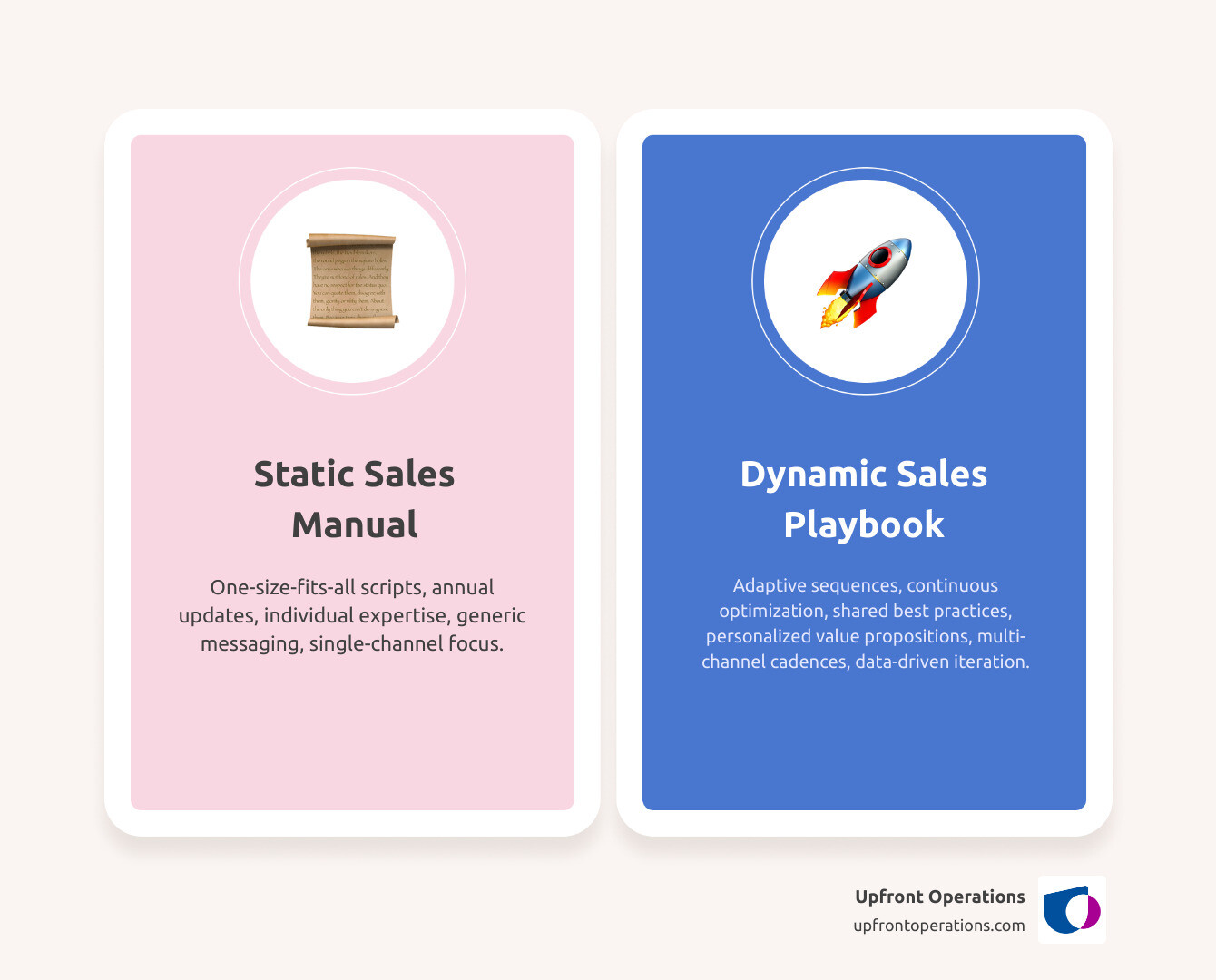
Infographic comparing static sales manual (one-size-fits-all scripts, annual updates, individual expertise, generic messaging, single-channel focus) versus dynamic sales playbook (adaptive sequences, continuous optimization, shared best practices, personalized value propositions, multi-channel cadences, data-driven iteration) - sales prospecting playbook infographic comparison-2-items-casual

The Strategic Foundation of a Modern sales prospecting playbook

We often hear "sales process" and "sales playbook" used interchangeably, but they serve distinct purposes.

Sales Process (The Roadmap)Sales Playbook (The Driving Instructions)
Defines stages (Prospecting, Qualification, Closing).Tactical guidance for executing activities in each stage.
The "what" and "when" of the journey.The "how" and "why" behind each action.
Provides structure and predictability.Ensures consistent execution that drives results.
Defines milestones and gates.Offers specific research, scripts, and follow-up sequences.

The sales process gives the overarching structure, while the sales prospecting playbook provides the granular guidance for the critical prospecting phase. Modern playbooks have evolved from static manuals into dynamic, data-driven resources that embody the collective wisdom of an organization’s most successful strategies.

This approach drives:

  • Procedural Consistency: Every rep operates from the same proven framework, ensuring brand message consistency.
  • Data-Driven Optimization: Playbooks are living documents refined with real-time feedback to adapt to market changes.
  • Standardization: Standardizing successful processes allows for better resource allocation and accurate forecasting.
  • Forecasting Accuracy: Repeatable processes allow businesses, from NYC startups to growing SMBs, to predict pipeline generation with greater accuracy.

Organizations investing in comprehensive playbooks typically see 20-30% improvements in prospecting effectiveness and reduced new hire ramp times within 6-12 months.

Core Components: From ICP to Multi-Channel Outreach

Building an effective sales prospecting playbook starts with understanding who to reach and how to engage them through smart, persistent cadences.

Digital buyer persona profile with firmographics (industry, company size, revenue), technographics (tech stack, tools used), demographics (job title, seniority, location), psychographics (goals, challenges, motivations, pain points), and behavioral data (engagement, buying signals) - sales prospecting playbook

Defining and Refining Your Ideal Customer Profile (ICP)

Our journey begins with the Ideal Customer Profile (ICP). This defines companies that derive the most value from your solution.

  • Firmographics: Industry, company size, and location (often New York for our clients).
  • Technographics: The technology stack they use, which indicates compatibility.
  • Trigger Events: Behavioral signals like funding rounds or new hires that provide the "why now?" for outreach.

We recommend reassessing your ICP every six months. Companies with less than 10% of their customer base fitting their ICP are 50% less likely to survive past 5 years. For more on the fundamentals, see HubSpot's guide to sales prospecting.

Crafting Messaging and Multi-Channel sales prospecting playbook Cadences

Messaging must be precise and value-led. Speak to specific pain points and offer tangible value in every touchpoint. It often takes 5+ touches to get a response, yet 44% of reps stop after one attempt. A cadence of six touches over 3 weeks maximizes reply rates.

  • Cold Calling: Lead with value and use pattern interrupts. It takes about 8 attempts to connect live.
  • Personalized Email: Keep emails short (50-125 words) and mobile-optimized.
  • LinkedIn Social Selling: 50% of B2B buyers use LinkedIn for decisions. Voice notes have a 3x higher response rate.
  • Video Prospecting: Personalized videos can increase reply rates by 80%.

Speed is also critical; scientific research on the impact of lead response time shows that the odds of connecting decrease significantly if you wait even five minutes.

Technology Integration and AI

A modern playbook is powered by technology. At Upfront Operations, we focus on:

  • CRM Management: Integrating playbooks with systems like Salesforce ensures every interaction is logged.
  • Sales Engagement Platforms (SEP): Automating tactical elements while allowing for deep personalization.
  • AI and Intent Data: Using AI to identify high-intent prospects and suggest hyper-personalized messaging.

Our fractional sales operations experts design these systems to ensure your tech stack supports your sales prospecting playbook. Learn more about our sales operations services.

Scaling Performance: Enterprise vs. SMB Playbook Strategies

Implementing a sales prospecting playbook isn't a one-size-fits-all endeavor. The approach varies significantly between large enterprise organizations and smaller B2B companies. At Upfront Operations, we understand these nuances and tailor our strategies accordingly.

Enterprise Considerations

For enterprise organizations, which often have large, geographically distributed teams, multiple product lines, and complex buying committees, the challenge is consistency at scale.

  • Modular Design: We often recommend a modular playbook architecture. This means a core set of universal principles and plays, with additional modules custom for specific territories (like those operating out of New York City), product focus areas, or target customer segments. This ensures comprehensive guidance without overwhelming sales representatives.
  • Complex Buying Committees: Enterprise sales typically involve longer sales cycles and multiple stakeholders. Playbooks need sophisticated strategies for identifying and engaging various roles within a buying committee, from end-users to economic buyers.
  • Territory Management: Effective territory management is crucial to avoid overlap and ensure comprehensive market coverage. Playbooks provide clear guidance on how to research, segment, and prioritize accounts within assigned territories.

SMB Opportunities

Smaller B2B companies, while often facing resource constraints, have unique advantages they can leverage to compete effectively with larger enterprises.

  • Agility & Rapid Iteration: SMBs can move faster. We help them implement rapid iteration cycles to test and optimize approaches more quickly than larger, more bureaucratic competitors. This means our sales prospecting playbook for an SMB is designed for continuous, quick improvements.
  • Customer Proximity & Personalization: SMBs often have a deeper, more personal understanding of their customers. This allows for highly targeted playbooks for core segments, focusing on hyper-personalization based on intimate customer insights.
  • Founder/Executive Involvement: In many smaller businesses, founders or executives are still actively involved in prospecting. Their unique insights and direct connection with the company's vision can be a powerful differentiator. Our playbooks capture this "founder-led prospecting" magic and make it repeatable.
  • On-Demand Microservices: For small businesses and solopreneurs in places like New York, resource constraints are a reality. They may not have the budget for a full-time sales ops team. This is where Upfront Operations' on-demand microservices come in. We can provide essential support like setting up and optimizing business email systems or building small business websites that are crucial for effective prospecting, allowing them to compete without the overhead. Our services provide the specialized support needed to build and maintain an effective playbook, giving them a competitive edge.

By understanding these distinct needs, we can help both enterprise and SMBs build sales prospecting playbooks that are not just effective, but perfectly aligned with their operational realities and strategic goals.

Implementation Excellence: Onboarding and Team Adoption

A sales prospecting playbook is only effective if the team uses it. Proper implementation dramatically reduces ramp-time for new hires, providing a codified framework from day one.

Here’s how we ensure adoption:

  1. Collaborative Creation: Involve frontline reps and top performers to ensure the playbook is practical and has buy-in.
  2. Define Sales Philosophy: Align the team on the core values and methodologies underpinning your approach.
  3. Workflow Integration: Embed playbook elements directly into the CRM. If a rep has to leave their workflow to find a script, adoption will suffer.
  4. Playbook-Focused Coaching: Managers should use coaching sessions to discuss how reps apply specific plays and troubleshoot challenges.
  5. Share Success Stories: Highlight examples where the playbook led to a meeting or a closed deal to build confidence.
  6. Feedback Loops: Establish weekly forums for reps to suggest improvements, keeping the document relevant.
  7. Gamification: Tie CRM updates or playbook adherence to incentives or recognition.

Consistent use leads to improved brand consistency, faster training, and better forecasting. Our approach is rooted in practical experience, ensuring your team actively accepts the guide. Learn more about our team and how we partner with you to drive excellence.

Frequently Asked Questions about Sales Playbooks

What is the difference between a sales playbook and a sales process?

The sales process is the high-level roadmap (the "what" and "when"), while the sales prospecting playbook is the detailed GPS instructions (the "how" and "why"). The process defines stages like "Qualification" and "Proposal," while the playbook provides the scripts, email templates, and objection handling needed to succeed within those stages. Organizations see 20-30% improvements when both are used together.

How often should a sales prospecting playbook be updated?

A playbook is a living guide. We recommend:

  • Quarterly Reviews: Analyze performance metrics to make minor adjustments.
  • Annual Updates: Conduct a comprehensive review of market changes and product features.
  • Trigger-Based Updates: Update immediately if there are major competitive shifts, new product launches, or significant changes in buyer behavior.

How do you ensure sales reps actually use the playbook?

Adoption comes from making the playbook indispensable, not mandatory. This is achieved through:

  1. Tech Integration: Putting scripts and templates directly where reps work (CRM/SEP).
  2. Peer Contribution: Including winning strategies from top performers.
  3. Active Coaching: Managers coaching specifically to the playbook's plays.
  4. Ease of Use: Ensuring the playbook is searchable and accessible on all devices.

When reps see the playbook directly contributing to their commission and success, it transforms from a burden into a vital assistant.

Conclusion

The modern B2B sales landscape demands precision, personalization, and persistence. A well-crafted and consistently used sales prospecting playbook is no longer a luxury but a fundamental necessity for any sales organization striving for predictable growth and sustained success. It transforms chaotic individual efforts into a cohesive, high-performing revenue engine.

At Upfront Operations, we specialize in delivering the expertise and support needed to build and optimize these critical tools. Whether you're a burgeoning startup in New York City needing to define your first ICP, or an established company looking to refine your multi-channel cadences and integrate advanced AI, our fractional sales operations experts are here to help. We're dedicated to supercharging your CRM management, lead nurturing, and pipeline optimization, ensuring your team closes deals faster and scales with unstoppable momentum.

For small businesses and solopreneurs, we simplify the complex, offering essential on-demand microservices like professional business email setup and bespoke small business websites, providing the foundational elements crucial for effective prospecting. For larger organizations, we provide elite fractional sales operations experts, completely surpassing the value traditional agencies and freelance platforms provide.

Don't let inconsistent prospecting hold you back. Let us help you master the game and build a sales prospecting playbook that truly drives results.

View our pricing and packages to see how we can tailor our services to your specific needs and help you achieve your sales goals.

Ask an In-House Growth Expert (Not a Sales Call)

Nice! Next you'll be directed to the page where you can pick a time that works best for you.

If you are not available, you can schedule another time by visiting this link
Oops! Something went wrong while submitting the form.

Ryan T. Murphy

Managing Partner, Sr. Sales Operations Manager

With over a decade in CRM management and marketing operations, Ryan has driven growth for 32 businesses from startups to global enterprises with 12,000+ employees.

Mastering the Game: Building Playbooks for Sales Managers, Onboarding, and More