February 27, 2026

10
min read
Boost Your Bottom Line Optimizing Your Sales Pipeline with CRM Software
Learn how to optimize your sales pipeline with crm software for predictable revenue, faster growth & peak performance.
Learn how to optimize your sales pipeline with crm software for predictable revenue, faster growth & peak performance.
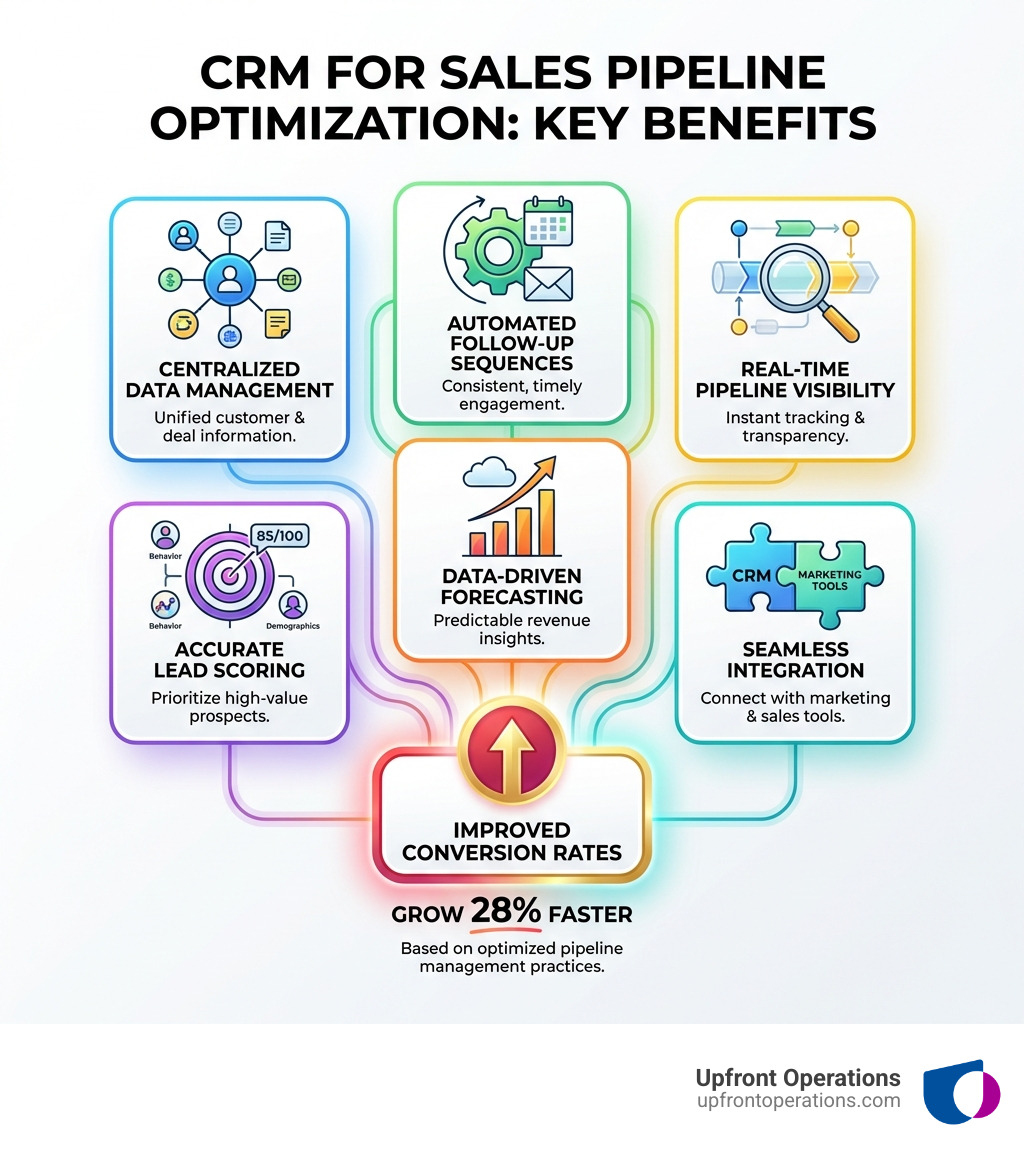

How to optimize your sales pipeline with CRM software starts with understanding a simple truth: your sales pipeline represents the future health of your business. Here's the quick answer:
Key Steps to Optimize Your Sales Pipeline with CRM Software:
A sales pipeline is a visual representation of where every prospect stands in your sales journey—from initial contact to closed deal. When managed well, it tells you exactly how much revenue is coming, when it's arriving, and where your team should focus their energy. When managed poorly, it becomes a graveyard of missed opportunities and inaccurate forecasts.
The difference between these two outcomes? CRM software.
The numbers don't lie. Companies that optimize their pipeline management practices grow 28% faster than their peers. Yet most sales teams still struggle with manual processes, spreadsheets that go out of date the moment they're saved, and leads that slip through the cracks because someone forgot to follow up.
Your sales team is likely facing these exact challenges: inconsistent follow-ups, low conversion rates, and the constant drain of manual, time-consuming tasks that pull them away from actually selling. You've probably tried agencies that lock you into rigid contracts or freelancers who disappear when you need them most.
I'm Ryan T. Murphy, founder of UpfrontOps, and over the past 12 years, I've helped 32 companies implement the exact systems needed to optimize their sales pipeline with CRM software, cutting sales cycles by up to 28% and opening up millions in new revenue. Whether you need on-demand support for CRM automation setup, lead scoring implementation, custom sales dashboards, or even foundational tools like a website and business email, our fractional experts and microservices can help you implement these strategies without the overhead of a full-time hire.
Basic how to optimize your sales pipeline with crm software glossary:
For too long, sales teams have wrestled with the limitations of traditional sales pipeline management. We've all seen it: the cluttered spreadsheets, the sticky notes, the mental notes that inevitably get forgotten. This fragmented approach not only makes forecasting a nightmare but also turns valuable selling time into tedious administrative work. If you're managing a full pipeline without a CRM, you're playing with fire – or at least, you're leaving a lot of money on the table.
Enter the CRM revolution. Modern CRM software transforms pipeline management from a reactive, chaotic process into a proactive, strategic advantage. It centralizes all your sales data, giving us real-time visibility into every deal, every lead, and every customer interaction. This means we can say goodbye to outdated information and hello to data accuracy, fostering seamless collaboration across our sales teams and even with marketing.
At Upfront Operations, we understand the pain points of transitioning from manual methods to smart pipelines. Our on-demand microservices and fractional experts are specifically designed to help businesses, large or small, make this leap efficiently. Whether it's setting up your initial CRM, deploying a done-for-you CRM management service, or refining existing processes with targeted sales operations consulting, we offer support that surpasses the value traditional agencies and freelance platforms provide, ensuring your team spends less time on data entry and more time on high-value selling.
To truly optimize your sales pipeline with CRM software, we need to leverage its core capabilities. Think of these as the superpowers that transform your sales process:
These features, when properly implemented, are what take pipeline management to the next level. Our on-demand CRM management and sales reporting & dashboards microservices can help you integrate and optimize these features quickly and effectively.
A well-defined sales process is the backbone of a successful pipeline. In fact, companies with a formal sales process generate more revenue. Your CRM should reflect this process, not dictate it. This means customizing your pipeline stages to accurately mirror your unique customer journey.
Typical sales stages often include:
Within your CRM, we can add, edit, and delete deal stages to align perfectly with our workflow. A crucial step is to set stage probabilities based on historical conversion rates. This allows for more accurate forecasting. For instance, a "Proposal" stage might have a 70% probability of closing, while "Negotiation" might be 90%.
A relevant Harvard Business Review study underscores the importance of this formalization. Our fractional experts specialize in custom CRM configuration and on-demand sales process design, ensuring your system is a seamless extension of your sales strategy, not a hurdle.
Now that we understand the power of CRM, let's dive into the actionable strategies to truly optimize your sales pipeline with CRM software. This isn't just about having a CRM; it's about making data-driven decisions and continually refining our processes for maximum efficiency.
Not all leads are created equal, and chasing every single one is a recipe for burnout. Effective lead qualification and scoring ensure our sales team focuses on the highest-potential prospects.
We can use established frameworks like BANT (Budget, Authority, Need, Timeline) or MEDDPICC (Metrics, Economic Buyer, Decision Criteria, Decision Process, Implicate, Champion, Competition) to structure our qualification questions. CRM data then becomes our secret weapon for scoring:
By assigning points to these attributes, we can set score thresholds. For example, a lead reaching 50 points might become a Marketing Qualified Lead (MQL), ready for nurturing, while a lead hitting 100 points could be a Sales Qualified Lead (SQL), signaling immediate sales outreach. This prospect segmentation allows us to tailor our approach, saving precious selling time and focusing on buyers who are ready to purchase. Our fractional experts can help you design and implement a robust lead scoring system custom to your business needs through on-demand lead scoring & routing microservices.
Consistency is king in sales. It takes more than 8 touches to close a deal, yet most salespeople (a staggering 44%) give up after just one follow-up attempt. This is where CRM automation becomes indispensable.
Automation can handle repetitive tasks, freeing up our sales reps to focus on building relationships and closing deals:
Sales teams that use automation increase productivity by 14% and reduce overhead by 12%. Our on-demand automation setup services and CRM management are perfect for implementing these kinds of solutions without a long-term commitment. For more information on how we manage and automate CRM processes, check out More info about our CRM management services.
Your CRM shouldn't be an island. To truly optimize your sales pipeline with CRM software, it needs to be the central nervous system of your entire revenue operation. Integrating your CRM with other tools creates a "single source of truth," providing a comprehensive 360-degree view of every customer interaction.
Key integrations include:
Consolidating our tech stack eliminates data silos that cause surprise shortfalls and inaccurate forecasting. Our fractional experts specialize in CRM integrations and can deliver on-demand systems integration and RevOps consulting, ensuring our systems communicate effectively and provide us with the complete picture we need for strategic decision-making.
Optimization is an ongoing journey, not a destination. Once we've set up our CRM and implemented initial strategies, the next step is continuous improvement. This means constantly measuring, analyzing, and refining our pipeline based on data-driven insights. It's how we identify bottlenecks and manage our sales process proactively.
To understand the health and performance of our sales pipeline, we rely on key metrics tracked directly within our CRM. These aren't just numbers; they're diagnostic tools:
By monitoring these KPIs in custom sales pipeline dashboards, we can quickly spot trends, identify areas for improvement, and make informed adjustments to our sales strategy. Our fractional experts can help set up custom dashboards and reporting custom to your specific business goals through on-demand sales reporting & dashboards microservices.
Pipeline reviews are not just check-ins; they're essential coaching and strategy sessions. We recommend conducting formal pipeline review meetings weekly with our sales team. These meetings, powered by real-time CRM data, allow us to:
Beyond weekly operational reviews, we also suggest an in-depth quarterly analysis of the overall sales pipeline management process. This broader view allows for larger-scale strategic changes, such as revising lead qualification criteria or adopting new sales tools. Upfront Operations can support these reviews on-demand with fractional sales operations experts who step in as needed rather than requiring a full-time hire.
One of the most valuable benefits of a well-optimized sales pipeline powered by CRM is accurate revenue forecasting. Historically, forecasting has often been based on gut feeling, with many sales leaders admitting they lack a scientific approach. This leads to teams regularly missing their forecasts.
CRM changes this by enabling:
With accurate forecasts, we can make strategic sales decisions with confidence, from resource allocation to hiring plans, ensuring predictable and scalable growth. Our fractional experts can help implement advanced forecasting models and custom reporting within your CRM through on-demand revenue forecasting & planning support.
Even with the best CRM software, the human element can present challenges. Proactive problem-solving and a focus on team adoption are critical for long-term success when we optimize your sales pipeline with CRM software.
A CRM is only as good as the data within it, and that data comes from your sales team. Low CRM adoption rates lead to inaccurate data, poor employee engagement, and ultimately, lost profits. Here’s how we ensure high adoption:
Our fractional experts can provide custom training and ongoing support to ensure your team not only adopts the CRM but also accepts it as a vital tool. With on-demand CRM administration & support and sales team enablement, you get exactly the level of help you need, when you need it.
Beyond adoption, other challenges can hinder pipeline optimization:
| Challenge | Impact on Pipeline | On-Demand CRM-Based Solution |
|---|---|---|
| Low Adoption | Incomplete data, poor forecasts, rep frustration | Role-based training, simplified views, and quick-access playbooks powered by Upfront’s fractional sales ops experts |
| Dirty Data | Duplicates, wrong contacts, misleading reporting | One-time and recurring CRM data cleansing services |
| Misaligned Sales & Marketing | Leads dropped, inconsistent messaging, low conversion | Shared definitions (MQL/SQL), integrated systems, and on-demand RevOps alignment workshops |
| Overly Complex Processes | Slower cycles, rep resistance, inconsistent execution | Streamlined sales process design and automation clean-up |
At Upfront Operations, our fractional experts are adept at identifying and solving these common problems. Whether it's implementing our CRM data cleansing services, deploying targeted playbook & workflow design, or helping to realign your sales and marketing strategies with on-demand RevOps support, we provide targeted, on-demand solutions to keep your pipeline flowing smoothly.
For individual sales reps, we recommend checking your pipeline daily to update stages, add notes, and prioritize outreach. Sales managers should conduct formal team reviews weekly to assess deal health, provide coaching, and identify at-risk opportunities. Beyond these operational reviews, we advise an in-depth quarterly analysis of the overall sales pipeline management process to identify broader trends and implement larger-scale strategic changes.
A common benchmark for a healthy pipeline coverage ratio is 3-5 times your sales quota. For example, if your quarterly quota is $500,000, you should aim for $1.5 million to $2.5 million in opportunities in your pipeline. This ratio can vary; enterprise sales often require 4-5x coverage due to longer sales cycles, while transactional sales might need 2-3x. It's crucial to track our historical win rates to determine the specific coverage ratio that works best for our business.
Absolutely! While a small business might not have the same volume of leads as an enterprise, CRM pipeline management is even more critical. It establishes scalable processes early, provides crucial insights for growth, and prevents valuable leads from falling through the cracks. Even with a small team, a CRM ensures consistency in follow-up, helps prioritize the most promising opportunities, and provides the data needed to make informed decisions. Our microservices are specifically designed to offer essential, simple, and on-demand CRM support for small businesses and solopreneurs, ensuring you get enterprise-level expertise without the heavy investment.
To truly optimize your sales pipeline with CRM software means embracing a strategic approach where technology, process, and people work in harmony. We've seen how CRM software moves us beyond the limitations of manual methods, offering centralized data, real-time visibility, and powerful automation. From mastering lead qualification and consistent follow-up to integrating our tech stack and accurately forecasting revenue, CRM acts as the central hub for our entire sales operation.
By consistently tracking key metrics, conducting regular reviews, and proactively addressing challenges like adoption and data quality, we pave the way for predictable, scalable growth. At Upfront Operations, we're passionate about helping businesses like yours achieve this. We provide on-demand microservices—from CRM management and lead scoring & routing to sales reporting & dashboards and fractional sales operations—so you get exactly the support you need, when you need it, without the commitment of a full-time hire.
Explore our on-demand Sales Operations services to implement these strategies and boost your growth.