Why Your Sales Team is Losing Deals (And How Digital Sales Operations Fixes It)

Digital sales operations is the backbone of modern revenue teams—combining tools, processes, data, and people to optimize how your sales organization plans, executes, and scales. It replaces manual, time-consuming tasks with streamlined workflows, turning your sales function from a reactive scramble into a predictable revenue engine.
At its core, digital sales operations includes:
- Process Optimization - Standardizing workflows so reps spend more time selling (currently just 30% of their day)
- Technology Integration - Connecting your CRM, sales enablement platforms, CPQ tools, and analytics into one unified system
- Data Management - Centralizing customer and prospect data to eliminate silos and enable real-time insights
- Performance Measurement - Tracking KPIs like win rate, sales cycle length, and forecast accuracy to drive continuous improvement
The payoff is real. Companies with strong sales operations achieve 20-30% higher productivity, 38% higher win rates when aligned with marketing, and 3× faster revenue growth than those without dedicated sales ops teams.
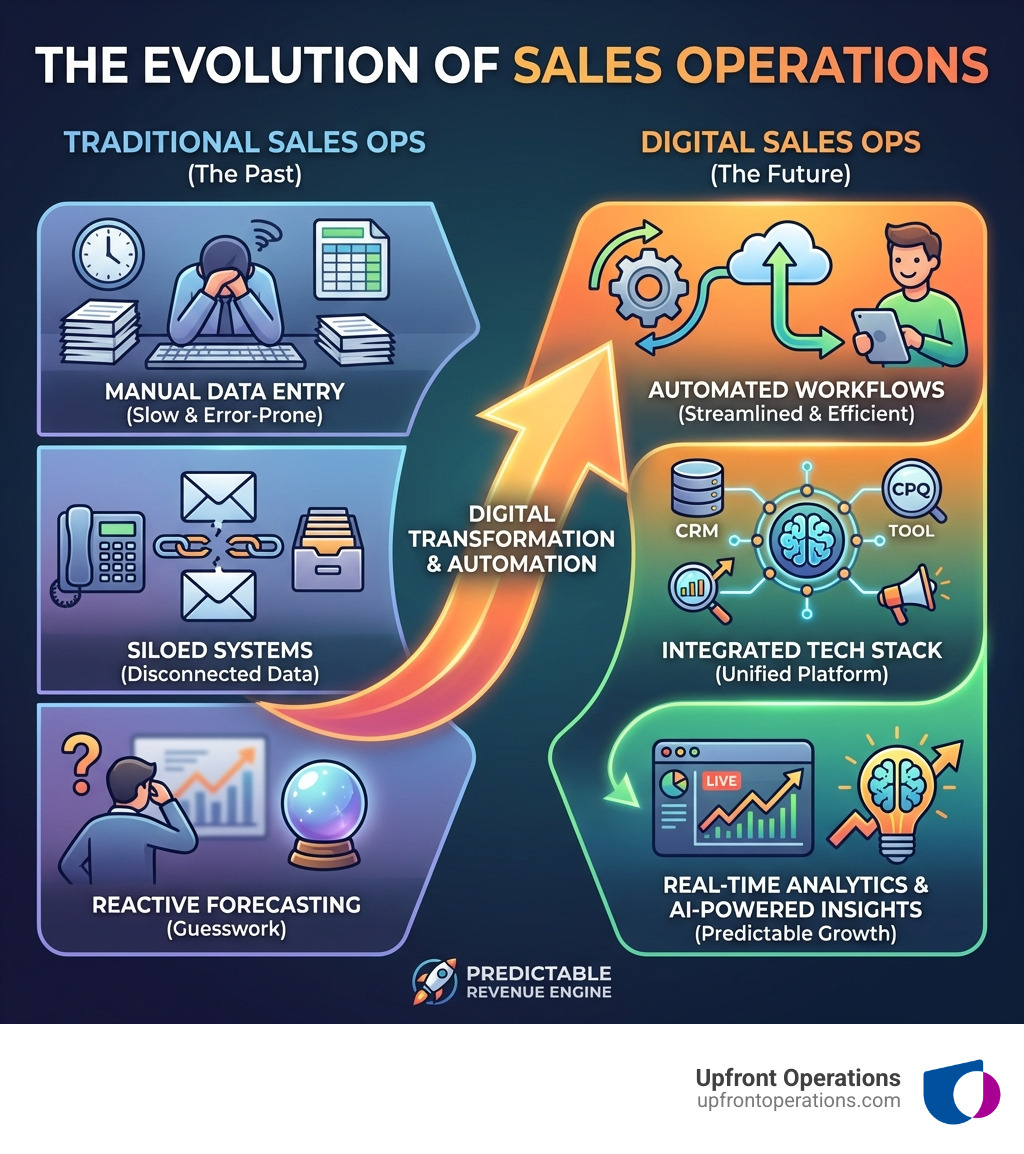
Imagine orders flying in through multiple channels—phone, email, web forms—each landing in a different system, demanding manual entry while your inventory updates lag behind. Your reps are drowning in admin work. Customers are left in the dark. Deals stall in your pipeline with no clear next step.
This is the reality for businesses stuck in traditional sales operations. You're leaving money on the table—not because your product is weak or your reps aren't good enough, but because your systems can't keep up.
Digital sales operations flips this script. It automates order processing, routes leads instantly based on capacity and fit, syncs inventory in real-time, and delivers data-driven insights to guide every customer interaction. It transforms your sales function from a cost center into a strategic growth engine.
The shift from traditional to digital isn't just about adding more software—it's about building an integrated system where technology, clean data, and smart processes work together to free your team from busywork and empower them to close more deals, faster.
I'm Ryan T. Murphy, founder of UpfrontOps, and over the past 12 years I've helped 32 companies streamline their digital sales operations—cutting sales cycles by up to 28% and open uping millions in new revenue through automation, CRM optimization, and data-driven strategy. Whether you're a scrappy startup or a mid-sized business fighting manual chaos, I've seen how the right digital sales operations foundation transforms scattered efforts into predictable growth.
Digital sales operations terms you need:
The Engine Room: Core Components of a Modern Sales Machine
Think of your digital sales operations as the engine room of a high-performance vehicle. It’s where all the moving parts come together to drive speed, efficiency, and power. Without a well-tuned engine, even the most beautiful car won't get you far. The same is true for your sales team. A robust digital sales operations framework ensures your sales teams operate efficiently, predictably, and in alignment with your business objectives.
The Four Pillars of Digital Sales Operations
At Upfront Operations, we see four fundamental pillars supporting a thriving digital sales operations strategy:
- Strategic Planning: This isn't just about setting sales targets; it's about aligning sales goals with broader business objectives. It involves territory design, headcount modeling, compensation planning, and quota setting to ensure your efforts are focused where they matter most. We help define clear mission statements for sales ops teams that align with overall sales goals, ensuring everyone is pulling in the same direction.
- Sales Process Optimization: This pillar is all about making your sales journey as smooth as possible. We standardize workflows, implement proven methodologies, and identify bottlenecks to drive efficiency and predictability. This means automating tasks like lead qualification, approvals, and reporting, reducing the administrative burden on your sales reps.
- Data Management and Analytics: Data is gold. This pillar focuses on centralizing and analyzing sales data to improve forecasting accuracy, pipeline management, and overall decision-making. It means eliminating data silos and creating a single source of truth, enabling data-driven sales execution. We ensure that your CRM is a reliable repository of customer information, not a digital graveyard.
- Technology Stack Management: The right tools are crucial, but an overloaded or unintegrated tech stack can do more harm than good. This pillar is about evaluating, integrating, and optimizing your sales technology to streamline workflows and support customer engagement. It’s about ensuring your tools work for you, not against you.
Essential Technologies and Your Tech Stack
Building an effective digital sales operations tech stack isn't about collecting every shiny new tool; it's about strategic integration that supports your sales process. We advocate for a lean, powerful stack that integrates seamlessly.

Here are the must-have categories:
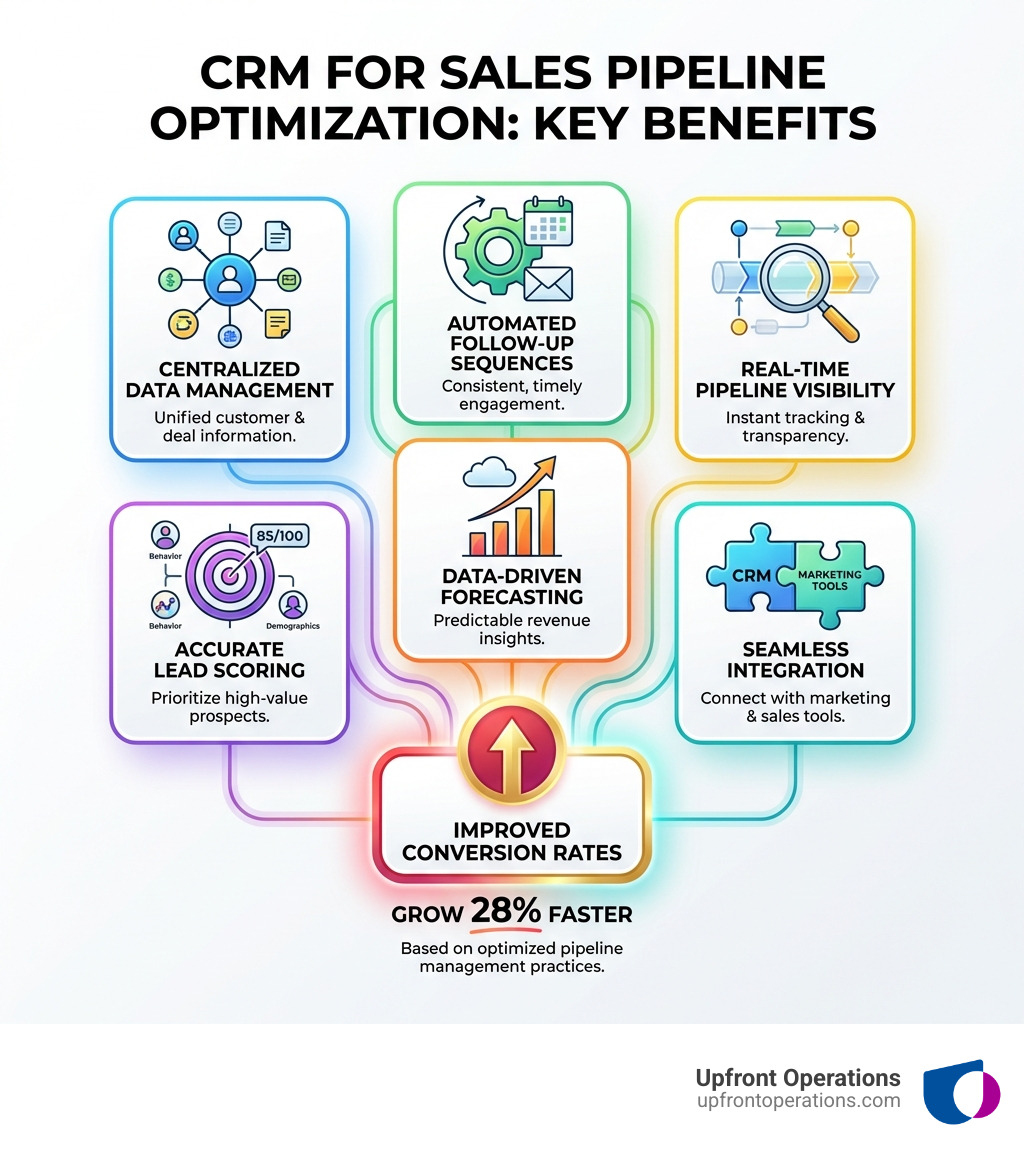
- CRM Systems: The foundation of any modern sales operation. Tools like Salesforce or HubSpot are non-negotiable for managing customer relationships, tracking interactions, and centralizing data. Companies that adopt CRM effectively increase sales by 29%, improve productivity by 34%, and improve forecast accuracy by 42%. We specialize in CRM management, ensuring your system is optimized to support your sales team's needs.
- Sales Enablement Platforms: These platforms provide reps with the content, training, and tools they need to engage with prospects effectively. They help new hires ramp up 40-50% quicker with structured training modules and reduce time spent searching for content.
- CPQ (Configure, Price, Quote) Software: Essential for businesses with complex product offerings, CPQ tools automate the quoting process, cutting turnaround time by 60% and increasing conversion rates by up to 17%.
- Business Intelligence (BI) Tools: For deeper insights, BI tools (like Tableau or Clari) help analyze performance, identify trends, and make data-backed decisions.
- Communication Platforms: Integrating tools like Slack can centralize team communication, allow real-time access to customer data, and facilitate collaboration, reducing the average worker's 25% workday spent on email-related tasks (only 38% of which are revenue-generating!).
At Upfront Operations, we understand that for small businesses and solopreneurs, building a full tech stack from scratch can be daunting. That's why our selling point includes delivering essential microservices on-demand, like professional websites and business email, to help you establish a strong digital presence without the overhead of an in-house team. For larger companies, our elite fractional sales operations experts can help you evaluate, integrate, and optimize your existing stack, ensuring every tool pulls its weight.
Open uping Growth: How to Leverage Digital Sales Operations for Peak Efficiency
Leveraging digital sales operations isn't just about making things run smoothly; it's about open uping significant growth. When your processes are optimized, your data is clean, and your technology is integrated, your sales team transforms into a revenue-generating powerhouse.
Streamlining Processes to Reclaim Selling Time
One of the most eye-opening statistics in sales is that reps only spend about 30% of their time actually selling. The rest is often consumed by administrative tasks, searching for information, or dealing with inefficient processes. This is where digital sales operations truly shines.
- Automating Administrative Tasks: Imagine a world where lead assignment, data entry, and report generation happen automatically. This frees up your reps to do what they do best: build relationships and close deals. We help implement automation workflows that reduce this burden, allowing reps to focus on revenue-generating activities.
- Lead Routing and Management: No more lost leads or manual assignments. Digital sales operations ensures leads are routed to the correct sales representatives based on capacity, territory, and buyer needs, improving lead follow-up efficiency by 40%.
- Pipeline Optimization: By standardizing sales stages, defining clear next steps, and automating notifications, we ensure deals move smoothly through the pipeline, reducing stalled opportunities and improving sales cycle efficiency by 25%.
- Standardizing Workflows: Creating clear, repeatable processes for every sales activity ensures consistency, reduces errors, and makes onboarding new hires a breeze. This predictability is key to scaling your sales efforts.
Using Data for Hyper-Personalization and Better Decisions
In today's competitive landscape, generic approaches simply don't cut it. Customers expect personalized experiences, and digital sales operations provides the data and insights to deliver them.

- Data-Driven Insights: By centralizing and analyzing customer data, sales operations provides actionable insights into customer preferences, buying behaviors, and historical interactions. This allows your team to understand what resonates with each individual.
- Personalized Customer Journeys: Armed with data, your sales reps can craft custom messages, recommend relevant products, and anticipate questions, making every customer interaction feel bespoke. This hyper-personalization can significantly improve customer experience and personalization.
- Anticipating Customer Needs: Predictive analytics, powered by your digital sales operations data, can help you identify customers who are most likely to convert or churn, allowing for proactive engagement.
- Crafting Personalized Pitches: No more one-size-fits-all presentations. Data empowers your reps to create pitches that speak directly to a prospect's pain points and interests, increasing effectiveness and win rates.
Companies with strong sales operations functions achieve 20-30% higher sales productivity compared to their peers. This isn't magic; it's the result of systematically leveraging data and optimizing processes. We can help you harness this power. More info about our services
The Future is Now: AI, Automation, and Future-Proofing Your Strategy
The sales landscape is constantly evolving, and the future of digital sales operations is undeniably intertwined with artificial intelligence (AI) and advanced automation. These technologies are changing sales from a reactive function into a proactive, predictive engine.
AI is no longer a futuristic concept; it's a present-day reality that's revolutionizing how sales teams operate.
- AI for Lead Scoring: AI algorithms can analyze vast amounts of data—from website visits to social media engagement—to score leads more accurately, ensuring your reps focus on the hottest prospects. This means less wasted time on cold leads and more conversions.
- AI-Driven Forecasting: Forget guesswork. AI can analyze historical sales data, market trends, and even external signals to generate highly accurate sales forecasts. AI-driven forecasting improves quota accuracy by 3×, helping you plan resources and set realistic targets.
- Conversational AI Assistants: These smart assistants can handle initial customer inquiries, qualify leads, book meetings, and even draft emails, freeing up human reps for more complex, relationship-building tasks. Companies that leverage AI for sales see 50% more leads and appointments, along with a 60-70% reduction in call time.
- AI Revenue Growth: The numbers speak for themselves: sales teams that use AI saw revenue growth in the past year, compared with teams that didn’t. In fact, sales teams that use AI are 3.7x more likely to reach sales quotas.
Our elite fractional sales operations experts are at the forefront of AI integration, guiding larger companies in deploying these transformative tools to gain a significant competitive edge. For small businesses, we can help identify cost-effective AI solutions that deliver immediate value without breaking the bank.
Key Trends Shaping the Future
Beyond AI, several key trends are shaping the evolving landscape of digital sales operations:
- Digital-First B2B Selling: The pandemic accelerated a shift that was already underway. By 2025, 80% of B2B sales interactions will take place in digital channels. This means your digital presence and processes must be impeccable.
- Self-Serve Models: Customers increasingly prefer to research and even purchase on their own terms. Digital sales operations must support robust self-serve options while still providing personalized assistance when needed.
- Deeper Integration with Marketing and Customer Success: The lines between sales, marketing, and customer success are blurring. The rise of Revenue Operations (RevOps) signifies a strategic shift to align these functions under a unified revenue strategy, optimizing the entire customer lifecycle from awareness to advocacy. Companies with RevOps grow revenue 3× faster than those without.
This integrated approach ensures a seamless customer experience and maximizes lifetime value. We believe that understanding and adapting to these trends is crucial for long-term success. You can learn more about this shift by exploring The future of B2B sales interactions.
Here's a quick look at how Sales Operations and Revenue Operations compare:
| Feature | Sales Operations | Revenue Operations |
|---|
| Primary Focus | Optimizing sales-specific processes and efficiency | Aligning sales, marketing, and customer success |
| Scope | Sales execution, pipeline, forecasting | Entire revenue cycle (top-of-funnel to renewal) |
| Goal | Improve sales performance and productivity | Maximize overall revenue growth and customer lifetime value |
| Key Metrics | Win rate, sales cycle length, quota attainment | Customer acquisition cost, churn rate, customer lifetime value |
Building and Measuring Your Dream Team: Roles, Skills, and ROI
Even with the most advanced technology, your digital sales operations success ultimately hinges on the people driving it. Building the right team with the right skills, and then effectively measuring their impact, is paramount.
Essential Roles and Skills for Success
A successful digital sales operations team isn't just a collection of individuals; it's a strategic unit designed to support, optimize, and scale your sales efforts.
- Sales Operations Manager: This strategic leader oversees the entire sales operations function. They are responsible for strategic planning, process optimization, technology integration, and performance evaluation. They act as the bridge between sales leadership and the operational execution.
- Sales Operations Analyst: The data wizard of the team. Analysts dive deep into sales data, identify trends, build reports, and provide actionable insights to sales leaders. They are critical for data-driven decision-making and forecasting accuracy.
- Technical Skills: Proficiency in CRM systems (like Salesforce), sales enablement platforms, and analytics tools is non-negotiable. The team needs to be power users of your tech stack.
- Analytical Thinking: The ability to dissect complex problems, interpret data, and draw meaningful conclusions is vital for identifying bottlenecks and opportunities.
- Project Management: Sales operations often involves implementing new tools or processes, requiring strong project management skills to ensure successful adoption and integration.
For larger companies, building out a full in-house team can be a significant investment. That's where our elite fractional sales operations experts come in. We offer on-demand expertise, providing the strategic and tactical support you need without the overhead of a full-time hire. This fractional expert model allows you to tap into top-tier talent precisely when and where you need it, surpassing the value traditional agencies provide. Learn more about our team
Measuring the ROI of Your Digital Sales Operations
You wouldn't invest in a new sales tool without expecting a return, and the same applies to your entire digital sales operations initiative. Measuring ROI is crucial for demonstrating value and justifying continued investment.
Key Performance Indicators (KPIs) we track include:
- Sales Velocity: How quickly deals move through your pipeline. Faster velocity means more revenue.
- Win Rate: The percentage of opportunities won. Strong sales ops can improve this significantly—companies with strong sales operations functions experience 38% higher win rates when sales and marketing are aligned.
- Customer Acquisition Cost (CAC): The cost to acquire a new customer. Optimized operations can reduce this by streamlining lead generation and conversion.
- Sales Cycle Length: The time it takes from initial contact to closing a deal. Companies that invest in Sales Operations experience 25-40% shorter sales cycles.
- Forecast Accuracy: How close your sales forecasts are to actual results. Accurate forecasting leads to better resource allocation and business planning. Companies with well-structured Sales Ops management improve forecast accuracy by 3×.
- Revenue per Rep: A measure of individual sales rep productivity. When reps spend less time on admin and more time selling, this metric naturally improves.
By consistently tracking these metrics, we can demonstrate the tangible impact of your digital sales operations efforts on your bottom line.
Frequently Asked Questions about Digital Sales Operations
We often get asked similar questions from businesses looking to start on their digital sales operations journey. Let's address some of the most common ones.
What are the first steps to implementing a digital sales operations strategy?
Taking the plunge into digital sales operations can feel overwhelming, but a structured approach makes it manageable.
- Start with an Audit: Before you change anything, understand your current state. What are your existing processes? What tools are you using (or not using)? Where are the bottlenecks and inefficiencies?
- Define Clear Objectives: What do you want to achieve? Higher win rates? Shorter sales cycles? Improved forecast accuracy? Specific, measurable goals will guide your strategy.
- Prioritize Technology: You don't need all 7,000+ sales and marketing software applications out there. Focus on core systems like CRM and identify tools that address your biggest pain points and integrate well.
- Focus on Process Optimization: Technology is only as good as the process it supports. Standardize workflows, automate repetitive tasks, and ensure your team understands and adopts new methodologies.
- Gain Leadership Buy-in: Digital sales operations is a strategic initiative, not just an IT project. Ensure your leadership team understands the value and is committed to supporting the change.
How does digital sales operations differ from sales enablement?
While closely related and often working hand-in-hand, digital sales operations and sales enablement serve distinct purposes:
- Sales Operations (The "How"): Focuses on the strategic, systemic, and analytical aspects of sales. It's about optimizing the entire sales process, managing the tech stack, ensuring data quality, forecasting, territory management, and compensation. Sales ops targets leadership and organizational strategy.
- Sales Enablement (The "What"): Concentrates on empowering individual sales reps with the tools, content, and training they need to perform effectively. It's about providing sales playbooks, product knowledge, compelling content, and coaching. Sales enablement targets individual sales reps and teams directly.
Think of it this way: Sales operations builds and maintains the racetrack, while sales enablement gives the race car driver the best car, fuel, and training to win. Both are essential for success.
Can small businesses benefit from digital sales operations?
Absolutely! In fact, small businesses often have the most to gain from strategic digital sales operations.
- Scalability: Digital tools and optimized processes allow small teams to achieve disproportionately large results, scaling operations without needing to rapidly scale headcount.
- On-Demand Services: Our microservices, like professional websites and business email, are designed specifically for small businesses and solopreneurs to establish a strong digital foundation efficiently. We deliver these essential services on-demand, providing the support you need without the commitment of a full-time team.
- Focus on High-Impact Automation: Even basic automation—like automated lead routing or email sequences—can free up significant time for a small business owner or a lean sales team, allowing them to focus on high-value selling activities.
- Cost-Effective Tools: Many powerful digital sales operations tools now offer affordable plans or even free tiers, making advanced capabilities accessible to smaller budgets.
We believe that every business, regardless of size, deserves access to game-changing sales operations support. Our approach ensures you get precisely the expertise and tools you need, precisely when you need them, making digital sales operations an accessible and powerful growth lever for all.
Conclusion
We've journeyed through the intricate world of digital sales operations, exploring its core components, how it transforms efficiency, its future driven by AI, and the teams that make it all happen. What's clear is that digital sales operations is no longer a luxury; it's a strategic imperative for any business aiming for predictable revenue growth in today's digital-first landscape.
By streamlining processes, integrating technology, leveraging data for personalization, and embracing AI, you can move your sales function beyond mere administration. You can transform it into a powerful engine that drives efficiency, boosts productivity, and ultimately, empowers your team to close deals faster and scale with unstoppable momentum.
At Upfront Operations, we're passionate about delivering game-changing sales operations support. Whether you need essential microservices on-demand to build your digital presence or elite fractional sales operations experts to optimize your entire revenue engine, we provide custom solutions that surpass traditional agencies and freelance platforms. We're here to help you steer the complexities of digital sales operations and turn your sales goals into reality.
Ready to boost your CRM management, lead nurturing, and pipeline optimization? Explore our flexible pricing options