Why Modern Teams Are Rethinking How They Communicate

An internal communication solution is a platform or set of tools that helps organizations share information, align teams, and engage employees across all levels and locations. The best solutions combine real-time messaging, centralized knowledge management, and targeted communication channels to ensure the right information reaches the right people at the right time.
Top Internal Communication Solutions at a Glance:
- All-in-One Platforms - Simpplr, Unily, Workvivo (best for comprehensive employee experience)
- Instant Messaging Hubs - Slack, Microsoft Teams, Google Workspace (best for real-time collaboration)
- Frontline-Focused Tools - Connecteam, SnapComms, ContactMonkey (best for deskless workers and targeted alerts)
- Key Features to Prioritize - Mobile access, AI personalization, analytics, security, integrations
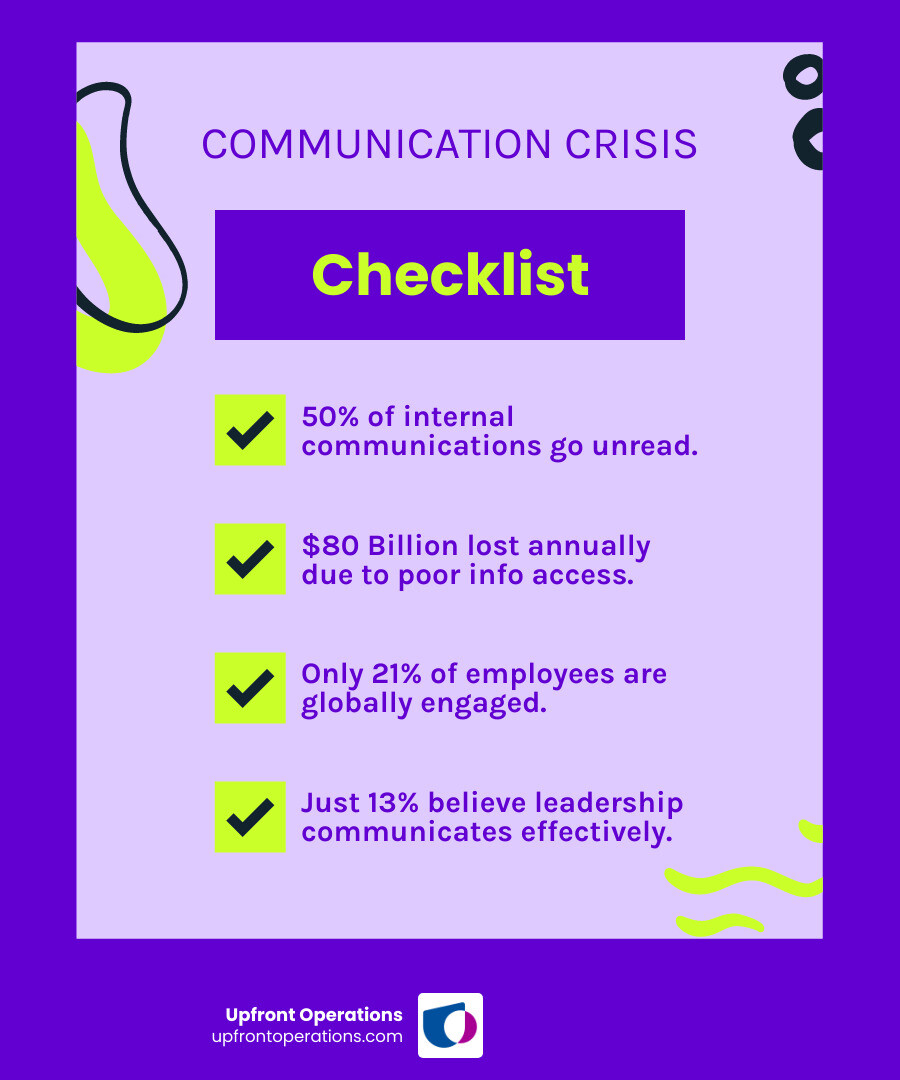
Half of all internal communications aren't read. That's not a typo—it's a crisis hiding in plain sight. While leaders assume their messages land, only 13% of employees believe their leadership communicates effectively. This disconnect costs real money: poor information access alone drains $80 billion annually from enterprises.
The shift to hybrid and remote work has amplified these challenges. With 43% of remote employees feeling disconnected from colleagues and only 21% of workers globally engaged, traditional communication methods—endless email chains, buried announcements, and one-way broadcasts—simply don't cut it anymore.
The stakes have never been higher. Disengaged employees are twice as likely to leave within a year. Miscommunication drives down productivity for nearly half of all workers. And when only 44% of staff believe leaders are aligned with them (despite 66% of leaders thinking otherwise), it's clear that the tools we use to connect aren't actually connecting us.
This isn't just about sending messages—it's about building culture, driving alignment, and enabling every employee to do their best work. Whether you're managing a distributed sales team, coordinating frontline workers, or simply trying to cut through the noise of information overload, the right internal communication solution can transform how your organization operates.
I'm Ryan T. Murphy, founder of UpfrontOps, and over the past 12 years I've helped 32 companies streamline their operations—including implementing internal communication solutions that reduced sales cycles by up to 28% and improved team alignment across distributed workforces. The right communication infrastructure isn't just nice to have; it's the foundation for everything from sales effectiveness to customer success.
Why Your Business Can't Afford to Ignore Internal Communication
Information overload and email fatigue mean critical announcements often go unread—half of all internal communications aren’t even opened. For frontline workers, from sales teams in New York to remote support staff, poor information access costs enterprises a staggering $80 billion annually. This leads to disconnected teams, low morale, and a weakened company culture, hurting employee retention.
The leadership communication gap is also a major issue: while 66% of leaders feel aligned with employees, only 44% of staff agree. This disconnect erodes trust and hinders strategic goals.
You can dig deeper into the global state of employee engagement and well-being in Gallup's State of the Global Workplace Report.
The High Cost of Disconnection
The consequences of ignoring these internal communication challenges are far-reaching and costly:
- Productivity loss: Nearly 50% of employees attribute lost productivity to miscommunication. The time spent clarifying details can cost an organization $15,000 per employee annually—resources better spent on closing deals.
- Increased employee stress: Unclear or hard-to-find information is a major stressor for over 40% of workers, leading to burnout and disengagement.
- High turnover rates: A startling 50% of employees are seeking new jobs, and disengaged workers are twice as likely to leave. Poor communication makes employees feel undervalued and disconnected.
- Misalignment on goals: When 40% of teams lack a clear charter and goals, effort is wasted and opportunities are missed.
- $80 billion annual cost: This figure bears repeating. Poor information access for frontline workers directly impacts the bottom line and the ability of sales and ops teams to succeed.
- Ineffective change management: Without clear communication, employees resist change, stalling projects and strategic pivots.
Now, let's flip the coin. What happens when you get internal communication right? The benefits are truly transformative:
- Improved collaboration: When communication flows freely, teams work better together. A collaborative environment fosters innovation and problem-solving.
- Increased productivity: Clear, timely communication means less time clarifying and more focus on core tasks, naturally soaring productivity.
- Improved employee engagement: Engaged employees are more productive and loyal. Recognition and a strong onboarding experience are key drivers of satisfaction and purpose.
- Stronger company culture: A vibrant communication solution helps build a cohesive culture, which is linked to higher revenue and employee satisfaction.
- Higher employee satisfaction: When employees feel heard, informed, and connected, their job satisfaction improves, creating a positive work environment.
- Better alignment with business objectives: Effective communication ensures every team member understands company goals and their role in achieving them, from optimizing sales pipelines to streamlining operations.
The days of relying solely on email for internal communication are long gone. Modern internal communication tools offer a rich mix of features designed to facilitate centralized information, real-time updates, and both asynchronous and synchronous communication, effectively breaking down silos. These tools are no longer just "nice-to-haves"; they are essential for business resilience and agility, especially in our hybrid and remote work environments.
Let's look at the main types of internal communication solution and how they stack up:
| Type of Solution | Primary Use | Best For | Example Tools |
|---|
| All-in-One Intranet Platforms | Centralized knowledge, news, and employee engagement | Large organizations, complex structures, comprehensive employee experience | Simpplr, Unily, Staffbase, Workvivo, Happeo |
| Instant Messaging & Chat Apps | Real-time collaboration, quick discussions, project updates | Fast-paced teams, project-based work, reducing email overload | Slack, Microsoft Teams, Google Workspace (Chat) |
| Targeted Communication Tools | Specific message delivery, feedback, frontline engagement | Deskless workforces, emergency comms, internal marketing, employee feedback | Connecteam, SnapComms, ContactMonkey |
Think of an all-in-one intranet platform as your company's digital headquarters. It's a centralized hub for knowledge management, company news, employee directories, and social features. These platforms personalize content for individual roles and interests. For Upfront Operations, a robust intranet gives our on-demand sales operations experts immediate access to client playbooks and company updates, no matter where they are.
Instant Messaging & Chat Apps
For real-time conversation, instant messaging apps like Slack, Microsoft Teams, and Google Workspace are indispensable. They offer team channels for project collaboration, direct messaging, and file sharing, significantly reducing email overload. Slack, for instance, positions itself as a team's "collective brain," replacing email with a faster, more organized system. For fast-moving clients in New York, these tools are non-negotiable for maintaining team cohesion.
Sometimes, you need to ensure a specific message cuts through the noise, or you need to reach a particular segment of your workforce. That's where targeted communication tools shine.
- Digital newsletters: Tools like ContactMonkey create engaging, trackable newsletters to promote company values, clarify policies, and celebrate successes.
- Emergency alerts and scrolling tickers: Platforms like SnapComms deliver pop-up alerts and tickers directly to employee screens, bypassing email for urgent messages, even for deskless workers.
- Employee surveys: These tools are vital for two-way communication, allowing you to gather real-time feedback on engagement and sentiment.
- Recognition platforms: These features make it easy to celebrate successes and acknowledge contributions, building a culture of appreciation.
- Onboarding centers: A personalized onboarding journey within your communication tool helps new hires get up to speed quickly, improving satisfaction and retention.
The Ultimate Internal Communication Solution Roundup for 2026
As we look ahead, the landscape of workplace communication will be more dynamic than ever. Choosing the right internal communication solution means considering platforms that are not only powerful today but also future-proof. Here's a roundup of leading solutions, categorized by their primary strengths, keeping an eye on the features that will matter most in 2026.
These platforms aim to be the central hub for all employee communications and engagement, offering a holistic employee experience.
- Simpplr: A leading AI-powered employee experience platform that excels at connecting distributed workforces. It boasts high employee adoption rates, 200+ integrations, and AI-driven content personalization, making it a true digital headquarters.
- Unily: A comprehensive employee experience platform built for enterprise-grade security and scalability. It focuses on unique content types like FAQs and surveys, making it ideal for large, global organizations.
- Staffbase: This platform focuses heavily on employee communication with features like audience segmentation and SMS support, making it effective for reaching diverse and deskless workforces.
- Workvivo: An all-in-one platform that leverages Zoom technology for real-time communication like virtual town halls, aiming to foster a strong company culture through social features.
These platforms are leaning heavily into AI-powered personalization to deliver relevant content to each employee, comprehensive analytics to measure impact, and a strong focus on the overall employee experience.
Instant Messaging & Collaboration Hubs
These tools are the workhorses for real-time communication, project collaboration, and seamless integration with other business applications.
- Slack: Positioned as a team's "collective brain," Slack uses channel-based communication to organize conversations and integrates with apps and AI. Slack Connect also enables secure communication with external partners.
- Microsoft Teams: A powerhouse for organizations in the Microsoft ecosystem, deeply integrated with Office apps. Its AI assistant, Copilot, helps streamline workflows and find information.
- Google Workspace: This suite includes Gmail, Drive, and Meet, all designed for seamless collaboration. Its real-time coauthoring with version control is a key feature for document-heavy teams.
These hubs are constantly evolving with app integrations to centralize workflows, advanced video conferencing capabilities, and increasingly sophisticated AI assistants like Copilot to improve productivity and information retrieval.
For organizations with a significant deskless workforce or those needing to deliver highly targeted and impactful messages, these solutions offer specialized features.
- Connecteam: Designed for companies with a large deskless workforce, this mobile-first platform streamlines scheduling, communication, and task management for frontline and remote workers.
- SnapComms: This multi-channel platform bypasses email to deliver critical messages via pop-up alerts and scrolling tickers. It aims for 100% readership for urgent announcements.
- ContactMonkey: This tool improves internal email with tracking, segmentation, and embedded surveys. It provides robust analytics to help communicators measure engagement and understand their audience.
These tools prioritize mobile-first design, catering specifically to the deskless workforce, and offer features for high-readership alerts and email tracking to ensure messages are not just sent, but actually seen and engaged with. For our clients, particularly those with a distributed sales force or field operations in New York and beyond, these specialized solutions can be a game-changer for daily operational efficiency and immediate communication needs.
Choosing and implementing the best internal communication solution for your organization isn't a one-size-fits-all endeavor. It requires a thoughtful needs assessment, clear goal alignment, and a strategic implementation plan. Here are some key questions we encourage our clients to ask vendors:
- What are your system's core capabilities, and how do they directly address our specific communication challenges?
- Can your platform integrate seamlessly with our existing CRM, HRIS, and other essential business tools?
- What kind of analytics and reporting capabilities do you offer to measure message effectiveness and employee engagement?
- How does your solution support mobile accessibility for our deskless and remote workforce?
- What security protocols and compliance certifications (e.g., ISO 27001, SOC 2 Type II) does your platform adhere to?
- What training and ongoing support do you provide to ensure successful user adoption?
- How does your platform scale as our company grows and our communication needs evolve?
More info about our services
Key Features to Look for in Your Next Internal Communication Solution
As you evaluate potential platforms for 2026 and beyond, keep these critical features in mind:
- Governed AI: The future of internal communication is intelligent. Governed AI ensures that AI capabilities (like content generation assistance, personalization, and sentiment analysis) are used securely, ethically, and in compliance with company policies. Enterprises need to adopt Governed AI yesterday to automate workflows and improve productivity without compromising data integrity.
- Mobile readiness: With hybrid and remote work models becoming the norm, mobile accessibility is a non-negotiable feature. Your chosen solution must offer a robust mobile app that works seamlessly for all employees, especially those without desk access or company email addresses.
- Robust analytics: To measure ROI and continuously improve, you need more than just open rates. Look for platforms that offer comprehensive analytics on engagement, message reach, content performance (time-on-page, click-through rates), and employee sentiment. AI-powered analytics can even track sentiment in real-time.
- Personalization: To cut through digital noise, your internal communication solution must allow for personalization of content based on employee roles, locations, functions, and interests. This ensures messages are relevant and impactful.
- Enterprise-grade security: Data privacy and security are paramount. Ensure the platform adheres to high standards like ISO 27001 and SOC 2 Type II, with features like role-based access controls, content approval workflows, and encryption.
- Seamless integrations: Your new communication tool shouldn't be another silo. It needs to integrate smoothly with your existing tech stack, including HR systems, CRM, project management tools, and other collaboration platforms.
- Multilingual support: For diverse workforces or international operations, multi-language support is crucial to ensure all employees receive information in a language they understand.
A Step-by-Step Guide to Choosing Your Internal Communication Solution
Navigating the vast array of options can be daunting. Here’s a practical approach we recommend:
- Audit current tools: Before looking forward, understand your present. What communication tools are currently in use? What are their strengths and weaknesses? Where are the gaps and pain points for your employees? This helps narrow down your tech stack.
- Define clear objectives: What do you want to achieve with a new internal communication solution? Is it to boost employee engagement, improve productivity, streamline onboarding, or improve leadership transparency? Ensure these objectives align directly with your broader business strategy.
- Map internal audiences: Not all employees consume information the same way. Segment your audience by role, location (e.g., our New York sales team vs. remote support staff), and preferred communication channels. This will guide your feature prioritization.
- Prioritize essential features: Based on your objectives and audience mapping, create a prioritized list of must-have features (like those listed above). This will help you filter through potential solutions efficiently.
- Request personalized demos: Don't settle for generic sales pitches. Ask vendors for demos custom to your specific use cases and challenges. This is your chance to see how the software truly performs for your needs.
- Involve employees in decisions: User adoption is critical. Involve a diverse group of employees in the selection process. Their feedback on ease of use and practicality will be invaluable and foster a sense of ownership.
Best Practices for a Successful Rollout
Even the best internal communication solution won't succeed without a thoughtful rollout.
- Provide comprehensive training: Don't just launch and hope. Offer training that caters to different digital literacy levels and job roles. Show employees how the new tool makes their lives easier.
- Establish governance and workflows: Define clear rules for content creation, approval, and dissemination. Who can post what, and where? This ensures message discipline and prevents information overload.
- Promote two-way communication: Encourage feedback, questions, and discussions. Position communication as a dialogue, not a monologue. Invest in feedback mechanisms to shape future communication strategies.
- Measure key metrics: Continuously track the metrics you defined earlier (engagement, readership, adoption). Look beyond simple views and clicks to active participation rates, feedback quality, and goal-aligned behaviors.
- Continuously gather feedback: The rollout isn't the end; it's the beginning. Use surveys and informal channels to gather ongoing feedback, identify areas for improvement, and fine-tune your strategy.
Modern internal communication tools are a game-changer for leadership. They move beyond the traditional "memo from the top" to create more engaging and transparent communication channels. Features like dedicated leadership centers, where executives can post updates, share vision, and answer questions, humanize leadership. Video messages and virtual town halls allow leaders to connect directly with employees, regardless of location. AMAs (Ask Me Anything) sessions foster transparency and build trust by giving employees a direct line to ask questions. This direct, consistent communication from leadership helps keep employees aligned with company objectives and builds a thriving workplace culture.
What role does AI play in modern internal communication?
AI is rapidly changing internal communication, moving it from reactive to proactive and personalized. Here's how:
- Content personalization: AI can analyze employee roles, preferences, and past interactions to deliver highly relevant content, ensuring messages cut through the noise.
- Automated workflows: AI can automate routine tasks like scheduling messages, generating summaries, or routing feedback, freeing up communication teams for more strategic work.
- Sentiment analysis: AI-powered tools can monitor discussions and feedback to gauge employee sentiment in real-time, allowing organizations to address concerns proactively.
- Smart search: Improved search capabilities, often powered by AI, make it easier for employees to find the information they need quickly within vast knowledge bases.
- Predictive analytics: AI can identify communication gaps or potential areas of disengagement before they become major problems, allowing for targeted interventions.
- Content generation assistance: AI can assist in drafting communications, summarizing lengthy documents, or adapting content for different channels, ensuring consistency and efficiency.
Measuring the ROI of an internal communication solution involves tracking both quantitative and qualitative metrics. It's about demonstrating how improved communication translates into tangible business benefits:
- Engagement metrics: Track open rates, click-through rates, time spent on content, and participation rates in surveys, polls, and social features.
- Adoption rates: Monitor how many employees are actively using the platform and its various features. High adoption is a strong indicator of value.
- Readership rates: For critical information, track if messages are being read (especially with tools that guarantee readership, like SnapComms).
- Employee feedback scores: Conduct pulse surveys or use sentiment analysis to track improvements in employee satisfaction, understanding of company goals, and perception of leadership communication.
- Reduction in email volume: A successful internal communication solution should lead to a significant decrease in internal email traffic, indicating a shift to more efficient channels.
- Productivity improvements: While harder to quantify directly, look for reduced time spent clarifying information, faster project completion, and improved cross-functional collaboration. This indirectly impacts sales cycles and operational efficiency.
- Employee retention data: Over time, improved communication and engagement should correlate with lower turnover rates, saving the company significant recruitment and training costs.
At Upfront Operations, we understand the importance of data-driven decisions. Our fractional sales operations experts can integrate with your team to help track these metrics, ensuring your internal communication strategy directly supports your sales objectives and overall business growth, from lead nurturing to pipeline optimization.
Conclusion
In today's dynamic business environment, an effective internal communication solution is no longer a luxury—it's a strategic asset. It's the engine that drives culture, a powerful productivity booster, and the heart of employee engagement. From navigating the complexities of hybrid work to ensuring every frontline worker has the information they need, these tools are shaping the future of how we connect, collaborate, and achieve our goals.
For businesses in New York and beyond, embracing a modern internal communication strategy is essential for staying competitive. It's about cutting through the noise, fostering a truly connected workforce, and ultimately, building a more resilient and successful organization.
At Upfront Operations, we believe that seamless internal communication is foundational to operational excellence. Whether you need an on-demand foundational business email setup, an expert to boost your CRM management, or a fractional sales operations expert to optimize your pipeline, we ensure your internal systems support your ambitious objectives. We deliver game-changing support to help your business thrive.
Get started with our services