January 30, 2026

10
min read
The Complete Guide to Sales Pipeline Optimization
Master sales pipeline optimization for explosive revenue growth. Learn strategies, build pipelines, and leverage tech for ...
Master sales pipeline optimization for explosive revenue growth. Learn strategies, build pipelines, and leverage tech for ...

Sales pipeline optimization is the process of systematically improving how deals move through your sales process—from initial contact to closed-won. By eliminating bottlenecks, improving conversion rates, and accelerating deal velocity, you can build a predictable revenue engine.
Key Optimization Strategies:
Expected Results: Companies that optimize their pipeline management practices grow 28% faster than their peers, while those with a clearly defined sales process see 18% faster revenue growth.
Struggling with inconsistent sales and low conversion rates? The problem often isn't your product or team—it's a leaky sales pipeline. Manual processes, poor data, and misaligned teams create friction that lets opportunities slip through the cracks.
The good news? Sales pipeline optimization doesn't require a complete overhaul. It starts with understanding your bottlenecks, establishing clear processes, and leveraging the right technology and expertise.
I'm Ryan T. Murphy, founder of UpfrontOps. Over 12 years, I've helped 32 companies accelerate sales cycles by an average of 28% using strategic optimization and smart automation. My approach combines CRM configuration, process design, and on-demand microservices—like lead nurturing and custom dashboards—to help you close deals faster without adding headcount.
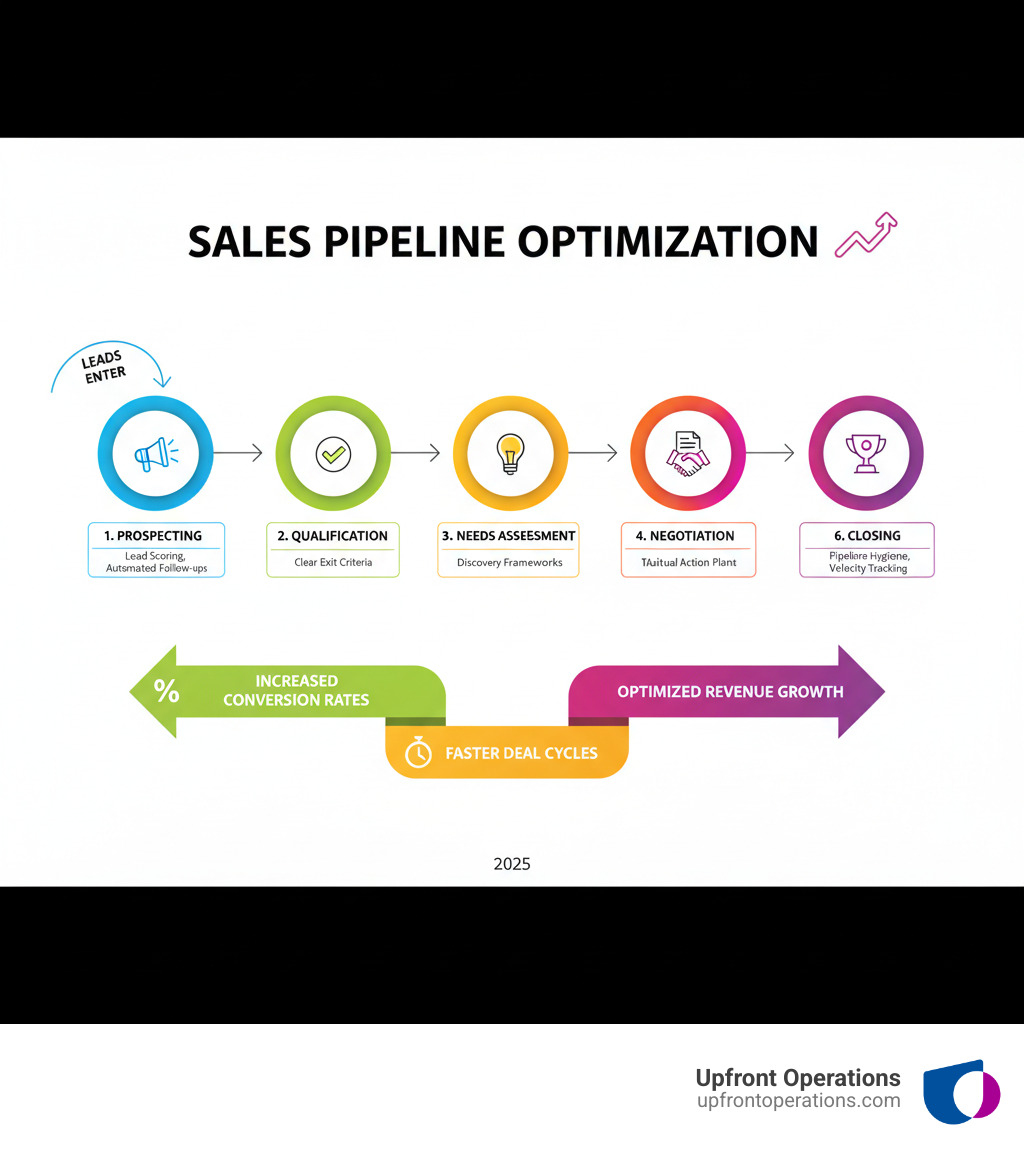
Think of your sales pipeline as a roadmap showing where every potential customer is in their journey with your business. It's a visual way to track how prospects move from initial contact to a signed contract. Instead of scattering deal info across sticky notes and spreadsheets, a well-structured pipeline gives you a clear, organized view of who's interested, what stage they're at, and what needs to happen next.
This isn't just about organization. A properly managed pipeline helps you forecast revenue with confidence, spot deals about to close, and identify where prospects are getting stuck. When you can see your entire sales process laid out, you can prioritize your time on the deals that matter most.
People often confuse the "sales pipeline" with the "sales funnel," but they serve different purposes. The pipeline focuses on your team's actions to advance deals, while the funnel represents the buyer's journey as many leads narrow down to a few customers. For a quick primer on funnels, see Sales funnel.
| Feature | Sales Pipeline | Sales Funnel |
|---|---|---|
| Perspective | Seller's Journey: Focuses on the actions your sales team takes to move a deal forward. | Buyer's Journey: Visualizes the narrowing of prospects as they move through different stages, from a broad top (many leads) to a narrow bottom (fewer customers). |
| Purpose | To track and manage individual deals, ensuring consistent action, and forecasting revenue. | To understand conversion rates at each stage, identify where prospects are dropping off, and optimize the overall marketing and sales process. |
| Visualization | A series of stages, often linear, that a specific deal progresses through. | A wider top (many prospects) that narrows down to a smaller bottom (fewer customers), illustrating the attrition rate. Some experts even suggest a "cocktail glass" model, where the top is wide for initial prospects, but once qualified, the stem is narrow, implying most qualified leads should convert. |
Effective pipeline management is the difference between guessing and knowing. It allows you to forecast revenue with data, allocate resources intelligently, and identify bottlenecks before they derail your growth. Maybe you notice deals are stalling at the proposal stage or taking too long to move from demo to negotiation. These insights let you fix issues proactively.
This isn't just about closing more deals—it's about building a predictable, scalable system that supports consistent growth.
At Upfront Operations, we help businesses set up and optimize their pipelines through targeted, on-demand services. Whether you need help with CRM configuration to get your pipeline tracking off the ground, or you need an expert to audit your current process and identify where deals are leaking, we deliver exactly what you need without the overhead of a full-time hire. Popular on-demand requests include pipeline dashboard creation and automated lead nurturing sequences that keep prospects engaged between touches.
Building a sales pipeline is like getting a custom suit—a perfect fit changes everything. Your pipeline needs to match your unique business, your customers' buying journey, and the way your team actually sells. There's no cookie-cutter solution.
The foundation of effective sales pipeline optimization is defining the right stages that map directly to how your buyers make decisions. A SaaS company selling to enterprise clients will have a very different journey than an e-commerce business or a consulting firm.
Most pipelines include these core stages: Prospecting (identifying leads), Qualification (vetting serious buyers), Needs Assessment/Demo (showing your solution), Proposal (formalizing the offer), Negotiation (finding common ground), Closing (sealing the deal), and Post-Purchase (onboarding and upsell).
But here's where most pipelines break down: without clear exit criteria for each stage, deals get stuck. Your reps need to know exactly what must happen before a deal can move forward. For example, a prospect shouldn't advance from Qualification to Needs Assessment until they've agreed to a demo date and confirmed decision-makers will attend. These objective actions prevent deals from stalling.
Lead qualification frameworks provide structure. BANT (Budget, Authority, Need, Timeline) is a classic. For more complex B2B sales, frameworks like MEDDIC (Metrics, Economic Buyer, Decision Criteria, Decision Process, Identify Pain, Champion) or GPCT (Goals, Plans, Challenges, Timeline) offer deeper insights. The goal is to qualify or disqualify leads early to save time.
The real secret weapon? Your Ideal Customer Profile (ICP). When you know exactly who your best customers are—their demographics, pain points, and buying behaviors—you can focus your energy on high-potential leads, dramatically improving conversion rates.
If setting up these frameworks feels overwhelming, that's where on-demand support makes all the difference. Whether you need help with CRM setup to track your stages properly or fractional sales operations experts to design qualification criteria that work for your business, you don't have to figure it out alone. The goal is a pipeline that fits your business perfectly and drives predictable growth.
Think of sales pipeline optimization as tuning a high-performance engine. You're making strategic adjustments that compound over time to deliver dramatically better results. This is an ongoing practice that separates fast-growing companies from those stuck in neutral.
An uncomfortable truth: 91% of CRM data is incomplete, and a staggering 70% becomes obsolete annually. This bad data clutters your pipeline with dead deals, sabotages forecasts, and wastes your team's time. Pipeline hygiene is the practice of regularly cleaning house. Every week or month, ruthlessly remove stagnant leads, update contact information, and ensure every deal stage reflects reality. If a deal has been stuck for a month with zero response, either re-engage or move it out.
The key is treating our CRM as a single source of truth where every interaction is logged and every status is updated promptly. If this feels overwhelming, our on-demand CRM setup and management services can handle the heavy lifting, ensuring your pipeline stays pristine.
Misalignment between sales and marketing is expensive. Siloed teams lead to mixed messages and lost leads. Companies with strong alignment grow 20% year over year, while misaligned ones decline by 4%. The fix starts with unified goals, a shared definition of a qualified lead, and a seamless handoff process that gives sales the context they need.
Despite 95% of sales reps saying relevant content influences deals, only 27% actually collaborate with marketing on it. That's a massive missed opportunity. When sales and marketing co-create content for each pipeline stage—like comparison guides or ROI calculators—conversion rates jump. Our on-demand experts can help bridge this gap by crafting compelling sales enablement content.
It takes an average of more than 8 touches to close a deal, yet 44% of salespeople give up after just one follow-up. Without a structured process, reps abandon opportunities just before they convert. A consistent follow-up cadence isn't about being annoying; it's about being present with valuable information. We implement multi-step sequences that mix emails, calls, and LinkedIn messages, ensuring each touchpoint adds value. When follow-up is built into your process and supported by automation, it happens consistently.
Sales teams lose up to an hour daily on manual tasks. Automation is transformative, delivering 14% productivity increases and 12% overhead reductions by handling repetitive work. It frees your team to focus on the human elements that close deals. Lead nurturing sequences, meeting schedulers, and automatic CRM updates are just a few examples.
Our lead nurturing automation service is designed for businesses that want these benefits without the complexity of enterprise platforms. We set up intelligent sequences that feel personal, keeping prospects engaged while your team focuses on high-value conversations.
Pipeline optimization is a company-wide effort. A slow legal review, cumbersome invoicing, or an unresponsive product team can all stall deals. The most efficient sales operations happen when R&D, HR, Finance, and Operations all understand their role in supporting revenue. We audit these functions to identify friction points and accelerate the entire pipeline.
Track both leading and lagging indicators. Lagging indicators (e.g., last quarter's revenue) show past results. Leading indicators (e.g., demo completion rates) predict future outcomes, allowing you to course-correct. Surprisingly, 30.6% of organizations don't consistently use both, meaning they're driving while only looking in the rearview mirror. Key metrics include the number of qualified leads, conversion rates per stage, and your win/loss ratio (analyzed for insights).
Once the fundamentals are solid, layer in advanced techniques.
Sales Pipeline Velocity = (Number of Opportunities × Win Rate × Average Deal Size) ÷ Average Sales Cycle Length
This formula gives you a daily revenue rate and highlights which lever to pull to improve it.
Without data, we're just guessing. Data transforms sales pipeline optimization from a buzzword into a revenue-generating machine. It shows where prospects get stuck, which stages have weak conversion rates, and why deals fall apart. Analyzing lost deals systematically provides insights that inform your next moves. It's about using data to make smarter, faster decisions.
Of course, data only helps if you have the right tools. At the foundation sits your CRM system—the central hub for tracking interactions and managing deals. A properly configured CRM automates tasks and ensures nothing slips through. However, many businesses choose the wrong CRM or set it up incorrectly.
If you're a small business owner or solopreneur, our on-demand CRM setup service gets you running on systems like HubSpot or Salesforce—configured for your specific sales process.
Beyond your CRM, sales engagement platforms manage outreach sequences, while analytics tools turn raw data into actionable intelligence through trend analysis and performance dashboards. The real game-changer is automation, which handles repetitive tasks like lead scoring, nurturing sequences, and data entry. When automation handles the busywork, your sales team can focus on what they do best: building relationships and closing deals.
But not every business can afford a full-time specialist. That's why we built our on-demand microservices model. Need automated lead nurturing, a custom sales dashboard, or professional business email setup? We deliver exactly what you need, on-demand.
For larger companies, our elite fractional sales operations experts provide the same level of expertise as a full-time hire, but without the overhead. Whether you need help identifying bottlenecks, implementing new tools, or building analytics dashboards, we deliver precisely what you need, when you need it.
Technology and data are the foundation of modern sales pipeline optimization, changing guesswork into predictable, scalable revenue growth.
First, conduct a pipeline audit to find where deals stall or drop off. Second, establish clear exit criteria for each stage based on specific prospect actions, not feelings. This ensures consistency. Finally, clean your pipeline by removing dead or stagnant deals that skew your forecasts. A clean pipeline provides an honest view of your business.
If you need help with this initial audit and cleanup, our on-demand CRM management service can tackle this project quickly, getting your pipeline squeaky clean without adding to your workload.
Pipeline reviews should be a regular habit. For tactical adjustments, hold weekly one-on-one reviews with each rep to discuss deal status, obstacles, and next steps. For strategic improvements, conduct monthly or quarterly team reviews to analyze patterns, spot larger issues, and refine your overall process. Consistency is what transforms sales pipeline optimization from a one-time project into a competitive advantage.
Absolutely. Small businesses often see the biggest impact because every lead is critical. Optimization helps you maximize the value of every lead through consistent follow-up and clear qualification. It also provides better cash flow predictability, allowing for smarter decisions on hiring and investment. This is invaluable when resources are tight.
You don't need enterprise software to get started. Our on-demand microservices—like custom CRM setup, automated lead nurturing, and pipeline dashboard creation—are designed to give small businesses in New York and beyond access to elite sales operations support without the enterprise price tag.
The key takeaway is that sales pipeline optimization is a practical, achievable strategy for any business size. The principles of clear stages, pipeline hygiene, smart automation, and data-driven decisions create predictable, scalable growth.
Optimization is never "done." Your pipeline is a living system that needs regular attention. The businesses that thrive are the ones that accept continuous improvement and build a data-driven culture where decisions are based on numbers, not just gut feelings.
Looking ahead, AI and predictive analytics will make pipelines even smarter, helping anticipate which deals will close and identifying at-risk opportunities. The future of sales is faster and more responsive.
But you don't need to wait for the future to see results. At Upfront Operations, we've built our model to give you access to elite sales operations expertise exactly when you need it. No long-term contracts or full-time salaries. Need to clean up your CRM or implement automated lead nurturing? We have an on-demand microservice for that. Looking for strategic guidance? Our fractional sales operations experts have helped 32 companies accelerate their sales cycles by an average of 28%.
The leaks in your pipeline are costing you revenue every day. The good news is that most can be fixed faster than you think, and you don't need a full-time team to do it.
Learn how our on-demand experts can optimize your pipeline and start turning those missed opportunities into closed deals.