March 9, 2026

10
min read
Growth Hacks: Simple Strategies to Scale Your Business Quickly
Unlock proven strategies to grow business faster. Scale operations, attract customers, leverage tech, and implement growth...
Unlock proven strategies to grow business faster. Scale operations, attract customers, leverage tech, and implement growth...

If you want to grow business faster, you need more than ambition—you need a clear strategy. This means mastering your core operations, building a high-converting sales funnel, choosing the right growth path, and leveraging data to stay agile.
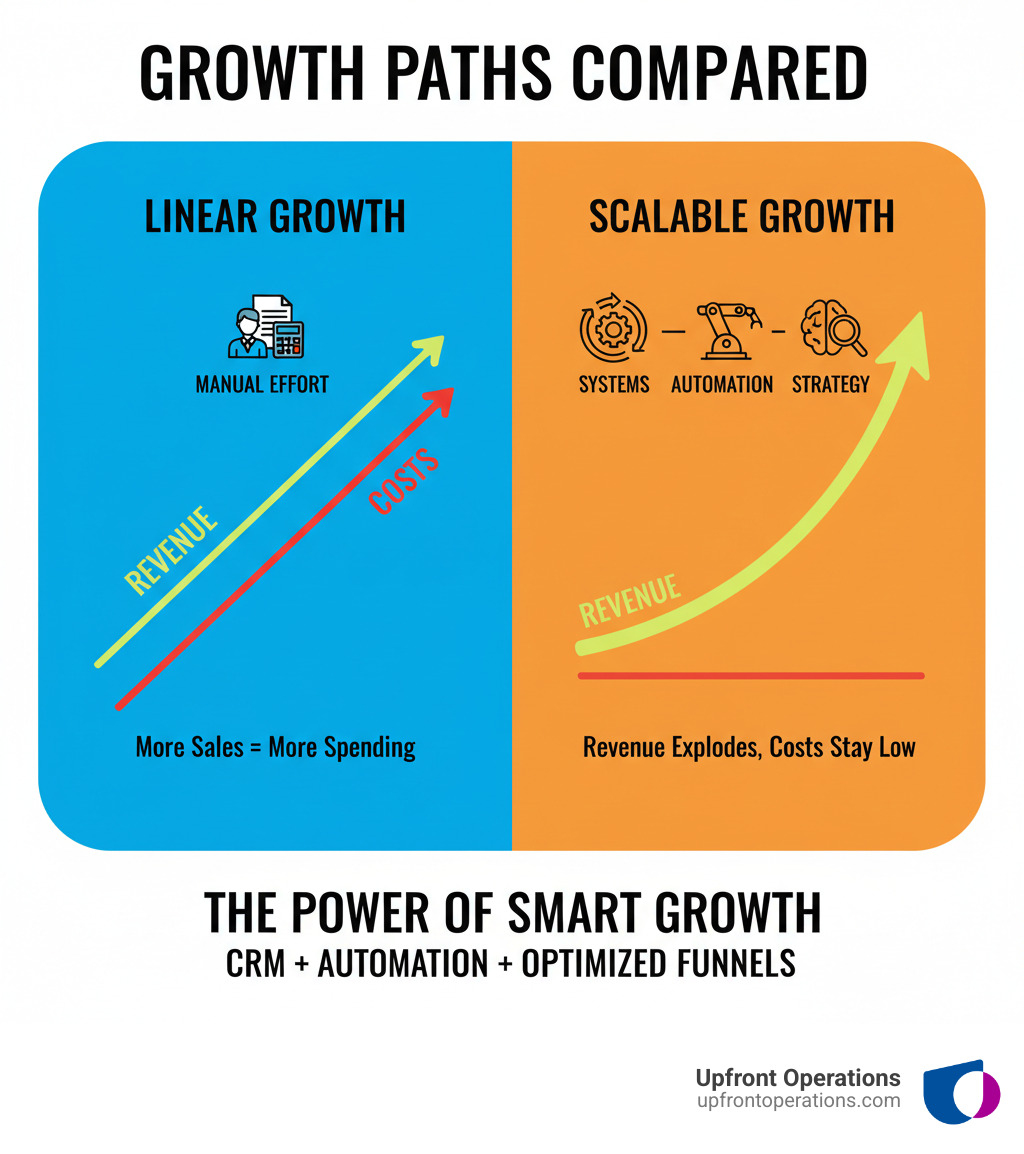
Growing a business isn't the same as scaling one. Growth often means adding resources linearly—more people, more overhead. Scaling means building systems that let you increase revenue without proportionally increasing costs. While 65% of small businesses report being profitable, many struggle to scale. The difference is a deliberate growth strategy.
Most business owners face the same obstacles: manual tasks, inconsistent follow-ups, and a lack of clear systems. The answer isn't working harder—it's working smarter with the right frameworks, tools, and on-demand expertise. The companies that grow fastest invest in scalable systems early, automate repetitive tasks, and obsess over their customer's journey. They use data, not guesses, and know when to bring in expert support for CRM optimization or automated lead nurturing.
This guide walks you through actionable strategies to accelerate your growth, from nailing your operational foundation to strategic expansion.
I'm Ryan T. Murphy, founder of UpfrontOps. Over the past 12 years, I've helped dozens of companies grow faster by streamlining their sales operations and building systems that turn leads into revenue. I've seen what separates businesses that scale from those that stall, and this guide shares what works.
You can't build a skyscraper on a shaky foundation. Before you try to grow business faster, ensure your core operations can handle the weight of success. Getting your internal house in order—solid planning, smart goals, scalable tech, and a growth-ready team—is what separates businesses that scale smoothly from those that collapse.
You can't hit a target you can't see. Ongoing market research helps you understand customer needs, spot competitor weaknesses, and find "white space" where your solution fits perfectly. Since 81% of shoppers conduct research online before buying, your customers are already looking for answers. Good research answers three questions: What problems are we solving? Who are we solving them for? And how can we do it better? Without these answers, your growth efforts are just guesswork.
"We want to grow" is a wish, not a goal. To grow business faster, you need goals that are Specific, Measurable, Achievable, Relevant, and Time-bound (SMART). Instead of "increase sales," try "increase qualified leads by 20% in Q3 by optimizing our lead nurturing workflows." This gives you a concrete target. A tactical plan should support your goals with key performance indicators (KPIs), responsibilities, and timelines. Shockingly, nearly half of businesses do digital marketing with no clear strategy. A well-defined plan ensures everyone is aligned and moving in the same direction.
If your systems can't scale, your business can't scale. You need technology that can handle ten times your current volume without ten times the manual effort. This means investing in a solid CRM system, clean accounting systems, and automation tools. For small businesses, this can start with on-demand essentials like an on-demand business website that converts or a professional business email that builds credibility. As you grow, you'll need more sophisticated systems for CRM management and lead nurturing. Automation is a force multiplier: it boosts efficiency, improves accuracy, and reduces costs, allowing you to handle expansion without burning out your team.
Your technology is important, but your people are everything. To grow business faster, build a growth-oriented culture by hiring people who share your values and bring fresh perspectives. Invest in employee training and leadership development to ensure your team can handle new challenges. Clear communication is non-negotiable; everyone must understand the strategic objectives and their role in achieving them. Finally, cultivate agility and adaptability. The companies that thrive can respond quickly to market changes, test new ideas, and adjust course based on data.
With a solid foundation, it's time to build a sales and marketing engine that magnetically pulls customers in and keeps them coming back. This is the heart of your growth strategy, converting interest into revenue. How well you engineer your customer acquisition and retention systems often determines whether you grow business faster or plateau.
Your sales funnel is the roadmap from "Who are you?" to "Take my money!" A high-converting funnel moves prospects through awareness, interest, decision, and purchase stages with intentional touchpoints. Are your landing pages compelling? Are you following up fast enough? This is where our on-demand pipeline optimization services make a difference. We plug leaks by setting up automated lead nurturing, creating high-converting sales assets, and building CRM workflows so no opportunity slips through. Responding to a lead in five minutes instead of five hours can skyrocket conversion rates.
It costs five times more to acquire a new customer than to keep an existing one. Yet many businesses neglect current customers. Smart businesses obsess over retention because loyal customers buy more, refer others, and provide invaluable feedback. The secret is making people feel valued through exceptional customer service and personalized communication. A solid CRM system helps you track preferences and purchase history to personalize every touchpoint. Customer loyalty programs and personalized offers transform one-time buyers into lifelong advocates, building a community of brand ambassadors who do your marketing for you.
Since 81% of shoppers research online, you need to provide the answers they're looking for. Great content—blog posts, videos, guides—attracts organic traffic, establishes you as a thought leader, and nurtures leads. But content needs SEO optimization to be found. This means targeting the right keywords, earning quality backlinks, and ensuring your site is technically sound. Furthermore, with 93% of buying decisions based on online reviews, your strategy must include encouraging and managing reviews. Social proof is often the deciding factor for potential customers.
A strong brand is more than a logo; it's a consistent promise you make to your customers. Brand consistency across your website, emails, and social media builds recognition and trust, making you the obvious choice. But you can't build a brand in isolation. Strategic networking and partnerships open doors that marketing alone can't. Collaborating with complementary businesses that serve the same audience expands your reach exponentially. These strategic partnerships, like co-marketing campaigns or referral arrangements, are force multipliers that help you reach more people, faster.
To grow business faster, you need a strategic roadmap. The Ansoff Matrix is a practical framework that helps you identify growth opportunities by looking at two dimensions: selling to existing vs. new markets, and offering existing vs. new products. Each quadrant represents a different strategic path with varying levels of risk and reward.

Market penetration is about selling more of what you already have to your existing market. It's the lowest-risk strategy because you're on familiar turf. The goal is to increase your market share by pulling customers from competitors or encouraging existing customers to buy more. This might involve adjusting prices, ramping up promotions, or improving customer service. According to McKinsey, 80% of growth often comes from maximizing core business accounts, proving that the fastest path to growth is often better serving the customers you already have. Starbucks did this by saturating markets and using a rewards program to build daily habits.
This strategy involves creating new offerings for the customers you already have. It's a smart move because you already understand their needs. This could mean adding new features based on feedback or introducing complementary services. For example, if you get an on-demand business website, you might later need SEO optimization or automated lead capture. This approach increases customer lifetime value without high acquisition costs. Our pipeline optimization services can help identify which customers are ready for an upsell and automate the outreach.
Market expansion means taking your proven products and introducing them to new audiences, whether a new geographic region or a different customer segment. Before you jump in, do your homework: Is there real demand? Can you handle the operational complexity? The upside can be massive, but it requires careful planning. Netflix's expansion into India is a perfect example; they adapted their pricing and content for a new market with millions of potential subscribers. This requires scalable systems, like a professional business email that maintains brand consistency across regions.
Diversification is the high-risk, high-reward quadrant: introducing new products into new markets. The key to de-risking this strategy is leveraging strategic partnerships. Co-marketing with complementary businesses lets you tap into their audience. For example, a marketing agency could partner with our sales operations support to offer a complete growth solution. Amazon's launch of AWS is the gold standard for diversification, turning an internal capability into a new, dominant business. For most, diversification involves smaller, calculated bets that leverage complementary strengths to enter new territory with less risk.
Technology is the difference between businesses that grow business faster and those left behind. Winning companies use automation to free up their teams, leverage data for smarter decisions, and stay agile enough to pivot when the market shifts.
Gut instinct gets you started, but data takes you to the next level. The big data analytics market hit $274.3 billion in 2022 because data-driven decisions lead to better performance. Data shows what's actually happening: how customers behave, what makes them buy, and where they drop off. Even free tools like Google Analytics provide actionable intelligence on traffic sources and conversions. Businesses that grow faster constantly ask, "What does the data tell us?" to make sharper decisions.
If you're still doing manual follow-ups and tracking deals in spreadsheets, you're wasting time. Automation frees you to focus on high-value interactions. Marketing automation handles email campaigns and lead nurturing, while sales automation ensures no lead falls through the cracks with on-demand services like automated follow-up workflows. The result is improved efficiency and scalability. But automation needs validation. A/B testing—comparing two versions of an email or landing page—helps you find what works best. This combination of automation and continuous testing creates a self-improving growth engine.
You can't manage what you don't measure. To grow business faster, track the KPIs that matter: revenue growth, Customer Acquisition Cost (CAC), and Customer Lifetime Value (CLV). If your CLV is higher than your CAC, you have a sustainable model. But measuring isn't enough; you must act on what you learn. Stay agile and adaptable, ready to pivot your strategy based on data. This iterative approach—measure, analyze, refine, repeat—is what separates companies that scale from those that stagnate.
"Growth hacking" sounds appealing, but chasing growth at any cost is a recipe for disaster. Sacrificing customer satisfaction for vanity metrics or using shady SEO tactics can destroy user trust and lead to long-term problems. As McKinsey's research on growth strategies shows, sustainable growth requires a commitment to long-term strategies and genuine innovation. The real path to growth is building solid systems, using technology wisely, and delivering real value to your customers.
The Ansoff Matrix provides a proven framework. The four core strategies are:
Beyond these, Strategic Partnerships can dramatically accelerate growth by combining resources and market access. The framework forces a deliberate, strategic choice about where to focus your energy.
A robust sales funnel is essential to grow business faster. First, map the customer journey to understand their questions and pain points. Next, attract leads with content, SEO, and ads. The critical step is nurturing those leads. Implementing CRM systems and automation is key; our on-demand automated follow-up workflows are designed to do this systematically. Finally, optimize every stage for conversion by refining landing pages and sales processes. Our pipeline optimization services help plug leaks and create a predictable system for customer acquisition.
Markets don't stand still. Technology evolves, competitors emerge, and customer preferences change. Agility and adaptability are survival skills. An agile business can quickly pivot its strategy, test new ideas with minimal risk, and respond to opportunities and threats. This flexibility is what separates businesses that thrive from those that merely survive. The companies that grow business faster aren't the ones with a perfect plan; they're the ones that can adjust course quickly based on real-world feedback and data.
To grow business faster, you must build a foundation that supports real, sustainable expansion. This isn't about chasing trends; it's about a disciplined approach: solid research, a powerful sales and marketing engine, a clear growth strategy, and smart use of technology. Growth is an ongoing cycle of planning, testing, measuring, and refining.
The businesses that scale successfully stay agile, invest in systems early, and bring in expert support when they need it—whether for CRM management, automated follow-up workflows, or pipeline optimization. The goal is to build something resilient and scalable that creates lasting value.
If you're ready to stop patching together your sales operations and start implementing these strategies with expert support, we can help. At Upfront Operations, we deliver game-changing sales operations support on-demand. We offer everything from essential microservices like professional business websites and business email for solopreneurs to elite fractional expertise for larger companies. Learn more about us and explore our flexible pricing designed to fit exactly what you need. Let's turn your ambition into measurable achievement.