Clock Icon - Technology Webflow Template
10
min read

From Keywords to Conversions: Setting Up an SEO Marketing Campaign

Learn how to setup seo marketing campaign from scratch. Master keyword research, content, link building, and tracking for ...

Why Your Website Isn't Getting Found (And How to Fix It)

An effective SEO marketing campaign starts with a clear plan: 1) Define SMART goals, 2) Conduct keyword and technical audits, and 3) Create optimized content, build backlinks, and track performance. Most campaigns show initial movement in 4-6 weeks and significant results in 6-12 months.

You know your product is valuable, but if you're not on page one of Google, you're invisible to the 89.62% of customers searching there. The problem isn't that SEO is impossible, but that most businesses treat it like a guessing game. This guide provides a systematic approach to how to setup seo marketing campaign that drives real business outcomes.

I'm Ryan T. Murphy, founder of UpfrontOps. Over the past 12 years, I've helped 32 companies 10X their website traffic by implementing the framework you're about to learn. We use clean data and on-demand expertise to turn search visibility into actual conversions.
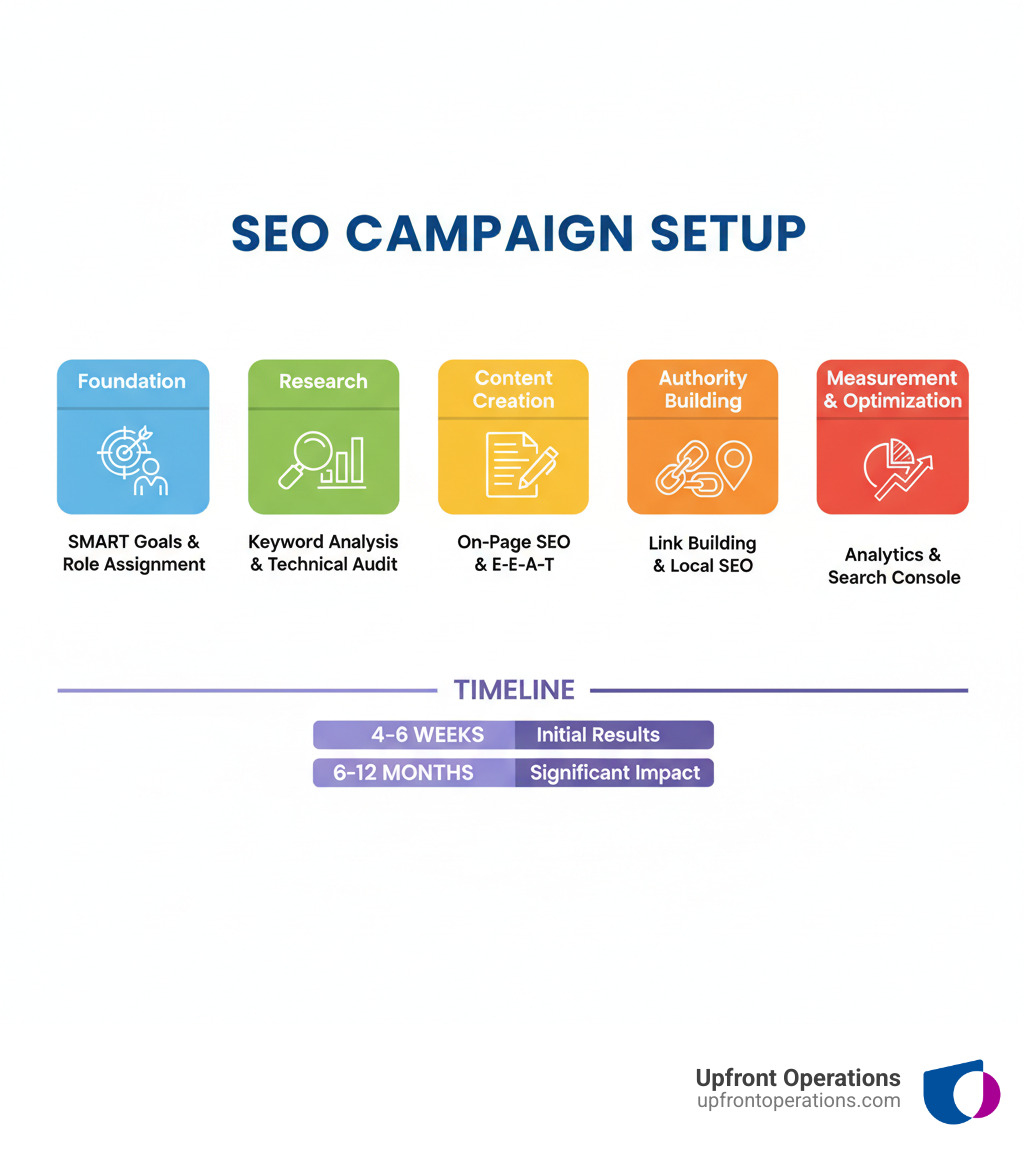
Infographic showing the 5 phases of setting up an SEO marketing campaign: Phase 1 - Foundation with SMART goals and role assignment, Phase 2 - Research through keyword analysis and technical audits, Phase 3 - Content creation with on-page optimization and E-E-A-T principles, Phase 4 - Authority building via link building and local SEO setup, Phase 5 - Measurement and optimization using Google Analytics and Search Console with typical timeline of 4-6 weeks for initial results and 6-12 months for significant impact - how to setup seo marketing campaign infographic

Phase 1: Laying the Foundation with Goals and Strategy

A team collaborating on a whiteboard with SMART goals - how to setup seo marketing campaign

Most SEO campaigns fail from a lack of strategy. This foundational phase of how to setup seo marketing campaign ensures you know what you're trying to achieve and who will do the work.

Defining and Setting SMART Campaign Goals

Vague goals like "more traffic" lead to vague results. Use SMART goals: Specific, Measurable, Attainable, Relevant, and Time-bound.

Examples:

  • Increase organic traffic by 20% within 6 months.
  • Rank on page 1 for 5 target keywords by the end of Q3.
  • Generate 50 qualified leads per month from organic search within the next quarter.

These goals define your Key Performance Indicators (KPIs) and align everyone on what success looks like.

Assigning Roles and Responsibilities

An effective campaign needs an SEO Specialist, Content Writer, and Web Developer. But you don't need a full-time team. Upfront Operations was built to solve this. Instead of expensive retainers, you can access on-demand expertise exactly when you need it.

Need a technical audit or your initial keyword research done? A fractional SEO expert can provide a roadmap. Need a solid foundation? Our website setup service ensures you start right. This on-demand model lets you match the right expertise to each task without paying for overhead.

Phase 2: The Core Research and Auditing Phase

A keyword research tool interface like Semrush or Ahrefs - how to setup seo marketing campaign

With goals set, it's time to gather intelligence. This research phase is about making decisions based on data, not guesses.

How to Conduct Effective Keyword Research for an SEO Campaign

Keyword research reveals the language your customers use.

  • Start with Seed Keywords: Broad terms describing your business (e.g., "sales operations," "CRM management").
  • Expand to Long-tail Keywords: More specific, higher-intent phrases (e.g., "how to optimize sales pipeline for B2B startups"). They have lower volume but higher conversion rates.
  • Analyze Competitors: Use tools like Ahrefs or Semrush to find keywords your rivals rank for. A Keyword Gap Analysis shows terms they rank for that you don't—your quick wins. For budget-conscious teams, Google Keyword Planner is a great starting point.

Performing a Baseline Technical SEO Audit

A technical audit ensures search engines can find and understand your site. Check these core elements:

  • Crawlability & Indexability: Can Google access and index your pages? Use Google Search Console to check.
  • Site Speed: Slow sites lose visitors and rank lower. Compress images and minify code for quick improvements.
  • Mobile-friendliness: With mobile-first indexing, a non-responsive site is a non-starter.
  • URL Structure: Use clean, descriptive URLs (e.g., /services/crm-management, not /?p=123).
  • XML Sitemap: Ensure you have one to help search engines find all your content.
  • Broken Links & Duplicate Content: Fix 404 errors and consolidate duplicate pages to protect user experience and ranking power. For a complete checklist, see Google's SEO Starter Guide.

Analyzing User Intent and the Competitive Landscape

Keywords tell you what people search; intent tells you why.

  • Intent Types: Is the searcher looking for information (Informational), a specific site (Navigational), comparing options (Commercial), or ready to buy (Transactional)?
  • SERP Analysis: Search your target keyword. The top results (blog posts, product pages, videos) show you what content format Google prefers. Analyze competitor strengths and weaknesses to find your opportunity to create something better.

Phase 3: Creating and Optimizing High-Impact Content

An illustration of the pillar-cluster content model - how to setup seo marketing campaign

With your research complete, it's time to create content that ranks and converts. This is about serving your audience and signaling quality to search engines.

Best Practices for Creating High-Quality, SEO-Optimized Content

Google rewards content that genuinely helps users.

  • Be Original and Comprehensive: Don't just rehash top results. Share unique insights, original data, or client case studies. Answer the user's question so thoroughly they don't need to go elsewhere.
  • Prioritize Readability: Use short sentences, bullet points, and visuals. A wall of text causes users to bounce.
  • Optimize On-Page Elements:
    • Title Tags: Keep under 60 characters with the primary keyword near the front.
    • Meta Descriptions: Write a compelling ~105 character summary to boost click-through rates.
    • Headings (H1, H2, H3): Use them to structure content logically for readers and search engines.
    • Keyword Integration: Weave keywords and related terms naturally into your text. If it feels forced, it is.

For businesses needing help, Upfront Operations provides on-demand content strategy and copywriting support to fill these gaps without hiring a full-time team.

The Role of E-E-A-T and Internal Linking

Google uses E-E-A-T (Experience, Expertise, Authoritativeness, Trustworthiness) to evaluate content quality.

  • Show, Don't Just Tell: Demonstrate Experience with real examples. Prove Expertise with deep knowledge. Build Authoritativeness by earning links and citations. Establish Trustworthiness with accurate information and transparency.

Internal Linking is a powerful, underused tactic. It guides users and search engines through your site.

  • Use Descriptive Anchor Text: Link with phrases like "our guide to CRM management" instead of "click here."
  • Build a Pillar-Cluster Model: Link specific "cluster" pages (like a post on keyword research) to a broad "pillar" page (like this guide).
  • Distribute Authority: Links from strong pages pass ranking power to weaker ones.

If you need help structuring your site, our on-demand website services can build a content architecture designed for SEO success.

A Google Business Profile listing on a map - how to setup seo marketing campaign

Great content needs a megaphone. Off-page SEO builds your reputation by earning signals of trust from the outside world, primarily through backlinks and local citations.

A backlink from another site is a vote of confidence. Quality trumps quantity—one link from a relevant, authoritative site is worth more than 100 from random blogs. While 41% of marketers find it the hardest part of SEO, it's non-negotiable for ranking.

  • Competitor Backlink Analysis: Use Ahrefs or Semrush to see who links to your competitors and target those same sites.
  • Guest Posting: Write valuable articles for reputable industry blogs to earn a link back.
  • Broken Link Building: Find broken links on other sites and suggest your content as a replacement.
  • Create Linkable Assets: Develop original research, free tools, or comprehensive guides that people naturally want to share.

How to Setup an SEO Marketing Campaign for Local Businesses

For businesses serving a specific area, local SEO is critical. 46% of Google searches are for local information.

  • Claim Your Profiles: Start with your Google Business Profile. It's free and essential for appearing in Google Maps. Also claim your listings on Bing Places and Apple Maps.
  • Ensure NAP Consistency: Your Name, Address, and Phone number (NAP) must be identical across all online directories (Yelp, Yellow Pages, etc.).
  • Encourage Customer Reviews: Positive reviews build trust and are a strong local ranking signal. 88% of mobile local searches result in a call or visit within 24 hours.
  • Create Localized Content: Target keywords for your service area, like "sales operations expert New York."

For small businesses, local SEO offers the fastest path to visibility. Upfront Operations provides essential microservices like professional website setup and business email configuration to build this foundation.
Phase 5: Tracking, Adapting to AI, and Avoiding Pitfalls

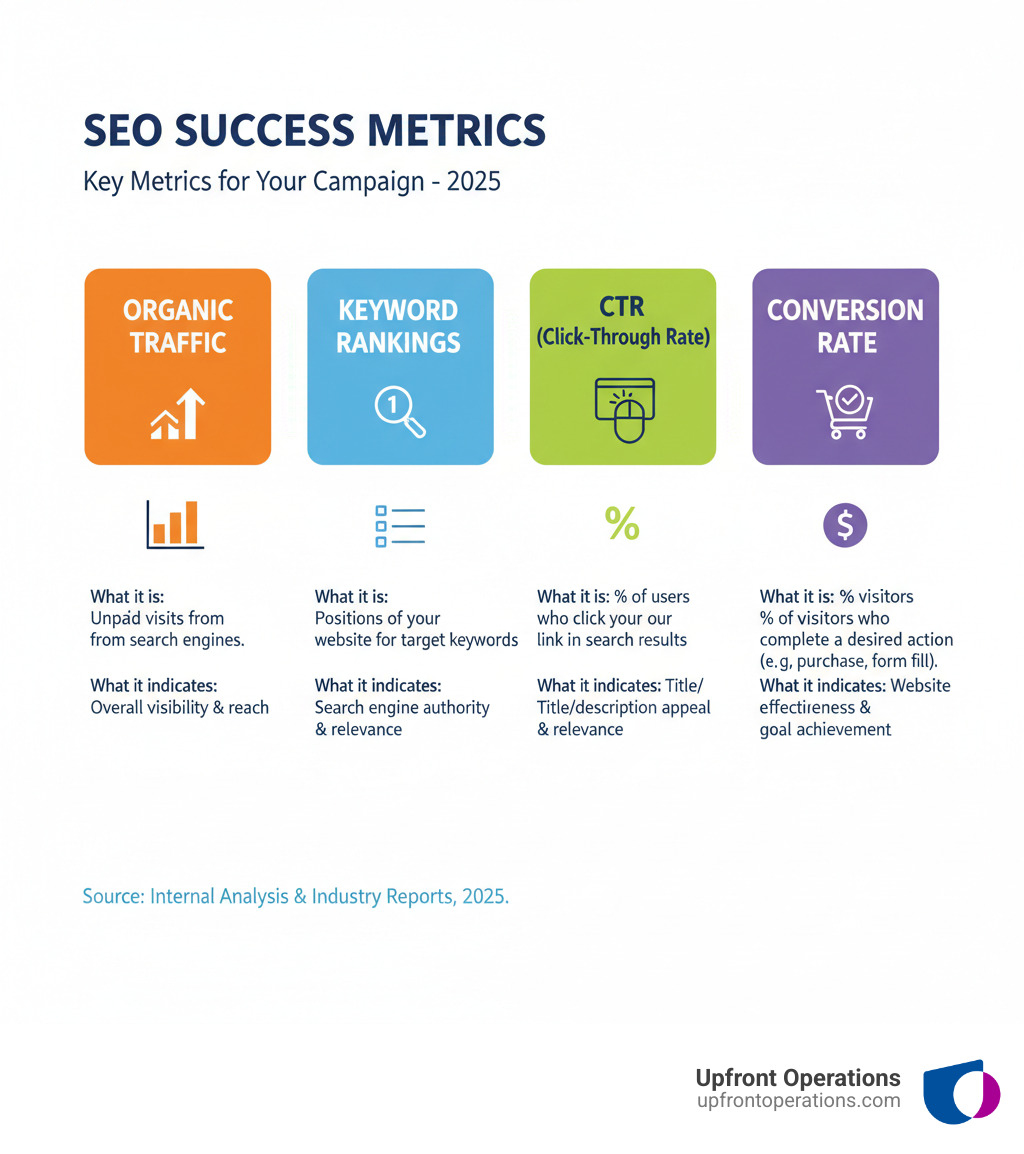
TABLE comparing key SEO metrics like Organic Traffic, Keyword Rankings, CTR, and Conversion Rate, explaining what each metric indicates - how to setup seo marketing campaign infographic

An SEO campaign doesn't end at launch. This phase is about monitoring, measuring, and refining your approach based on data.

Key Metrics to Measure Campaign Success

Track metrics that tie back to your SMART goals. Use Google Analytics 4 and Google Search Console to monitor:

  • Keyword Rankings: Are you moving up in search results for your target terms?
  • Organic Traffic: How many visitors are coming from search engines?
  • Click-Through Rate (CTR): What percentage of people who see your site in search results actually click it?
  • Conversion Rate: Are visitors taking the desired action (e.g., filling out a form)? This is the metric that ties SEO to revenue.
  • Backlinks Acquired: Are you earning new, high-quality links?
  • SEO ROI: Is the revenue generated from organic search justifying the investment?

If you need help with analytics, our on-demand experts can ensure your tracking is set up correctly from day one.

The Impact of AI and Common SEO Mistakes to Avoid

The rise of AI in search (AIO) means we must adapt. Structure content with clear headings, FAQ sections, and concise summaries that AI can easily feature. However, your unique E-E-A-T (Experience, Expertise, Authoritativeness, Trustworthiness) is your ultimate advantage, as AI cannot replicate real-world case studies or proprietary data.

Avoid these common pitfalls:

  • Neglecting Mobile Optimization: Over half of searches are mobile. A poor mobile experience is fatal.
  • Ignoring Page Speed: Users and Google demand fast-loading pages. Optimize images and code.
  • Poor URL Structure: Use clean, descriptive URLs, not cryptic ones.
  • Keyword Stuffing: This outdated tactic will harm your rankings. Write for humans.
  • Forgetting Analytics: If you don't track performance, you can't improve it.

Frequently Asked Questions about SEO Campaigns

What is the difference between an SEO campaign and an SEO strategy?

An SEO strategy is your long-term roadmap for growing search visibility. An SEO campaign is a focused, time-bound project within that strategy, designed to achieve a specific goal, like ranking for a new product or targeting a keyword group. The strategy is the destination; the campaign is a specific leg of the journey.

How long does it take to see results from an SEO campaign?

It depends on competition, your site's authority, and resources. Generally, you'll see initial movement in 4-6 weeks (e.g., ranking improvements). However, significant, stable results typically take 6-12 months. SEO is a marathon, not a sprint, but the results compound over time, driving traffic long after the initial work is done.

What is E-E-A-T and why does it matter?

E-E-A-T stands for Experience, Expertise, Authoritativeness, and Trustworthiness. It's Google's framework for evaluating content quality.

  • Experience: Show you've actually done what you're writing about.
  • Expertise: Demonstrate deep, credible knowledge on the topic.
  • Authoritativeness: Be recognized as a go-to resource in your field.
  • Trustworthiness: Be accurate, transparent, and secure.

Focusing on E-E-A-T aligns your content with Google's goal of providing helpful, reliable results, which is the foundation of sustainable SEO success.

Boost Your SEO and Sales Pipeline

You now have the complete roadmap for how to setup seo marketing campaign that drives real business results. From goals and research to content and authority, this framework moves you from invisible to indispensable in search.

But SEO is a long-term investment, not a quick fix. The 6-12 months it takes to see significant results is the start of compounding returns that can fuel your growth for years.

At Upfront Operations, we've used this exact system to help 32 companies 10X their traffic and shorten sales cycles. We deliver on-demand services that traditional agencies can't match. Whether you're a solopreneur needing a professional website setup or a growing company seeking fractional sales operations experts to optimize your CRM and pipeline, we provide exactly what you need, when you need it.

Your ideal customers are searching right now. Let's turn your visibility into conversions.

Get a quote for your project

Ask an In-House Growth Expert (Not a Sales Call)

Nice! Next you'll be directed to the page where you can pick a time that works best for you.

If you are not available, you can schedule another time by visiting this link
Oops! Something went wrong while submitting the form.

Ryan T. Murphy

Managing Partner, Sr. Sales Operations Manager

With over a decade in CRM management and marketing operations, Ryan has driven growth for 32 businesses from startups to global enterprises with 12,000+ employees.

From Keywords to Conversions: Setting Up an SEO Marketing Campaign