March 11, 2026

10
min read
Unlocking Your Rivals' Secrets: A Guide to Social Media Competitor Research
Master social media competitor research to differentiate, identify trends, and beat rivals. Get actionable insights now!
Master social media competitor research to differentiate, identify trends, and beat rivals. Get actionable insights now!

In the busy streets of New York, we know that if you aren't moving forward, you're being left behind. Social media competitor research is essentially your brand’s "intelligence agency." It isn't just about "spying" on what the shop next door is doing; it’s about understanding the entire ecosystem of your industry.
When we dive into this research, we are looking for brand differentiation. If everyone in your niche is posting dry, corporate updates on LinkedIn, and you notice a rival gaining massive traction with behind-the-scenes video content, you’ve just found a gap. You’ve identified a way to stand out.
Why does this matter so much? Because 96% of CI professionals say social media is a valuable source of intel. It provides a window into:
Conducting a thorough analysis requires a structured approach. We can't just scroll through Instagram for twenty minutes and call it "research" (tempting as that is!). We need to categorize who we are looking at to get a balanced view.
| Competitor Type | Definition | Example for a NYC Coffee Shop |
|---|---|---|
| Direct | Offers the same product to the same audience. | The local artisanal cafe two blocks away. |
| Indirect | Offers a different product that solves the same need. | A high-end grocery store with a self-serve coffee bar. |
| Aspirational | Industry leaders with massive reach and "gold standard" content. | Starbucks or Blue Bottle Coffee. |
Our step-by-step guide involves profile auditing (looking at their bios, links, and branding consistency) and content mapping (categorizing their last 20 posts to see what themes they hit).
If you find that your internal team is overwhelmed just trying to keep up with your own posting, let alone researching others, we can help. Upfront Operations provides on-demand sales and marketing support that can handle the heavy lifting of CRM management and data organization, so you can focus on the high-level strategy.
To find your true rivals, start with a simple keyword search. If you were a customer looking for your service in New York, what would you type into Google or the TikTok search bar? The brands that consistently appear in the top spots are your primary digital competitors.
Don't ignore audience overlap. Tools like Facebook's Audience Insights or even just looking at "Suggested Accounts" on Instagram can reveal which other brands your followers are interested in. Sometimes, your biggest rival isn't the person selling the same widget, but the person capturing the same "mindshare" of your target demographic.
Content is where the rubber meets the road. We need to look at content pillars—the 3 to 5 main topics your competitor talks about. Are they focused on education, entertainment, or pure promotion?
We also track posting frequency. Does the rival post three times a day or three times a week? More importantly, look at the video vs. static ratio. Research shows that 53% of marketers consider changing content formats a significant challenge. If your competitors are struggling to produce Reels or Stories, and you can nail that format, you win the engagement battle.
Data doesn't lie, but it can be overwhelming. To make data-driven decisions, we focus on performance benchmarking. You don't need a PhD in data science to do this; you just need the right focus.
If you are worried about the cost of high-end analytics, you can discover our transparent pricing for microservices that help small businesses get professional-grade results without the "big agency" price tag.
When we perform social media competitor research, these are the non-negotiable metrics:
Social listening is the "secret sauce." It involves monitoring brand mentions even when the brand isn't tagged. This provides unfiltered feedback from real customers.
Tools like Sprout Social, Rival IQ, and BuzzSumo can automate this. For example, you might find through social listening that customers love a competitor's product but hate their shipping times in the New York area. That is a goldmine for your marketing: "Fast, Local NYC Delivery" becomes your new headline.
Once you have the data, you need to make sense of it. We use a SWOT matrix to turn research into a roadmap.
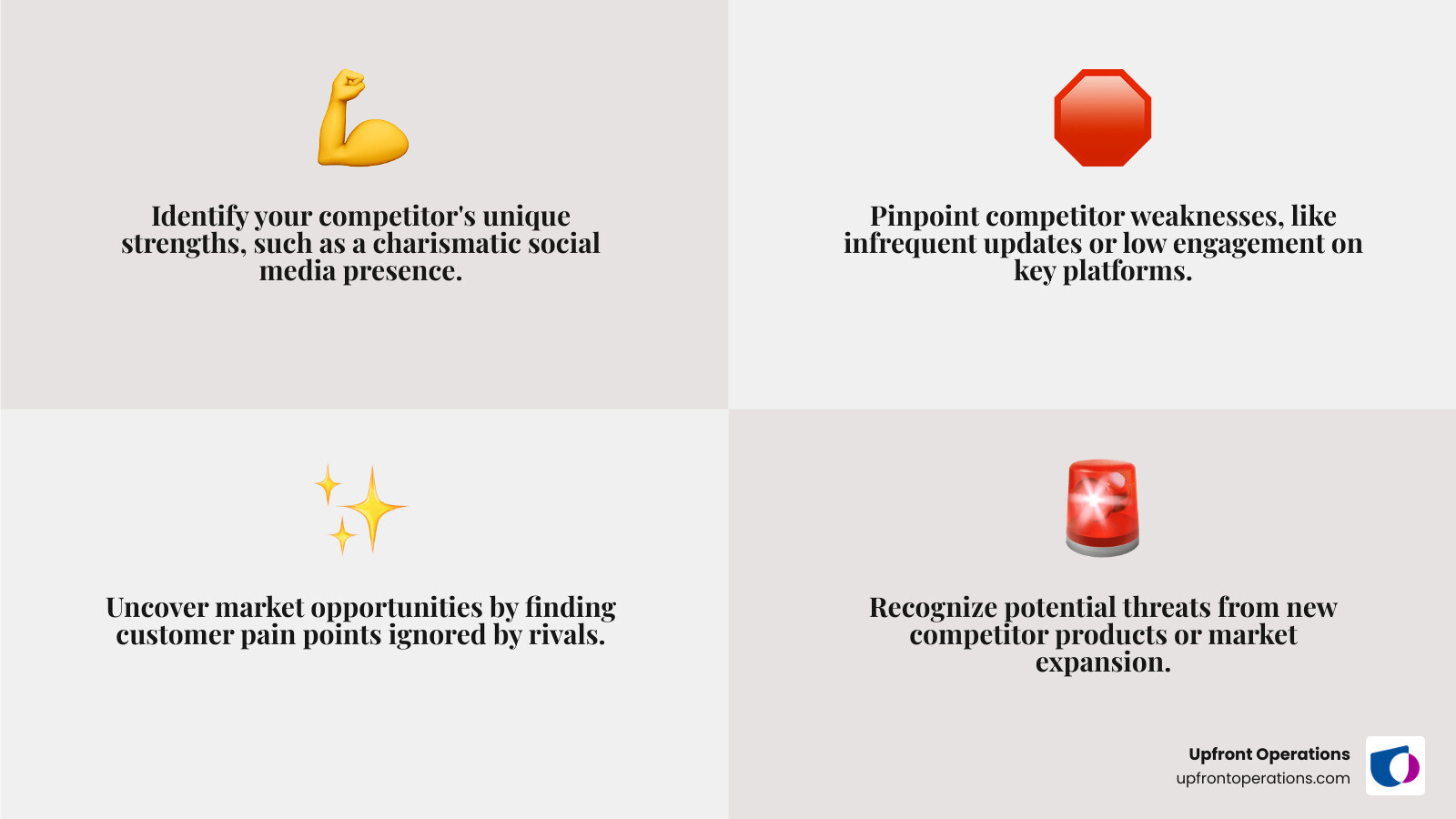
This strategic summary allows us to allocate resources effectively. Instead of trying to be everywhere, you can double down on the platforms where you have the highest chance of winning.
The final step is strategy refinement. Competitor research isn't a "one and done" task; it's a cycle. We recommend revisiting your full analysis at least quarterly.
Apply your insights by:
At Upfront Operations, our mission is to simplify these complex processes. We believe that even a solopreneur should have access to elite-level insights. Learn more about our mission and how we help businesses in New York and beyond scale with momentum.
We suggest a deep dive every quarter. However, you should do "light" monitoring weekly—just a quick check of their top-performing posts to see if the "vibe" of the industry is shifting.
Analysis is the broad look at their strategy and "vibe." Benchmarking is the specific, numerical comparison of KPIs (like "Our engagement is 2.1%, theirs is 3.5%").
Absolutely! You can manually track metrics in a Google Sheet, use platform-native analytics (like Instagram Insights), and use Google Trends to see search interest. It just takes more time.
Social media competitor research is the difference between shouting into the void and having a targeted conversation with your future customers. By understanding what your rivals are doing, you can stop guessing and start growing.
At Upfront Operations, we specialize in the "behind-the-scenes" work that makes this growth possible. Whether you need a new website setup, professional business email services, or elite CRM management to handle the leads your social media generates, we are here to help.
Don't let your rivals keep their secrets. Use this guide to open up them, and then supercharge your growth with Upfront Operations to turn those insights into revenue. Together, we’ll make sure your brand isn't just part of the conversation—it's leading it.