April 13, 2026

10
min read
Sales Superpowers: Your Guide to Consistent Wins and Strategic Success
Unlock consistent sales performance: Master pipelines, cadences, psychology & tech for predictable revenue growth and stra...
Unlock consistent sales performance: Master pipelines, cadences, psychology & tech for predictable revenue growth and stra...

Consistent sales performance is the difference between a business that grows steadily and one that lurches between feast and famine. Here's a quick summary of how to achieve it:
Most sales teams don't struggle because they lack talent. They struggle because they lack systems. One rep closes deals instinctively. Another follows their gut on follow-up timing. A third uses messaging that hasn't been updated in two years. The result? Revenue that's impossible to predict and growth that stalls just when it should accelerate.
According to McKinsey, companies that experience inconsistency challenges often burn unnecessary resources without actually improving the customer journey. Meanwhile, HubSpot research shows that 72% of companies that regularly analyze their sales performance achieve stronger year-over-year revenue growth. The gap between those two groups isn't luck — it's process.
I'm Ryan T. Murphy, founder of UpfrontOps, and over the past 12 years I've helped 32 companies build the systems, clean data, and smart automation needed to drive consistent sales performance at scale. In this guide, I'll walk you through exactly how to do the same.
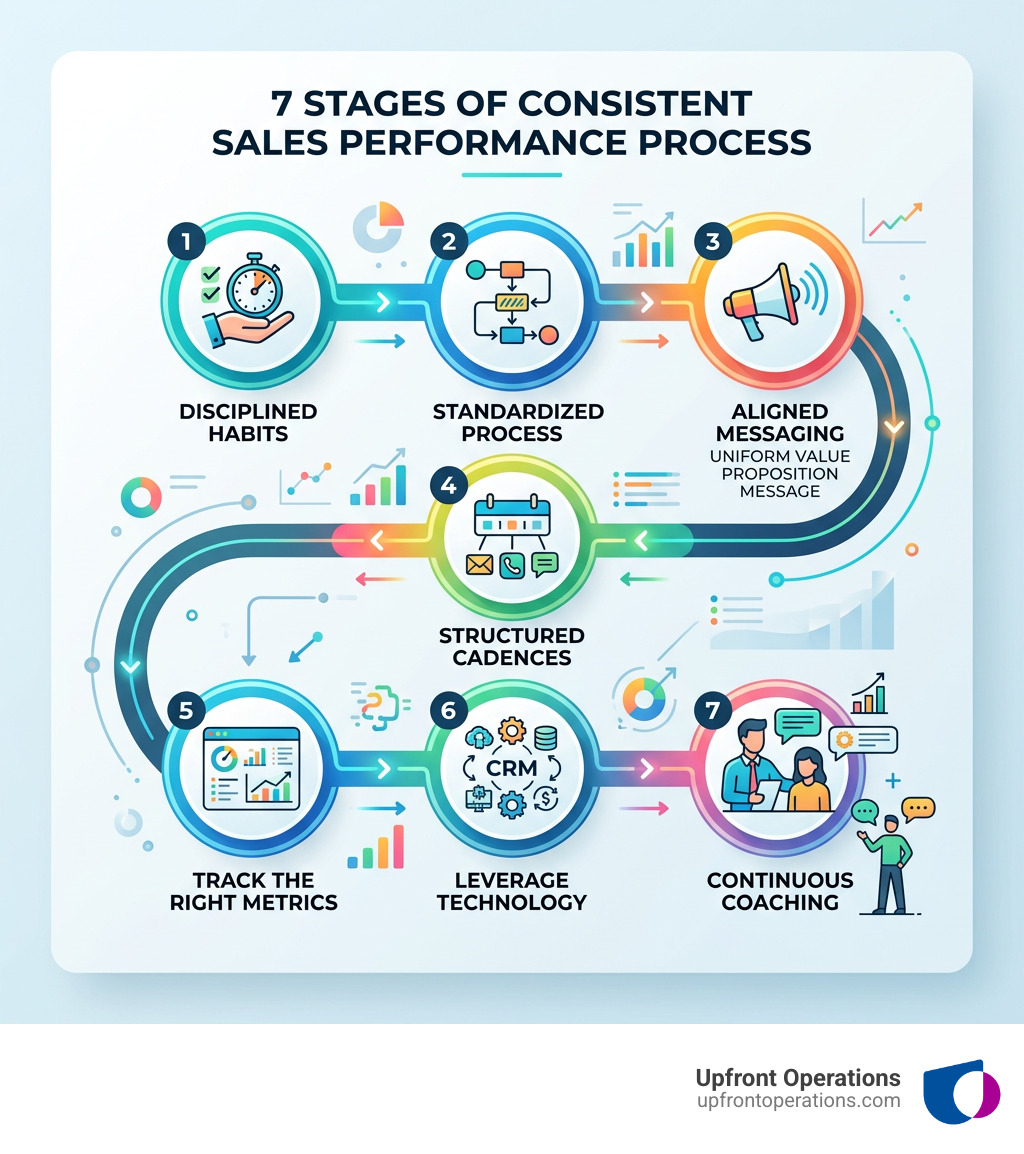
When we talk about consistent sales performance, we aren’t just talking about hitting a number once. We are talking about the ability to repeat that success month after month, regardless of which rep is handling the lead. It’s about moving from "heroics"—where one superstar carries the whole team—to a "system" where the median rep performs like a top producer.
A healthy sales organization relies on pipeline coverage. Most world-class teams target roughly 3-4x pipeline coverage. This means if your goal is to close $1M, you need $3M to $4M in active, qualified opportunities. Without this buffer, any slip in win rates leads to a missed quarter.
Furthermore, McKinsey research on systematic sales engagement shows that teams deploying structured processes see 10-20% pipeline improvements through better lead prioritization. When your execution is consistent, your forecast stability improves. We look for a forecast stability index above 0.85, meaning there is less than 15% volatility between what you say you’ll close and what actually lands.
Consistency is often disrupted by factors both within and outside our control.
To manage what we measure, we have to look beyond just the final "closed-won" number. We need to monitor the health of the machine in real-time.
| Metric | Why It Matters for Consistency | Target Benchmark |
|---|---|---|
| Win Rate Stability | Signals if your positioning is holding up against competitors. | Variance of ±5% from baseline |
| Pipeline Variance | Measures how much your total pipeline fluctuates month-over-month. | Less than 20% variance |
| Stage Duration | Identifies bottlenecks; if a deal sits too long, it’s likely "dead." | Less than 30% variation in time-in-stage |
| Leading Indicators | Tracks daily behaviors (calls, emails) that create future revenue. | 100% adherence to "Cookbook" goals |
Discipline is the fuel that turns sales talent into consistent sales performance. It’s the difference between the "one-hit wonder" and the "Beatles" of sales. While talent gets you in the door, discipline keeps the door open.
One of the most effective ways to build this discipline is through a structured sales cadence. Research shows that most reps quit after the fourth or fifth touchpoint. However, it takes an average of 8 touches to even book a meeting. The "sweet spot" for modern outreach is 8-12 touchpoints spread over 17-21 days.
At Upfront Operations, we help businesses implement these sales operations services to ensure no lead falls through the cracks. By using a multichannel distribution—roughly 40-50% email, 20-30% phone, 15-25% LinkedIn, and 5-10% video—you maximize your chances of connecting with a prospect where they are most comfortable.
In the Sandler methodology, we refer to a "Cookbook." This is a literal recipe for success. It defines exactly how many daily outreach attempts, weekly meetings, and new referrals a rep needs to generate to hit their long-term goals.
By focusing on these leading indicators, reps gain a sense of control. You can't always control if a prospect says "yes," but you can 100% control how many times you pick up the phone. This approach also fosters equal business stature, where reps stop "chasing" and start acting as valued consultants who respect their own time as much as the prospect's.
Optimization is about removing friction. Salesforce research found that sellers spend only 28% of their time actually selling. The rest is eaten up by administrative tasks, searching for content, or manual CRM management.
By weaving your sales methodology directly into your CRM, you ensure that every rep follows the same protocol for qualification and discovery. This leads to better lead nurturing and more accurate data. When your process is repeatable, your results become predictable.
Even with the best process, consistent sales performance can stall if the "human element" is off. This includes both the message we send to the world and the internal narrative our reps tell themselves.
Consistency in messaging is a direct extension of your brand. If three different reps give three different value propositions, you erode brand trust. Customers expect us to understand their needs; in fact, 66% of buyers say this is a top expectation. When we align our messaging through standardized sales plays, we see an average 12% increase in win rates.
Many skilled salespeople stall because of limiting beliefs. They might think, "I don’t want to be pushy," or "Our price is too high for this market." These silent narratives act as a "belief barrier" that prevents them from taking the necessary actions for success.
Building rejection resilience is key. We teach reps that "bad news early is good news" because it allows them to stop wasting time on unqualified leads and move to the right 60% of prospects who actually need their help. Simple habits, like daily affirmation practices or reviewing past "wins," can help overwrite these negative scripts.
Sales enablement tools, like conversation intelligence, allow managers to review real-world interactions. When organizations deliver coaching based on these actual conversations, they are 46% more likely to see reps hit their quotas.
Encouraging peer-generated content is another superpower. When a top rep in New York records a successful pitch and shares it with the team, it builds a culture of collaborative learning. This isn't just about training; it's about making sure the "what to say" and "how to say it" is accessible to everyone in real-time.
To truly scale, sales cannot exist on an island. It must be perfectly aligned with marketing. When these two teams aren't in sync, the buyer gets "whiplash"—receiving one message from an ad and a completely different one from a salesperson.
Sales-marketing alignment starts with shared goals. Both teams should agree on the exact definition of a Marketing Qualified Lead (MQL) and the protocol for an SQL handoff. According to research, companies with aligned teams see a 36% boost in customer retention and a 65% jump in pipeline conversion.
You can learn more about our philosophy on team synergy on our about page, where we discuss how we bridge the gap between strategy and execution.
Automation should augment humans, not replace them. McKinsey found that about one-third of sales tasks can be automated. By automating task management, follow-up reminders, and data entry, you give your reps back the time they need to do what they do best: build relationships.
AI-assisted selling is now table stakes. Tools that can suggest the best "next step" or personalize an email based on LinkedIn activity allow reps to work smarter, not harder. This CRM optimization ensures that your data is clean and your insights are actionable.
Finally, consistency requires a culture of accountability. This doesn't mean "micromanagement"—it means everyone knowing what "good" looks like.
Often, the issue isn't a lack of skill but a lack of discipline or the presence of limiting beliefs. If a rep has a "record quarter" and then stops prospecting to focus on closing, they will naturally see a dip in the following months. Inconsistent activity always leads to inconsistent results.
Typically, if you start a new, disciplined cadence today, you will see your calendar fill up with meetings by month three. By month four, those meetings should start converting into consistent sales performance and closed revenue. It is a 90-to-120-day cycle for most B2B industries.
The industry standard is 3-4x quota. If your team's pipeline falls below 2.5x, it's a major red flag that you will miss your future revenue targets. Maintaining this ratio is the best way to ensure pipeline health.
Achieving consistent sales performance isn't about finding a "magic pill." It's about the relentless execution of the fundamentals. It’s about building a system where discipline, process, and technology work together to create a predictable path to growth.
At Upfront Operations, we specialize in helping businesses remove the guesswork from their sales process. Whether you need fractional sales operations to lead your team, a professional business email setup, or website optimization to capture more leads, we provide the on-demand microservices you need to scale.
Ready to turn your sales team into a predictable revenue engine? Check out our pricing to see how our on-demand support can help you achieve your next strategic win. Consistent success is just a system away.