April 7, 2026

10
min read
How to Improve Sales Team Performance in 30 Days
Boost sales team performance in 30 days: audit metrics, optimize pipelines, build culture, and scale with AI for rapid rev...
Boost sales team performance in 30 days: audit metrics, optimize pipelines, build culture, and scale with AI for rapid rev...

Sales team performance determines whether your business grows predictably or lurches from one quarter to the next hoping for a lucky break.
Here is a quick snapshot of what drives strong sales team performance:
| Factor | What It Means |
|---|---|
| Clear metrics | Track win rate, close rate, CLV, and quota attainment |
| Linked activities | Connect calls, emails, and meetings to real outcomes |
| Coaching culture | Regular feedback loops, not just annual reviews |
| Right tech stack | CRM, sales engagement tools, and AI-powered insights |
| Post-sale focus | Measure retention, churn, and expansion — not just closes |
The numbers make this impossible to ignore. Sales organizations with a high-performance culture achieve 19% higher quota attainment and 22% higher win rates than their peers. They are also three times more likely to be seen as a trusted partner by their clients.
Yet most mid-sized businesses are still running their sales operations on gut feel, inconsistent follow-up, and spreadsheets that nobody updates.
The result? Missed targets, burned-out reps, and revenue left on the table — every single quarter.
This 30-day guide gives you a practical, week-by-week roadmap to change that. No theory. No fluff. Just the specific actions that move the needle.
I'm Ryan T. Murphy, founder of UpfrontOps, and over the past 12 years I've helped 32 companies — from startups to 12,000-person firms — fix broken sales systems and unlock millions in new revenue by improving sales team performance through smarter automation, cleaner data, and better processes. Let's dig in.
Explore more about Sales team performance:
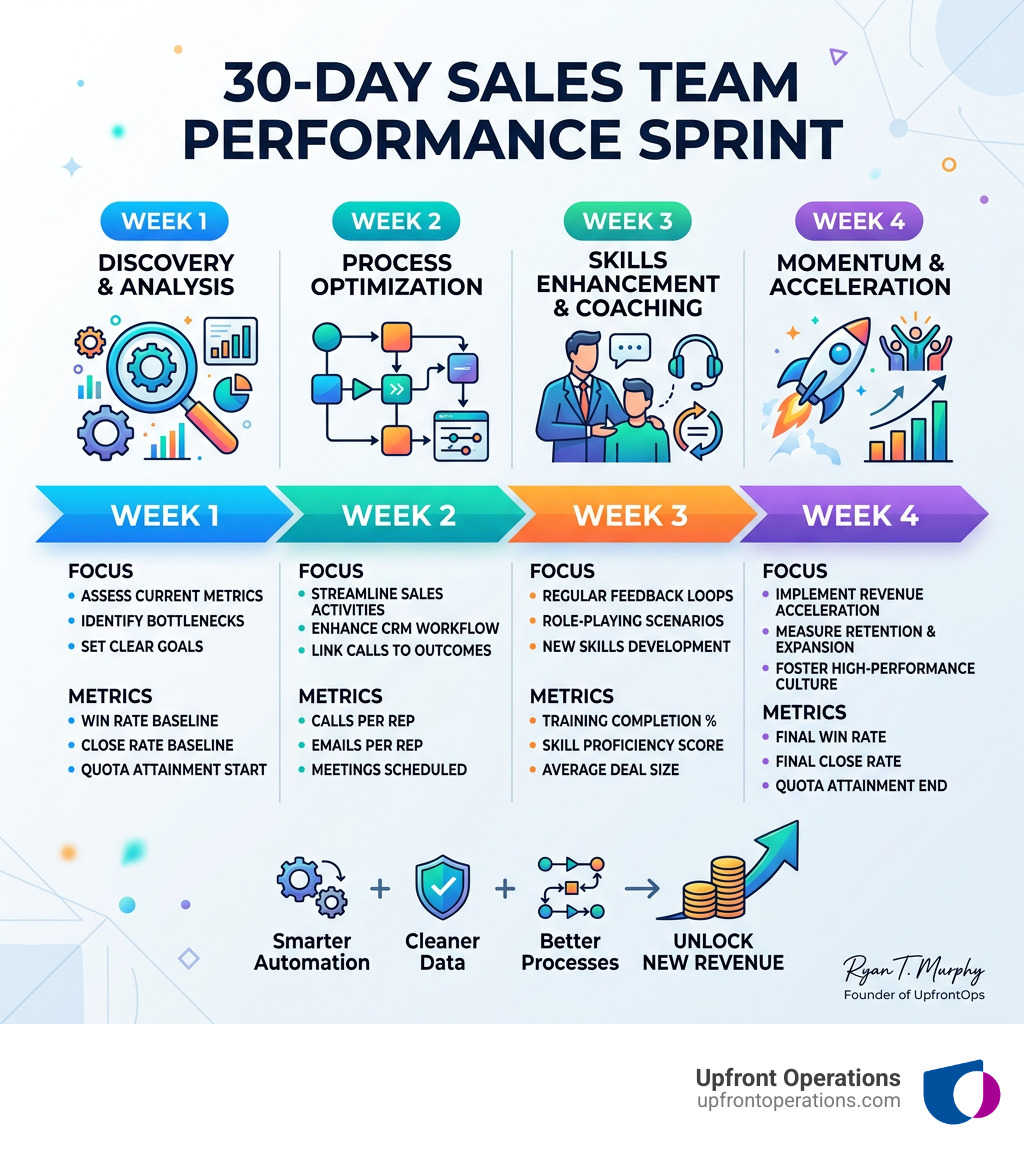
In our first week, we aren't trying to close more deals; we’re trying to understand why we aren't closing them already. Improving Sales team performance starts with a brutal, honest audit of your current data. If you’re running your organization on "vibes" and quarterly retrospectives, you’re playing checkers in a world of 4D chess.
We categorize our audit into four essential buckets:
If this sounds overwhelming, you don't have to overhaul your entire department overnight. At Upfront Operations, we provide on-demand sales operations services that can handle the heavy lifting of auditing your CRM and cleaning up your data so you can focus on leading your people.
While numbers like quota attainment and win rate (Wins / Total Closed Deals) are the bedrock of performance, they don't tell the whole story. A rep might hit their numbers but destroy the team spirit or leave customers with a bad taste in their mouths.
High-performing cultures focus on "remarkableness"—when customers mention a rep by name in surveys or referrals. We also look at customer sentiment. According to research on sales enablement, organizations that prioritize these qualitative "soft" skills see significantly lower regrettable turnover. Quantitative data tells you what happened; qualitative data tells you why.
A "leaky" pipeline is the silent killer of revenue. During this first week, we look for the "drop-off" points.
Common pipeline leaks often include inconsistent follow-up (48% of reps never follow up a second time!) and a lack of clear ICP (Ideal Customer Profile) alignment.
Now that we’ve audited the mess, Week 2 is about the math. To improve Sales team performance, you must move from lagging indicators (things that happened in the past, like revenue) to leading indicators (things that predict the future, like meetings booked).
| Metric Type | Examples | Why It Matters |
|---|---|---|
| Leading | Calls, Email Opens, Demos Scheduled | Predicts next month's revenue |
| Lagging | Monthly Revenue, Churn Rate, Quota Met | Tells you if your past strategy worked |
We also need to master the big three formulas:
Understanding these ratios allows you to set realistic targets. For example, if you know your average deal size is $20,000 and your win rate is 20%, you know exactly how many opportunities you need in the pipeline to hit a $1M goal. For more on how these numbers impact your bottom line, check out our pricing and ROI page.
One of the biggest mistakes we see is rewarding "busyness." A rep making 100 calls a day with zero meetings is less valuable than a rep making 20 targeted calls that result in 5 meetings.
We use the Activity-Objective-Result (AOR) framework:
If the activities aren't leading to the objectives, the "Result" will never happen. Persistence is key here—Forrester research shows that 80% of sales require at least five follow-up contacts, yet the vast majority of reps give up after two.
In 2025, if you aren't using AI, you’re falling behind. AI isn't just for chatbots; it’s for sentiment analysis (identifying if a prospect is actually interested based on their tone) and automated call summaries.
Imagine if your sales manager didn't have to listen to 40 hours of calls a week but instead received an AI-generated summary of every objection handled. This allows for "on-demand" coaching. At Upfront Operations, we specialize in on-demand CRM management and lead nurturing, using these advanced tools to ensure your pipeline stays healthy without adding more work to your plate.
By Week 3, the data is clean and the metrics are set. Now, we focus on the people. Sales team performance is a team sport. The "lone wolf" era is over; today’s buyers are more complex, involving more decision-makers than ever before.
A high-performance culture is built on:
If your leadership team is stretched thin, our fractional sales operations experts can step in to provide the high-level strategy and coaching frameworks usually reserved for Fortune 500 companies.
Coaching is not "pointing out what went wrong." It is a collaborative diagnostic process. We recommend the 5 Whys Analysis. If a rep missed their quota:
Now you have a solution (training) rather than just a complaint (missed quota).
Your compensation plan is your team's steering wheel. If you only reward new closes, don't be surprised when your reps ignore existing customers.
Avoid relying solely on generic salary benchmarks. Your territory, industry, and deal complexity are unique. Customizing your rewards ensures you don't lose your best people to a competitor for a few extra dollars.
In the final week, we ensure the engine is built for the long haul. A modern sales tech stack should reduce friction, not create it. If your CRM is so complex that reps spend two hours a day on data entry, your Sales team performance will suffer.
Essential tools include:
At Upfront Operations, we offer microservices to help you optimize your pipeline by integrating these tools seamlessly, ensuring your tech stack actually helps you sell more, faster.
True sales excellence doesn't end when the contract is signed. High-performing teams look at post-sale metrics:
Sustainable growth requires a balance. If you're only focused on the "short-term hit" of a new close, you'll eventually run out of leads. Building a referral loop through happy customers is the ultimate hack for Sales team performance.
It’s easy to burn out a sales team by demanding 110% effort every single day. We advocate for "workload protection." This means:
Even with a great plan, sales leaders often fall into traps. One of the biggest is Vanity Metrics. Having 10,000 LinkedIn followers or 500 "leads" means nothing if they don't convert to revenue. Be ruthless about what you measure.
Another pitfall is Laissez-faire Leadership. "I hire the best and get out of their way" is often an excuse for not providing the support and coaching reps actually need.
Finally, beware of the Toxic Top Performer. This is the rep who hits 200% of their quota but refuses to use the CRM, treats the support team poorly, and creates a "lone wolf" culture. Research shows that keeping a toxic person, regardless of their revenue, eventually costs the company more in "regrettable turnover" of other talented staff.
We recommend a structured 90-day protocol for underperformers:
For overperformers, the goal is retention. Offer them "career acceleration" paths, such as mentoring new hires or leading new market expansions, to keep them challenged and engaged.
While every business is different, the "Big Five" are: Win Rate, Quota Attainment, Average Deal Size, Sales Cycle Length, and Customer Lifetime Value (CLV). Tracking these gives you a 360-degree view of your team's health.
Massively. Sales organizations with a high-performance, collaborative culture see 19% higher quota attainment. Culture isn't about ping-pong tables; it's about shared goals, transparency, and a focus on the customer's success.
If your sales manager is spending more time fixing CRM glitches than coaching reps, or if your data is so messy you can't predict next month's revenue, it's time for fractional help. Upfront Operations provides this elite expertise on-demand, giving you the power of a full sales ops department without the full-time executive salary.
Improving Sales team performance isn't a mystery; it’s a process. By auditing your pillars, mastering your metrics, fostering a coaching culture, and optimizing your tech stack, you can transform your sales department into a predictable revenue engine in just 30 days.
At Upfront Operations, we live for this transformation. Whether you are a solopreneur needing a professional business email and a high-converting website, or a larger company looking for fractional sales operations to supercharge your CRM and pipeline, we deliver simple, game-changing microservices on-demand.
Don't let another quarter of "average" performance go by. Explore our full range of services today and let’s start building your unstoppable momentum.