April 6, 2026

10
min read
Stop chasing ghosts and start buying small business leads
Buy small business leads in 2025: Top platforms, compliance tips, conversion strategies & Upfront Operations expertise to ...
Buy small business leads in 2025: Top platforms, compliance tips, conversion strategies & Upfront Operations expertise to ...

Small business leads are potential customers — specifically small and medium-sized businesses (SMBs) — that fit your ideal buyer profile and have a realistic chance of purchasing your product or service.
If you're looking to buy or generate them fast, here are the top platforms to start with in 2026:
| Platform | Best For | Free Trial |
|---|---|---|
| Apollo.io | Large B2B database + outreach | Yes |
| ZoomInfo | Enterprise-grade SMB data | Yes |
| Cognism | Verified mobile numbers | Yes |
| Leadfeeder | Website visitor identification | Yes |
| UpLead | Accurate, real-time verified leads | Yes |
| Salesgenie | Turnkey campaigns + lead lists | Yes |
There are nearly 31 million small businesses in the U.S., according to the U.S. Small Business Administration, making up 99.9% of all U.S. businesses. That is an enormous market — and most B2B sales teams are barely scratching the surface of it.
The challenge isn't that SMB leads don't exist. It's that finding the right ones, at the right time, with accurate contact data, is genuinely hard work. Many sales teams waste hours chasing outdated lists, low-quality contacts, or leads that were never a good fit to begin with.
With nearly half of SMBs actively pursuing digital transformation, the window to reach them with the right offer — before your competitors do — is wide open right now.
I'm Ryan T. Murphy, founder of UpfrontOps, and over the past 13 years I've helped 32 companies build smarter systems for sourcing and converting small business leads — cutting sales cycles by up to 28% in the process through our on-demand sales operations support. In this guide, I'll walk you through the best platforms to buy SMB leads in 2026, what to look for, and how to turn those leads into paying customers.
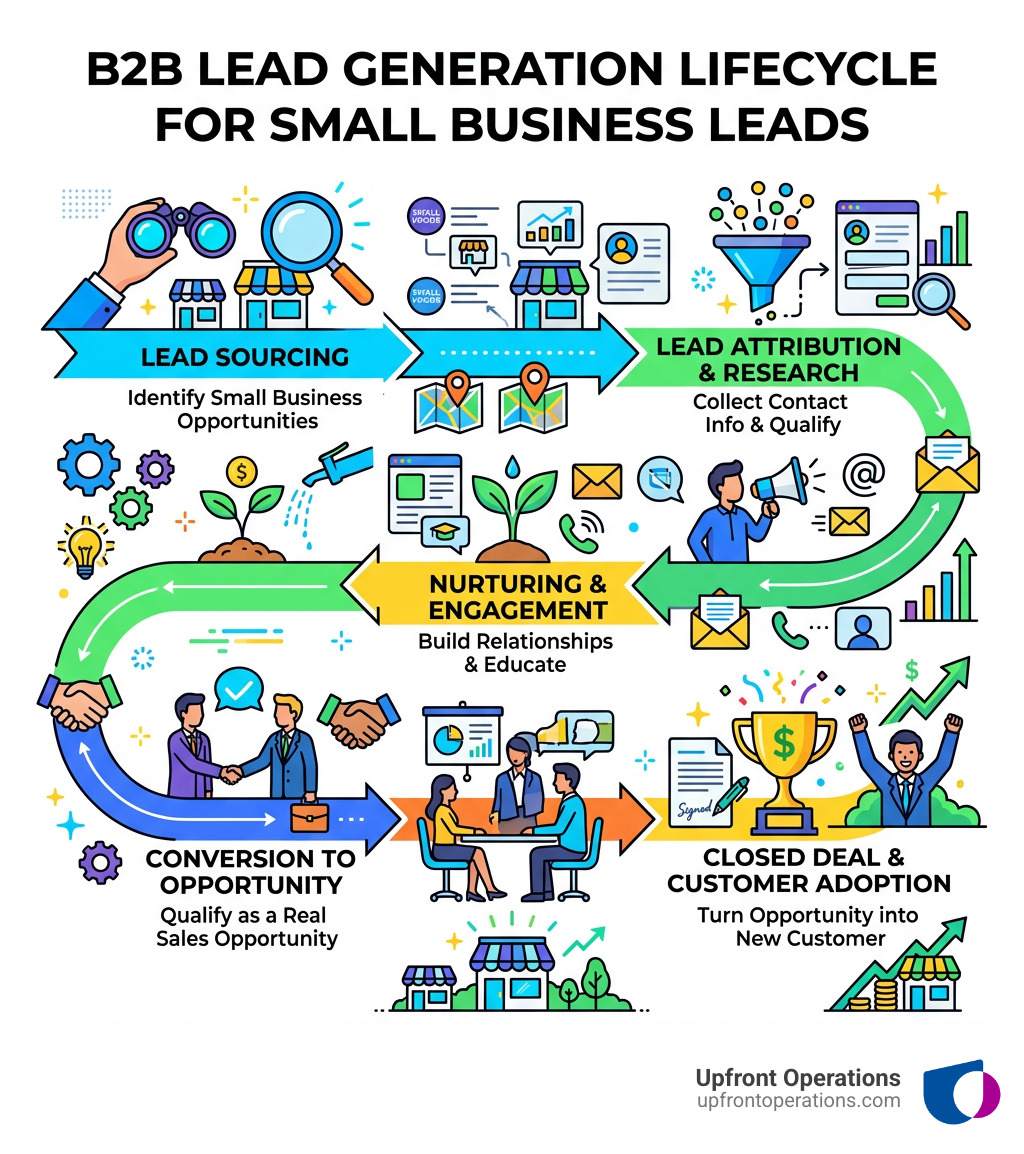
Small business leads glossary:
Many B2B vendors make the mistake of ignoring the "little guy" to chase massive enterprise whales. While those big deals are flashy, small business leads offer a level of agility and volume that enterprise sales simply can't match.
The most significant advantage is the shorter sales cycle. Research shows that while nearly half of enterprise-level B2B deals take seven months or longer to close, SMB deals move significantly faster. Why? Because you usually have direct access to the decision-maker. In a small business, the owner often wears the hats of CEO, IT director, and head of procurement. You aren't navigating fifteen layers of middle management; you’re talking to the person who signs the checks.
However, selling to SMBs requires a specific mindset. These owners are often highly risk-averse. They don't have massive IT budgets to "experiment" with, so they look for guaranteed ROI and "end-to-end" solutions that won't break their existing workflows. This is where consultative selling becomes your best friend. By positioning yourself as a trusted advisor rather than just a vendor, you can tap into a market where a 3:1 LTV (Lifetime Value) to CAC (Customer Acquisition Cost) ratio is highly achievable.
To succeed, we recommend niche targeting. Instead of targeting "all restaurants," target "locally-owned Italian restaurants in New York that recently updated their POS system." This level of specificity—combined with checking for business model stability and funding stages—ensures you aren't just buying names, but high-intent opportunities.

Buying small business leads is no longer about purchasing a dusty CSV file from a shady broker. Modern platforms use AI and real-time verification to ensure the data is fresh. Here are the heavy hitters for 2026:
Choosing a platform isn't just about the price tag; it’s about the "fit." You need to look for data verification processes—does the platform refresh its data every 30 days or every 300?
CRM integration is another non-negotiable. If your leads don't flow directly into your CRM, they will die in a spreadsheet. At Upfront Operations, we specialize in these seamless integrations as an on-demand microservice, ensuring your sales team spends their time selling, not copy-pasting.
We also suggest looking for intent signals. Does the platform tell you if a business just received a new round of funding or if they are currently searching for keywords related to your service? These "hot" signals can be the difference between a cold call and a closed deal. If you're feeling overwhelmed by the options, our fractional sales experts at Upfront Operations can provide a deep-dive audit to help you select and implement the perfect platform for your specific niche.
When evaluating these tools, keep an eye out for these "must-haves":
Is buying small business leads legal? The short answer is yes, provided you and your vendor follow data privacy regulations like GDPR (for European contacts) and CCPA (for California).
The risk isn't just legal; it's operational. High bounce rates from poor-quality lists can get your domain blacklisted by email providers. This is why list hygiene is vital. We offer list cleaning and management as an on-demand microservice, ensuring your emails actually land in the inbox.
How much does it cost?Pricing varies wildly. Some platforms like Lead 411 start around $899 per year for basic access. Others charge per lead, often ranging from $0.20 to $2.00 depending on the depth of the data (e.g., a verified mobile number costs more than just a LinkedIn URL).
To stay compliant and effective, we recommend using opt-in transparency and lead nurturing services to build a relationship with the lead before you go for the "hard sell." This keeps your brand reputation intact while staying within the lines of modern privacy laws.
Buying the lead is only 10% of the battle. The other 90% is the follow-up. Statistics show that 74.6% of new B2B customers take at least four months to close. If you give up after two emails, you are leaving money on the table.
Personalization is the "secret sauce" for SMBs. Small business owners can smell a generic template from a mile away. You need to mention their specific industry challenges or a recent achievement you saw on their LinkedIn.
At Upfront Operations, we focus on maximizing lead value through CRM management and pipeline optimization. We ensure that no lead falls through the cracks by setting up automated nurturing sequences and clear "next steps" for your sales team.
Customer Success also plays a massive role here. Companies with a strong success program are 54% more likely to retain 90% of their customers. For an SMB, knowing that you will support them after the sale is often more important than the price of the product itself.
While buying leads is the fastest way to fill your pipeline, organic generation is the most cost-effective long-term strategy.
Yes, it is legal in the U.S. and most other regions, provided the data is sourced and used according to privacy laws. Reputable vendors like those mentioned in this article ensure their databases are compliant. However, it is your responsibility to provide an "opt-out" option in your outreach and to respect "Do Not Call" registries.
You can expect to pay anywhere from $0.50 to $5.00 per lead for high-quality, verified data. Subscription-based platforms often offer better value, with monthly plans starting around $99/month for a set number of credits. Remember: cheap leads are often the most expensive in the long run due to high bounce rates and wasted sales time.
The primary differences are speed and scale. SMB leads have shorter sales cycles and fewer decision-makers, but lower individual contract values. Enterprise prospects require months of consensus-building among dozens of stakeholders but offer much larger payouts. For most growing companies, a healthy mix of both is the best strategy for stable revenue.
Stop chasing ghosts. The 31 million small businesses in the U.S. represent a massive, untapped opportunity for your B2B services. Whether you choose to buy leads from a platform like Apollo or generate them through local SEO, the key is consistency and professional sales operations.
At Upfront Operations, we are your partner for on-demand microservices. We don't just give you a list; we help you build the engine to convert those leads. From CRM management and pipeline optimization to providing fractional sales expertise, we give you the tools and the talent to scale with unstoppable momentum.
Ready to supercharge your sales? Check out our simple, transparent pricing and let's start turning those leads into loyal customers today.