Clock Icon - Technology Webflow Template
10
min read

Detailed Guide to Sales Data Unification

Unlock growth with sales data unification. Learn how to centralize, clean, and integrate your sales data for a 360-degree ...

Why Sales Data Unification is Critical for Modern Business Success

Sales data unification is the process of merging scattered sales information from multiple systems into a single, coherent view. This enables better decision-making and improved sales performance. With 73% of consumers expecting companies to anticipate their needs, fragmented data is no longer an option. Information trapped in separate systems—CRM, marketing platforms, ERPs, and support tools—creates data silos that hinder growth.

This guide will walk you through everything you need to know about unifying your sales data, from core concepts to implementation. Key components include:

  • Consolidation: Merging data from all your tools.
  • Standardization: Creating consistent formats and definitions.
  • Integration: Connecting systems for real-time data flow.
  • Governance: Establishing rules to maintain data quality.

I'm Ryan T. Murphy, founder of UpfrontOps. Over the past 12 years, I've helped dozens of companies transform their revenue operations through sales data unification, cutting sales cycles by up to 28%. Whether you need on-demand microservices to connect your tools or strategic guidance to overhaul your data architecture, we can turn your data chaos into a competitive advantage.
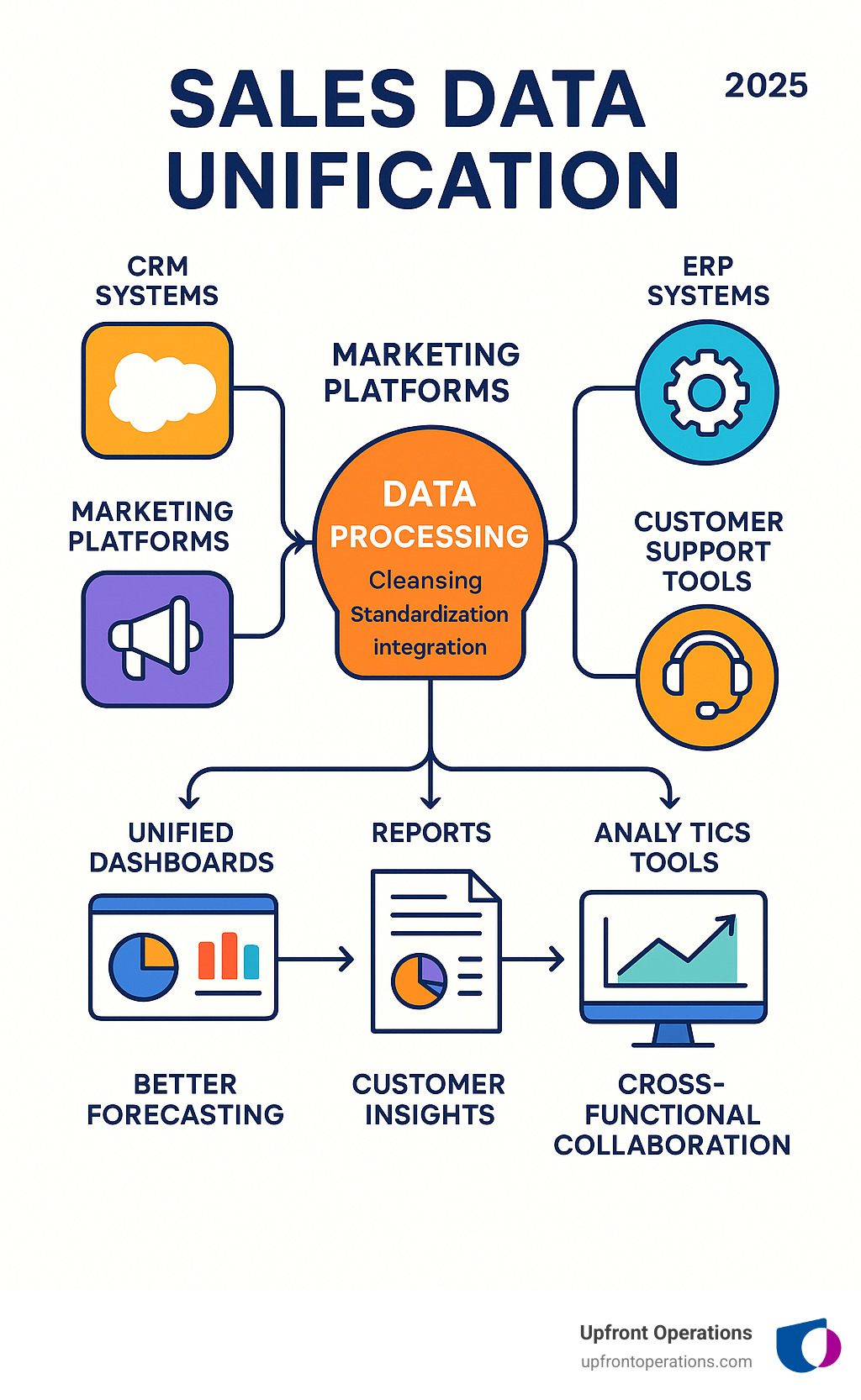
Comprehensive infographic showing the sales data unification process: multiple data sources (CRM systems like Salesforce and HubSpot, marketing platforms, ERP systems, customer support tools, and web analytics) flowing through a central data processing hub that cleanses, standardizes, and integrates the information, then outputs to unified dashboards, reports, and analytics tools that enable better sales forecasting, customer insights, and cross-functional collaboration - Sales data unification infographic

Understanding Sales Data Unification: The What and Why

In today's business world, data drives everything. With a staggering 2.5 quintillion bytes of data created daily, your competitive advantage depends on turning that information into actionable insights. This is where sales data unification becomes your secret weapon, helping you create full funnel visibility across your revenue engine.

What is Sales Data Unification?

Think of sales data unification as assembling a jigsaw puzzle where pieces come from your CRM, marketing platform, customer service software, and billing system. The process gathers these disparate pieces into a single, complete picture: a single source of truth that provides a holistic view of every customer interaction.

Unification goes beyond simple data integration. While integration helps systems talk, unification merges those conversations into one coherent story. It eliminates redundancies, fixes inconsistencies, and breaks down frustrating data silos. This is essential for building a growth-focused CRM that helps your team close more deals.

The High Cost of Fragmented Data

When your sales, marketing, and service teams lack a complete customer picture, it directly hits your bottom line. The consequences of fragmented data are severe:

  • Inaccurate Forecasting: Without a complete view of sales patterns and pipeline health, forecasts become expensive guesswork.
  • Wasted Sales Efforts: Reps waste time on incomplete leads or duplicate outreach, working with partial information.
  • Poor Customer Experience: Customers get frustrated repeating their story to different team members who lack context about their history.
  • Missed Revenue Opportunities: Without a unified view, you can't spot cross-sell or upsell opportunities that are hiding in plain sight.

The inefficiency is staggering. Data scientists often spend 60-80% of their time just cleaning and preparing data. This is a major bottleneck that we can help you fix with efficient sales processes.

Why Unification is a Strategic Imperative

Sales data unification is a strategic move that transforms your growth trajectory. It enables:

  • Improved Personalization: A 360-degree customer view allows you to craft messages that speak to individual needs, boosting engagement and conversions.
  • Cross-Functional Alignment: When sales, marketing, and customer success work from the same dataset, they operate as a cohesive unit, creating a seamless customer experience.
  • Proactive Decision-Making: Unified data reveals trends and predicts future needs, allowing you to get ahead of issues instead of constantly reacting to them.
  • Increased Operational Efficiency: Automating data collection and cleaning frees up your team to focus on high-value activities like selling and building relationships.

This comprehensive approach is the backbone of effective sales strategy and execution, turning scattered information into a strategic advantage.

The Core Process and Challenges of Sales Data Unification

4-step process diagram: Audit, Cleanse, Integrate, Govern - Sales data unification

Successful sales data unification requires a clear process. You don't need a full-time data expert to get started; on-demand solutions can guide you through the journey faster and more efficiently.

Key Steps in the Unification Journey

Every project follows a proven four-step path:

  1. Data Find & Audit: We locate all customer data across your systems (CRM, marketing tools, spreadsheets) and assess its quality and format.
  2. Data Cleansing & Standardization: This is the critical step of fixing messy data. We remove duplicates, correct errors, and standardize formats (e.g., phone numbers, company names). If this feels overwhelming, our team can fix CRM data quality problems as a targeted service.
  3. Data Integration & Mapping: We connect your systems and map fields to ensure they align, creating a "golden record"—the single, most accurate version of each customer.
  4. Data Governance & Maintenance: We establish rules for data access, updates, and quality checks to ensure your unified data stays clean and useful over time.

Common Roadblocks and How to Steer Them

Data unification projects often face common challenges. The data preparation industry is expected to reach $12.89 billion by 2028 because these issues are so widespread.

  • Data Quality Issues: Merging records like "John Smith" and "J. Smith" is a major hurdle. We use smart algorithms to identify and merge these records correctly.
  • Inconsistent Formats: Different systems store data differently (e.g., date formats, company names). We solve this with careful standardization.
  • System Incompatibility: Older, legacy systems can be difficult to integrate, but our experts can find workarounds.
  • Scalability Concerns: A solution must grow with your business. We design flexible systems that scale from 1,000 to 100,000+ records.
  • Lack of Expertise: Most businesses lack in-house data specialists. Our on-demand, fractional experts solve these classic sales operations challenges without the overhead of a full-time hire.

Ensuring Data Quality and Consistency

Your unified data is only as good as your quality controls. We use a multi-layered approach:

  • Data Profiling: Analyzing existing data to identify patterns and anomalies, creating a roadmap for cleaning.
  • Data Validation Rules: Automatic checks to ensure new data meets your standards before it enters the system.
  • Deduplication: Using sophisticated algorithms to find and merge duplicate records, creating a clean contact list.
  • Data Enrichment: Adding missing information (company details, contact info) from external sources to improve your data.
  • Continuous Monitoring: Ongoing checks to maintain data integrity. Our CRM data cleanup services can handle this for you, ensuring data quality is a continuous process, not a one-time project.

The Tech Stack: Tools for Effective Unification

Different tech logos (Salesforce, HubSpot, etc.) connecting to a central hub - Sales data unification

Building the right tech stack for sales data unification doesn't require a full-time data team. The key is choosing the right tools and connecting them effectively. We can help you build a RevOps tech stack that works for your specific needs.

Centralizing Your Data: CRM, CDP, and MDM

Three types of platforms are central to data unification:

  • Customer Relationship Management (CRM): The heart of your sales operation (e.g., Salesforce, HubSpot), managing customer interactions and pipelines.
  • Customer Data Platforms (CDP): Gathers behavioral and demographic data from all customer touchpoints (website, email, social media) to create rich, real-time profiles.
  • Master Data Management (MDM): Ensures consistency for core business data (customers, products) by creating a single "golden record" that all systems can trust.
FeatureCRMCDPMDM
Primary GoalManage customer interactions & sales processesCreate unified customer profiles for marketingEnsure consistency of core business data
Main UsersSales, Customer ServiceMarketing, Customer ExperienceIT, Data Governance, Business Intelligence
Data FocusTransactions, interactions, contact detailsBehavioral, demographic, real-time activityCore business entities and relationships
Unification RolePrimary sales data sourceUnifies customer data across all touchpointsUnifies master data across the enterprise

These systems work best together, with the CRM managing sales, the CDP enriching profiles, and the MDM ensuring data accuracy.

The Role of Integration and Automation Tools

Integration tools connect your applications and automate data flow. Key tools include:

  • ETL/ELT Platforms: These workhorses extract, transform, and load data from various sources into your central repository.
  • iPaaS (Integration Platform as a Service): These platforms simplify connecting different applications using pre-built connectors.
  • APIs: These connections allow your apps to share data in real-time.

Properly configuring these tools requires expertise. We offer targeted services to fix tech stack integration issues and implement effective sales automation solutions.

Building Your Unification Tech Stack On-Demand

You don't need a massive, months-long project to achieve sales data unification. Our on-demand, microservices approach delivers exactly what you need, when you need it.

This model means you get elite fractional RevOps expertise without the overhead. No long-term contracts or massive upfront investments—just smart solutions that turn data chaos into clarity.

Opening Up Business Growth with Unified Sales Data

Sales dashboard showing unified metrics like pipeline health, conversion rates, and revenue attribution - Sales data unification

When sales data unification clicks into place, scattered information transforms into a powerhouse that drives real business results. It's like upgrading from a flashlight to stadium lighting—suddenly, you can see the whole field clearly.

Empowering Your Sales Team for Peak Performance

Unified data makes your sales team unstoppable. Instead of hunting for information, they can focus on what they do best:

  • Accurate Sales Forecasting: With harmonized pipeline data and customer behavior, predicting future sales becomes a science, not guesswork. This can be improved with AI in sales forecasting.
  • Optimized Lead Management: Track every lead from first touch to close without anything slipping through the cracks, following lead management best practices.
  • Personalized Customer Engagement: Reps with a complete customer story can build trust faster and boost conversion rates.
  • Cross-sell & Upsell Opportunities: A full view of customer behavior reveals expansion opportunities, increasing lifetime value. This is even more powerful with automated customer retention workflows.

Fostering Cross-Functional Collaboration

Data unification breaks down departmental walls, creating true alignment:

  • Sales and Marketing Alignment: When both teams use the same data, marketing delivers better leads and sales provides better feedback. We can help fix marketing and sales alignment to ensure smooth collaboration.
  • Informing Product Development: Product teams get direct access to customer feedback and usage patterns, leading to better products. Detailed customer journey maps can visualize these insights.
  • Enhancing Customer Service: Service reps with full customer context provide faster, more personal, and proactive support.

The Impact of a Successful Sales Data Unification Strategy

The results of a successful strategy are clear and measurable:

  • Increased Revenue: Optimized processes and new opportunities drive top-line growth.
  • Shorter Sales Cycles: Reps move deals forward faster with complete information.
  • Higher Win Rates: Personalized and timely outreach improves closing ratios.
  • Improved ROI on Tech Spend: Your technology investments deliver more value when they work together seamlessly.

Unified data powers comprehensive sales performance analytics, allowing you to spot trends and optimize performance with precision.

Best Practices for a Winning Strategy

Getting sales data unification right is about having a smart strategy. Success starts with defining clear, measurable objectives (e.g., cut sales cycle by 20%, improve forecast accuracy) and securing executive buy-in. This collaborative spirit is essential for any successful sales operations strategy.

Laying the Groundwork for Success

  • Start Small & Iterate: Don't try to boil the ocean. Pick one high-impact project, like unifying CRM and marketing data, to prove value quickly and build momentum.
  • Identify & Map: Before you start, identify all key data sources and map the customer journey. This reveals where your most valuable data lives. We can help create business documentation to formalize this process and prevent future headaches.

Executing Your Unification Project

  • Establish Data Governance: Create clear rules for data quality, access, and maintenance early on. Without governance, your unified data will quickly degrade.
  • Choose Flexible Tools: Select tools that can scale with your business and integrate with your existing systems. Adhering to CRM best practices is critical for long-term success.
  • Automate Wherever Possible: Use automation to reduce manual data entry, minimize human error, and free up your team for more strategic work.

Maintaining Momentum and Measuring Success

Data unification is an ongoing process, not a one-time project.

  • Continuous Monitoring: Set up automated alerts and conduct regular data audits to catch issues before they become major problems.
  • Track Key Metrics: Measure the metrics tied to your original goals. Building sales reports that work makes this easy and keeps everyone focused on results.
  • Provide Ongoing Training: Ensure your team knows how to use the newly unified data. Our experts can provide ongoing sales operations training to maximize adoption and impact.

Frequently Asked Questions about Sales Data Unification

Here are answers to some common questions about sales data unification.

How long does a sales data unification project typically take?

The timeline varies from a few weeks to several months, depending on the complexity of your data and systems. However, you don't have to wait months for results. We use a phased approach, delivering value quickly by tackling high-impact areas first. Our on-demand microservices and fractional RevOps experts are designed to accelerate this process and deliver improvements right away.

Is data unification only for large enterprises?

Not at all. Data chaos affects businesses of all sizes. A solopreneur with data in spreadsheets and email faces the same core problems as a large enterprise. Sales data unification is scalable. Our microservices model makes it accessible and affordable for everyone, providing targeted help with small business sales strategies without enterprise-level budgets.

What's the difference between data unification and a data warehouse?

They are two sides of the same coin. Data unification is the process of cleaning, standardizing, and combining your scattered data. A data warehouse is the place—a central repository designed to store this unified data for analysis and reporting. You need unification to create a useful data warehouse. When we help you create unified reporting systems, we're handling both: preparing your data and making it accessible for better decision-making.

Conclusion

When 73% of consumers expect companies to anticipate their needs, sales data unification is no longer optional—it's essential for survival and growth. Unifying your data transforms chaos into clarity, creating a 360-degree customer view that empowers your entire organization. The results are clear: accurate forecasts, personalized engagement, seamless cross-functional collaboration, increased revenue, and shorter sales cycles.

The path to data clarity is within reach for businesses of all sizes, and it doesn't require a massive, months-long overhaul. At Upfront Operations, we deliver game-changing sales operations support through our unique on-demand approach.

Whether you need a specific microservice, like our project to unify your sales and marketing data, or you're ready to create unified reporting systems, we provide exactly what you need, when you need it. Our model gives you access to elite fractional RevOps experts without the overhead of a full-time hire.

We turn data chaos into a competitive advantage, helping you build unstoppable momentum. Ready to open up the full potential of your sales data? The journey from fragmented information to unified insights starts with a single, simple step.

Ask an In-House Growth Expert (Not a Sales Call)

Nice! Next you'll be directed to the page where you can pick a time that works best for you.

If you are not available, you can schedule another time by visiting this link
Oops! Something went wrong while submitting the form.

Ryan T. Murphy

Managing Partner, Sr. Sales Operations Manager

With over a decade in CRM management and marketing operations, Ryan has driven growth for 32 businesses from startups to global enterprises with 12,000+ employees.

Detailed Guide to Sales Data Unification