March 23, 2026

10
min read
Why Your Sales Team Might Be Slowing You Down and How to Fix It
Boost sales team efficiency now: Fix stalled pipelines, automate tasks, align sales & marketing, and hit growth benchmarks.
Boost sales team efficiency now: Fix stalled pipelines, automate tasks, align sales & marketing, and hit growth benchmarks.


Sales team efficiency is a measure of how much revenue your sales team generates relative to what you spend to run it. A higher ratio means more revenue per dollar invested. Here's what you need to know at a glance:
| Efficiency Ratio | What It Means |
|---|---|
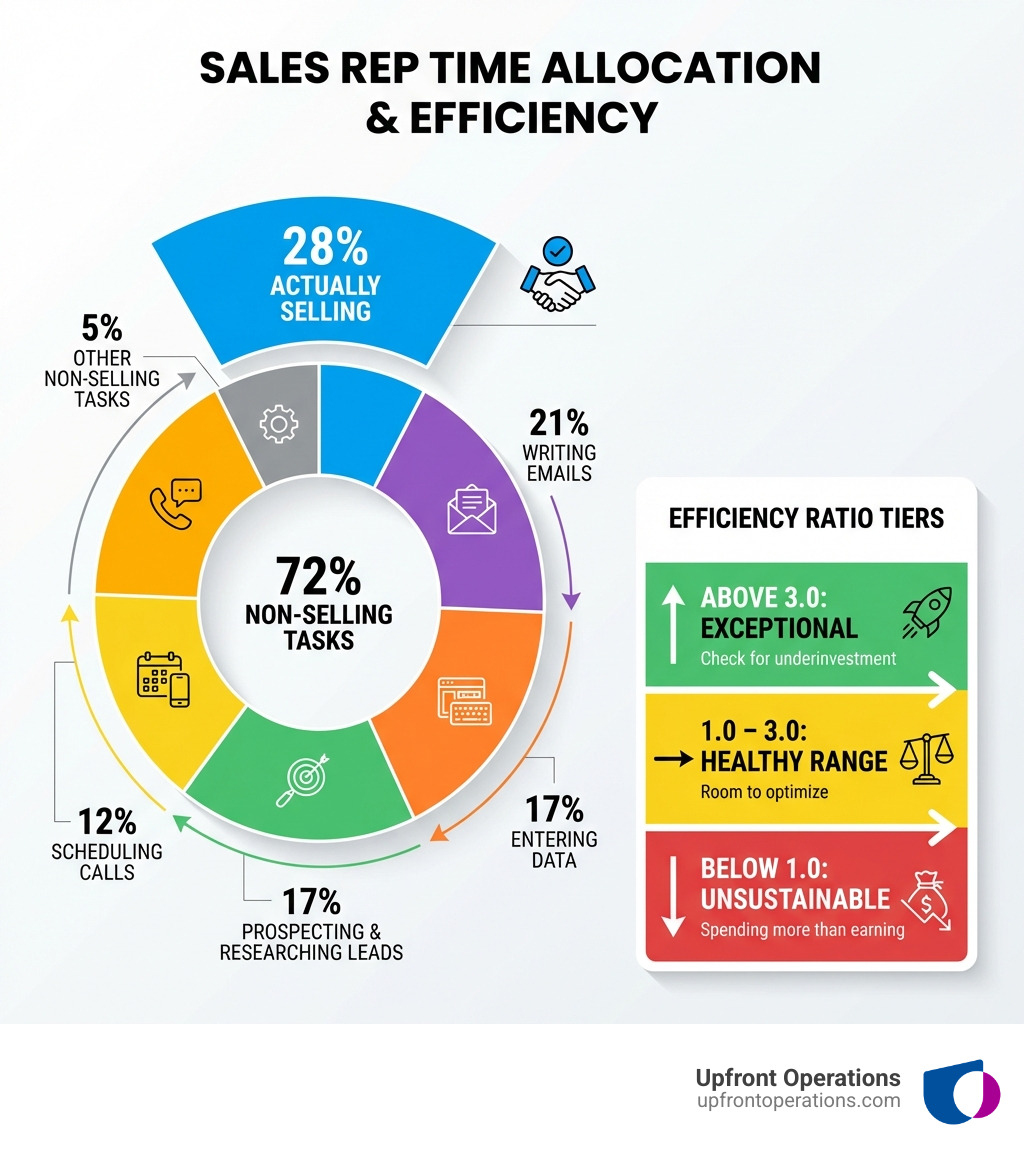
| Below 1.0 | Spending more than you're earning — unsustainable |
| 1.0 – 3.0 | Healthy range — room to optimize |
| Above 3.0 | Exceptional — but check for underinvestment |
To improve sales team efficiency, focus on:
If you're running a sales team, you've probably felt it: the pipeline looks active, the team looks busy, but the revenue numbers tell a different story.
Here's why that happens more often than most business owners expect. The average sales rep spends just 28% of their time actually selling. The rest goes to writing emails, logging data, researching leads, and scheduling calls — tasks that feel productive but don't directly close deals.
That's not a motivation problem. That's an operational problem.
And it's costing businesses more than they realize. When your reps are buried in admin work, follow-ups slip, good leads go cold, and deals stall in the pipeline. The result is a team that's working hard but not moving the revenue needle.
The good news? These are fixable problems — with the right systems, processes, and support in place.
I'm Ryan T. Murphy, founder of UpfrontOps, and over the past 12 years I've helped 32 companies — from early-stage startups to 12,000-person global firms — dramatically improve sales team efficiency by cutting wasted time, fixing broken funnels, and building leaner sales operations. In this guide, I'll walk you through exactly where efficiency breaks down and how to fix it — without burning out your team.
Simple guide to sales team efficiency terms:
When we talk about sales team efficiency, it’s easy to get it confused with "hustle." We often see managers praising the rep who makes 100 calls a day, but if those 100 calls only result in one low-value meeting, that rep isn't efficient—they’re just loud.
Efficiency is about resource optimization. It’s the "doing things right" part of the equation. According to scientific research on the state of B2B sales, the gap between high-performing teams and everyone else isn't just about working harder; it's about how they manage their input (time, money, tools) to maximize their output (revenue).
While they sound similar, there’s a distinct difference:
You need both. An efficient team that isn't effective is just failing quickly. An effective team that isn't efficient is leaving massive amounts of profit on the table because their "win" cost too much to achieve.
Why should you care about this specific ratio? Because it’s the ultimate profitability indicator for a growing business.
To fix the machine, we first have to measure it. There are three main ways we look at this at Upfront Operations when we perform pipeline optimization services for our clients.
| Formula | What it Measures | Why it Matters |
|---|---|---|
| Gross Sales Efficiency | New ARR / S&M Spend | Measures the raw power of your acquisition engine. |
| Net Sales Efficiency | (New ARR + Expansion - Churn) / S&M Spend | Measures holistic health, including customer retention. |
| The Magic Number | (Current Q Rev - Previous Q Rev) * 4 / Previous Q S&M Spend | The gold standard for SaaS scalability. |
Investors love the Magic Number because it shows growth persistence. If your Magic Number is greater than 1.0, it means for every dollar you spent on sales and marketing last quarter, you gained a dollar (or more) in recurring revenue this quarter. That is a green light for scaling.
What does "good" look like? While it varies, the median SaaS sales efficiency ratio typically hovers around 0.7. However, scientific research on B2B win rates and cycle lengths shows that top-tier companies aim for a ratio of 1.0 to 3.0.
Efficiency doesn't live in a vacuum. To get the full picture, you must track:
If your numbers are low, it’s usually because of "friction" in the system.
The biggest productivity killer isn't laziness; it's administrative burden. When reps have to jump between five different tools just to send a proposal, they lose focus. This "context switching" is an invisible tax on your revenue.
We often see companies try to save money by cutting their software budget, but as we discussed in our live virtual workshop on the fallout of slashing your CRM budget, this usually backfires. A clunky CRM that requires manual data entry leads to "bad data," and bad data leads to missed opportunities.
If your marketing team is sending over leads that don't fit your Ideal Customer Profile (ICP), your sales team is wasting their most valuable asset—time—on people who will never buy. This creates "stalled deals" that sit in the pipeline for months, dragging down your average sales cycle and making your team look less efficient than they actually are.
Improving sales team efficiency isn't about whipping the horses to run faster; it's about paving the road so they can glide.
This is arguably the #1 factor in efficiency. You need shared KPIs and a formal Service Level Agreement (SLA). Marketing shouldn't just be measured on "leads," but on "Sales Accepted Leads" (SALs). When both teams agree on what a "good" lead looks like, the sales team spends less time filtering and more time closing.
Did you know that structured coaching can improve win rates by 32%? It’s not just about the initial onboarding. Ongoing training on value-based selling and objection handling keeps the team sharp. At Upfront Operations, we recommend peer-led sessions where your top closers share exactly how they handle common pushbacks. According to Gartner, training paired with coaching can lead to an 88% performance boost.
The future of sales is "human-led, AI-assisted." Generative AI is already saving reps an average of 2 hours per day on administrative tasks. Tools like Agentforce have shown a 92% reduction in account research time—turning an hour of manual digging into a 5-minute summary.
This is where the "on-demand" nature of modern sales ops comes in. You don't always need a full-time RevOps department. Sometimes you just need an expert to come in, set up your automation, and get out. Whether it's supercharging your CRM management or setting up lead nurturing sequences, these microservices allow small teams to act like enterprise giants.
A ratio between 1.0 and 3.0 is considered healthy. If you’re below 1.0, you’re likely burning cash to grow. If you’re above 3.0, you’re doing great, but you might actually be underinvesting—meaning you could spend more on marketing to capture even more of the market without losing profitability.
AI handles the "grunt work." It can draft personalized follow-up emails, summarize long call recordings, and even predict which leads are most likely to close. By reclaiming those 2 hours of admin time every day, your reps can fit in two more high-value sales calls.
Gross efficiency only looks at new business. Net efficiency is more holistic—it includes expansion revenue (upsells) and subtracts churn. If your gross efficiency is high but your net is low, you don't have a sales problem; you have a customer retention problem.
Your sales team shouldn't be a bottleneck; they should be a high-velocity engine. By focusing on sales team efficiency, you aren't just asking for more work—you're removing the obstacles that keep your talented reps from doing what they do best: building relationships and closing deals.
At Upfront Operations, we specialize in this kind of operational excellence. Whether you need an elite fractional sales operations expert to overhaul your strategy or simple, on-demand microservices to fix a broken CRM, we’re here to help you scale with unstoppable momentum.
Ready to stop the revenue leakage? Check out our on-demand sales operations pricing and let’s get your team back to what matters—selling.