March 17, 2026

10
min read
Steal These Sales Operations Examples for Better Productivity
Boost revenue with sales operations examples: territory design, forecasting, lead management, and more for peak productivity.
Boost revenue with sales operations examples: territory design, forecasting, lead management, and more for peak productivity.

Sales operations examples show how businesses turn strategy into revenue. Here's what effective sales operations looks like in action:
Sales reps spend only 30% of their time actually selling, according to the State of Sales report. The rest? Administrative tasks, data entry, and hunting for information. That's where sales operations comes in.
Modern sales operations teams act as the strategic engine behind revenue growth. They don't just support sales—they design the systems, processes, and workflows that make selling efficient and predictable.
Think of it this way: sales reps focus on relationships and closing deals. Sales operations builds the infrastructure that lets them do more of both.
Companies with mature sales operations functions see 28% higher revenue growth than competitors. They achieve 35% faster sales cycles. Their forecast accuracy improves dramatically. Their reps spend more time with customers and less time wrestling with technology.
But what does sales operations actually do on a daily basis? What specific activities drive those results?
I'm Ryan T. Murphy, founder of UpfrontOps, and over the past 12 years I've implemented sales operations examples across 32 companies—from startups to global enterprises—helping them cut sales cycles by up to 28% and unlock millions in new revenue through smarter automation, territory design, and data-driven forecasting. Whether you need on-demand support with CRM management, lead nurturing workflows, or sales process optimization, the right sales operations examples can transform how your team sells.
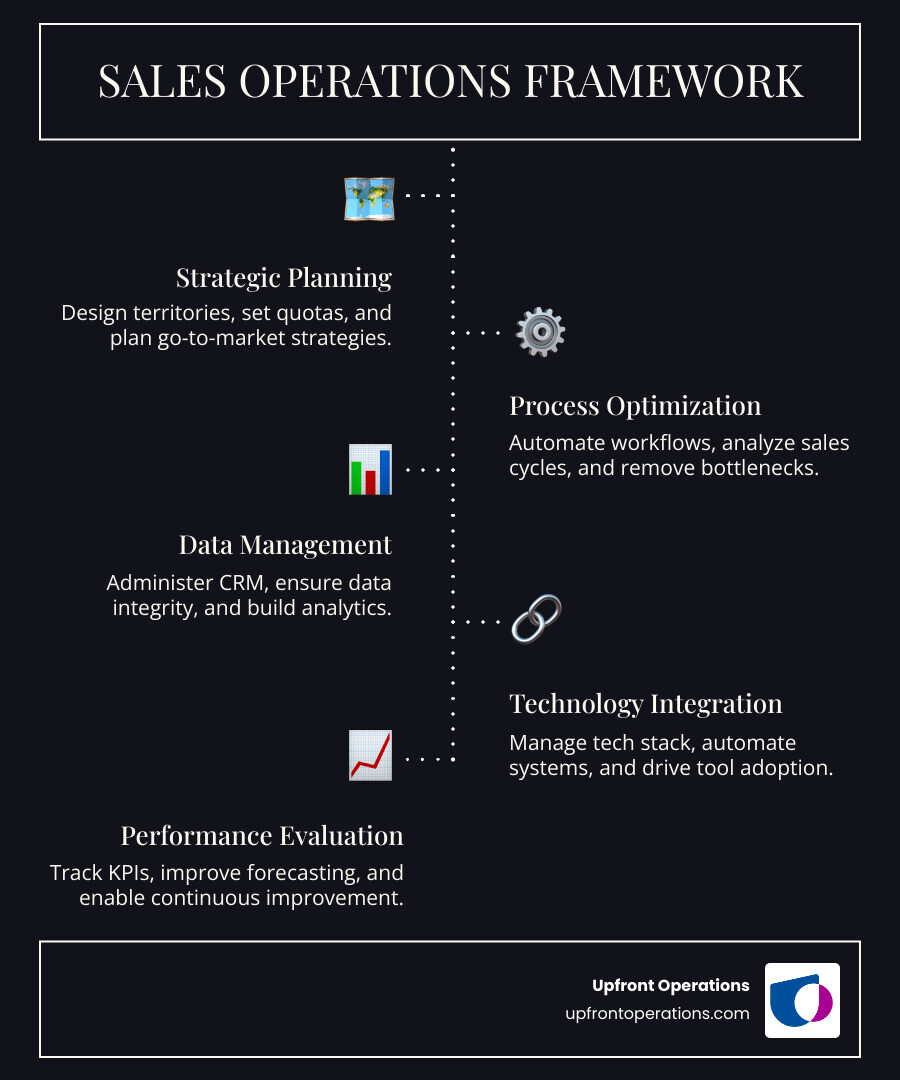
Key sales operations examples vocabulary:
At its heart, Sales Operations (often called "Sales Ops") is about creating a systemic approach to selling. If the sales team is the heart of the business, Sales Ops is the central nervous system. Its core purpose is to remove friction from the sales process, allowing reps to focus on what they do best: building relationships and closing deals.
While many people confuse Sales Ops with Sales Enablement, they serve different (but complementary) functions. Sales Ops handles the "behind-the-scenes" infrastructure—data, systems, and strategy—while Enablement focuses on the "front-line" training and content.
| Feature | Sales Operations | Sales Enablement |
|---|---|---|
| Primary Focus | Systems, Data, and Process | Training, Coaching, and Content |
| Ownership | CRM, Tech Stack, Compensation | Sales Playbooks, Onboarding, Sales Collateral |
| Goal | Efficiency and Predictability | Skill Development and Message Consistency |
| Success Metric | Sales Velocity, Forecast Accuracy | Quota Attainment, Ramp Time |
At Upfront Operations, we see Sales Ops as a revenue growth engine. Our mission is to provide the data-driven execution and strategic planning that smaller teams often lack. Whether we are acting as your elite fractional sales operations experts or providing simple microservices like a professional business email setup, our goal is commercial excellence. We believe that even a solopreneur in New York should have access to the same strategic rigor as a Fortune 500 company. You can learn more info about our mission and team to see how we bridge that gap.
To truly understand the impact of this function, we need to look at real-world sales operations examples. These aren't just theoretical concepts; they are the levers we pull to increase productivity.
Need help implementing these quickly without hiring a full-time ops team? Upfront Operations offers on-demand, buy-what-you-need support, including CRM management, lead nurturing workflows, and pipeline optimization you can spin up fast. Check out more info about our on-demand sales services to see how we can handle the heavy lifting for you.
Lead management is often where the most revenue "leaks" occur. Without a structured process, high-quality leads can sit in an inbox for days, eventually going cold.
According to the State of Sales report, reps spend a staggering amount of time on non-selling activities. Our on-demand services can help you implement practical fixes fast, like lead routing automation, CRM cleanup, and pipeline stage definitions that keep the team moving without more admin work.
What would you do if you had a crystal ball? Sales forecasting is the closest thing a business leader has to psychic powers.
If you want a clear, standardized forecasting model (without weeks of back-and-forth), this is a strong use case for bringing in fractional Sales Ops support on-demand to implement dashboards, stage definitions, and pipeline hygiene rules.
A modern sales team is only as good as its tech stack. However, more tools often lead to more problems if they aren't managed correctly.
Your CRM should be a "Single Source of Truth," not a "Data Graveyard." Sales Ops ensures that the CRM is configured to support the sales process, not hinder it. This includes:
If you are thinking about cutting costs, be careful. You can witness the fallout of slashing your CRM budget in our virtual workshop. A poorly maintained CRM is often more expensive in lost revenue than the subscription cost of a high-performing one.
You can't manage what you can't measure. Sales Ops teams use Objectives and Key Results (OKRs) to drive performance.
Interested in how we track these for our clients? You can find more info about our service pricing to see how our fractional experts can set up these dashboards for your New York business.
If you're building OKRs from scratch, a helpful reference is the OKR methodology overview on Wikipedia: Objectives and key results (OKR).
Even the best-laid plans hit snags. Here are the most common challenges we see and how we solve them:
In the early stages, you might have "Shadow Operations," where the founder or a sales manager handles CRM updates and reporting on the side. As you scale, you move to a centralized model with a dedicated manager. Eventually, large enterprises build specialized teams with analysts, technical advisors, and VPs of Sales Ops who act as strategic partners to the CEO.
Right now, the rapid adoption of AI is the biggest challenge and opportunity. Teams are struggling to integrate AI agents for lead nurturing and coaching without creating more noise. Additionally, unreliable forecasting and disjointed tech stacks continue to plague companies that haven't invested in a unified Revenue Operations (RevOps) model.
Sales operations is no longer a "nice-to-have" back-office function; it is the secret weapon of high-growth companies. From territory design to AI-powered forecasting, these sales operations examples demonstrate that a systemic, data-driven approach is the only way to scale in a modern market.
At Upfront Operations, we specialize in making these complex systems simple. Whether you are a solopreneur in New York needing a quick website and business email setup or a growing company looking for elite fractional sales operations experts to optimize your CRM and lead nurturing, we are here to help. Don't let manual tasks and data silos slow you down. Supercharge your sales operations today and start closing deals with unstoppable momentum!