March 20, 2026

10
min read
Building Your Lead Qualification Machine: An Automation Blueprint
Master automated lead qualification. Build your machine, boost speed-to-lead, and maximize ROI with our automation blueprint.
Master automated lead qualification. Build your machine, boost speed-to-lead, and maximize ROI with our automation blueprint.

Automated lead qualification is the process of using software and rules to automatically score, filter, and route incoming leads — so your sales team only spends time on prospects most likely to buy.
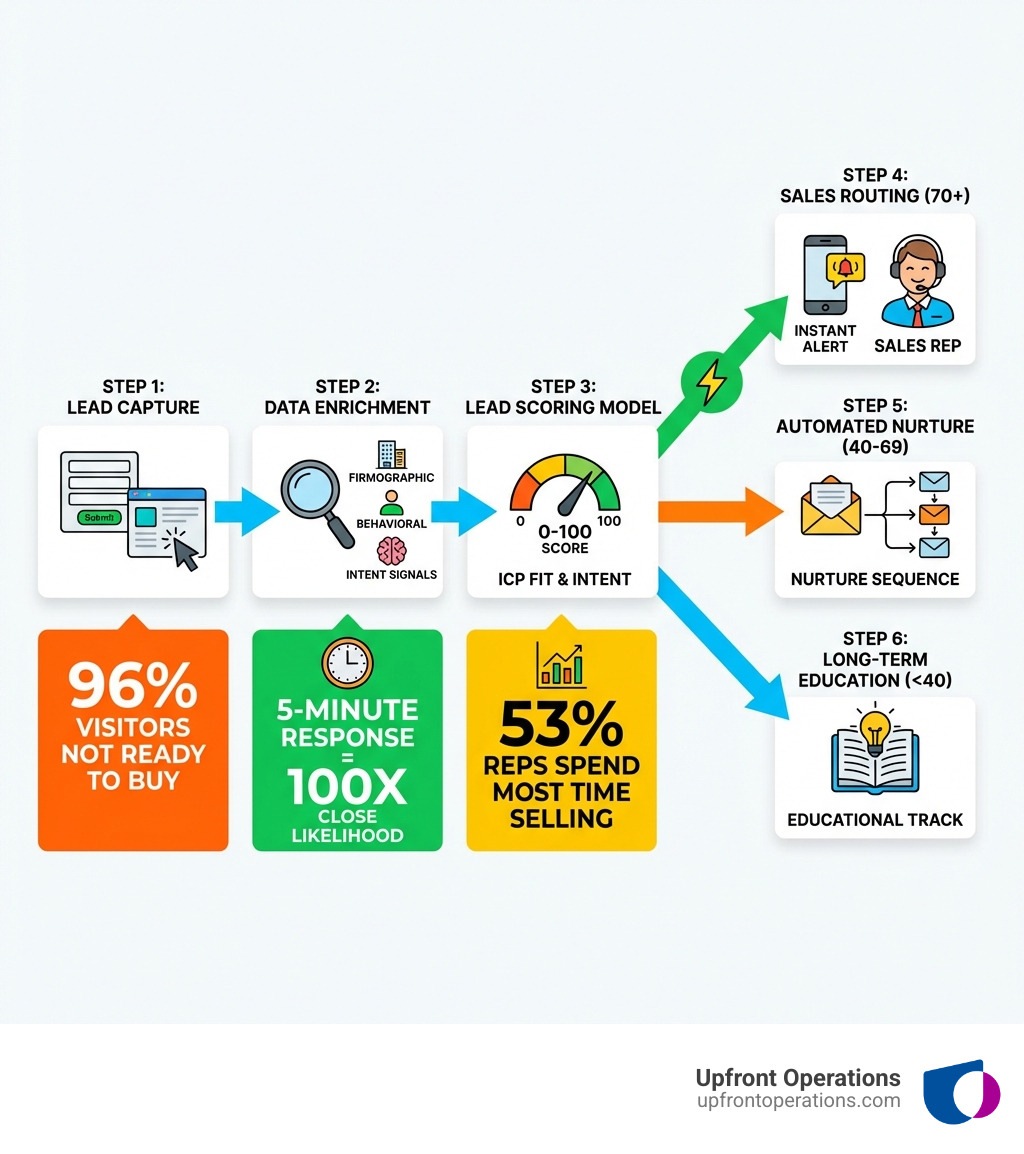
Here's a quick overview of how it works:
The numbers tell a hard story.
96% of website visitors aren't ready to buy. Of the ones who do convert, 80% never close. And yet most sales teams are still manually reviewing leads one by one — opening CRM records, cross-referencing LinkedIn, checking company websites — a process that can eat 15 to 30 minutes per lead.
That's not a lead problem. That's a process problem.
Speed makes it worse. Studies show that responding to a lead within 5 minutes makes you 100 times more likely to close than waiting even 30 minutes. But if your team is buried in manual qualification, that window slams shut before anyone picks up the phone.
The result? Flat conversion rates, missed follow-ups, and a sales team spending more time sorting leads than selling to them. In fact, only 53% of salespeople spend most of their workday actually selling.
Automation changes that equation entirely.
I'm Ryan T. Murphy, founder of UpfrontOps, and over the past 12 years I've helped 32 companies — from early-stage startups to 12,000-person global firms — build automated lead qualification systems that cut wasted time and unlock real revenue growth. This guide is the same blueprint I use with clients who need automated lead qualification that actually works, delivered on demand without the overhead of a full-time hire.
Quick Automated lead qualification terms:
To understand why Automated lead qualification is a game-changer, we have to look at how it differs from the "old way." Traditional qualification relies on human intuition and manual research. A lead comes in, and a rep spends 20 minutes Googling the company size, finding the person on LinkedIn, and checking if they’ve visited the pricing page. By the time they pick up the phone, the lead has already moved on to a competitor.
In the automated world, the software does the heavy lifting in milliseconds. The moment a form is submitted, the system pings data providers to find out the company’s annual revenue, their tech stack, and the lead's job title.
The impact of speed cannot be overstated. According to scientific research on the impact of immediate lead response, the odds of qualifying a lead are 21 times higher when contacted within 30 minutes versus 60 minutes. If you reduce that to five minutes, the likelihood of a successful conversion jumps by 100X.
Automation is the only way to achieve this. While a human is still getting their coffee, an automated system has already:
| Feature | Manual Scrubbing | Automated Qualification |
|---|---|---|
| Response Time | 30 minutes to 24 hours | Under 1 minute |
| Data Accuracy | Subject to human error | Consistent, data-backed |
| Rep Productivity | High time spent on research | 100% focus on selling |
| Scalability | Requires more hires to scale | Scales infinitely with software |
| Consistency | Varies by rep | Uniform application of rules |
When we help businesses in New York and beyond build these systems, we look for tools that don't just "score" leads but act on them. The best Automated lead qualification tech stacks include:
For companies that need these systems built fast, we offer fractional sales operations services to handle the technical heavy lifting.
Building the "machine" requires a logical sequence of triggers and actions. We start by defining trigger events. This isn't just a form submission; it could be a lead opening an email three times in one hour or a prospect visiting your "Enterprise Pricing" page.
Once triggered, the system performs data normalization. This ensures that "NY," "New York," and "N.Y.C." are all categorized correctly so your routing rules work. Then, we implement lead-to-account matching. If a lead from Google sign-ups, the system should automatically link them to the existing "Google" account in your CRM so the right Account Executive gets the notification.
Finally, we integrate instant scheduling. Using tools like Calendly or RevenueHero, we can show a booking page directly on the "Thank You" screen for qualified leads. This eliminates the "email tag" game that kills 47% of lead-to-meeting conversions.
Automation is the engine, but your qualification framework is the steering wheel. Even the best software won't help if your rules are wrong. We typically use one of three core frameworks:
At Upfront Operations, our fractional sales operations experts help you decide which framework fits your sales cycle. For many small businesses, a simplified BANT model is perfect, while our larger clients often require the depth of MEDDIC.
Your Automated lead qualification system is only as good as your ICP definition. We break this down into:
We typically set a 70+ score threshold for "Sales-Ready" leads. Anything between 40-69 goes into a nurture sequence, and anything below 40 is kept in a long-term educational track. This ensures your reps are only talking to the top 20-30% of leads that actually drive 75% of revenue.
If you're unsure where to start, you can check our transparent pricing for a quick ICP workshop or a full CRM audit.
The goal of Automated lead qualification is a measurable increase in revenue. We track several key KPIs:
However, automation has its traps. According to scientific research on the cost of poor data quality, bad data can destroy your business. If your enrichment tool provides old phone numbers, your automation will just help your reps fail faster.
Another pitfall is over-automation. If you send a "Let's talk!" email to a lead who just wanted to read a blog post, you'll annoy them. We advocate for a "human-in-the-loop" approach for enterprise accounts. Automation handles the sorting, but a human does the final check before a high-value outreach.
Poor integrations are another silent killer, costing 57% of companies $500K or more per year in "revenue leakage"—leads that simply get lost between systems. This is why we focus on on-demand microservices to fix these specific technical gaps without the need for a massive agency contract.
As we move through 2025, Automated lead qualification is becoming "predictive." We are moving beyond simple point-scoring to machine learning models that predict conversion with over 80% accuracy.
The trend is clear: the most successful companies will be those that treat their lead qualification as a "living system" that learns from every closed-won and closed-lost deal.
It’s a joint project. Marketing uses it to prove the quality of the leads they generate (MQLs), and Sales uses it to prioritize their day. When both teams agree on the "score," the friction between the two departments disappears.
Yes, because it can analyze thousands of data points that a human would miss. For example, AI might find that leads who visit your "About Us" page and a specific case study are 5X more likely to buy than those who just visit the pricing page.
It varies. For a small business, a simple setup using HubSpot's built-in tools might cost a few hundred dollars a month. For an enterprise, a "best-in-breed" stack with Clearbit, Apollo, and specialized routing software can run into the thousands. The key is to ensure the ROI (saved rep time and increased close rates) outweighs the software cost.
Building an Automated lead qualification machine isn't just about buying software; it's about reclaiming your sales team's time. By removing the manual bottlenecks and responding to high-intent leads in seconds, you create a scalable engine for unstoppable momentum.
Whether you are a solopreneur in New York looking for a simple website and lead capture setup, or a larger firm needing a fractional RevOps expert to overhaul your CRM, we can help.
Streamline your HubSpot operations today and stop letting qualified leads slip through the cracks of a manual process. Let’s turn your sales funnel into a high-speed conversion machine.