April 2, 2026

10
min read
The Ultimate Guide to Sales Ops Automation in 2026
Master Sales ops automation in 2026: Boost revenue, streamline leads, and scale with AI tools, RevOps strategies, and expe...
Master Sales ops automation in 2026: Boost revenue, streamline leads, and scale with AI tools, RevOps strategies, and expe...
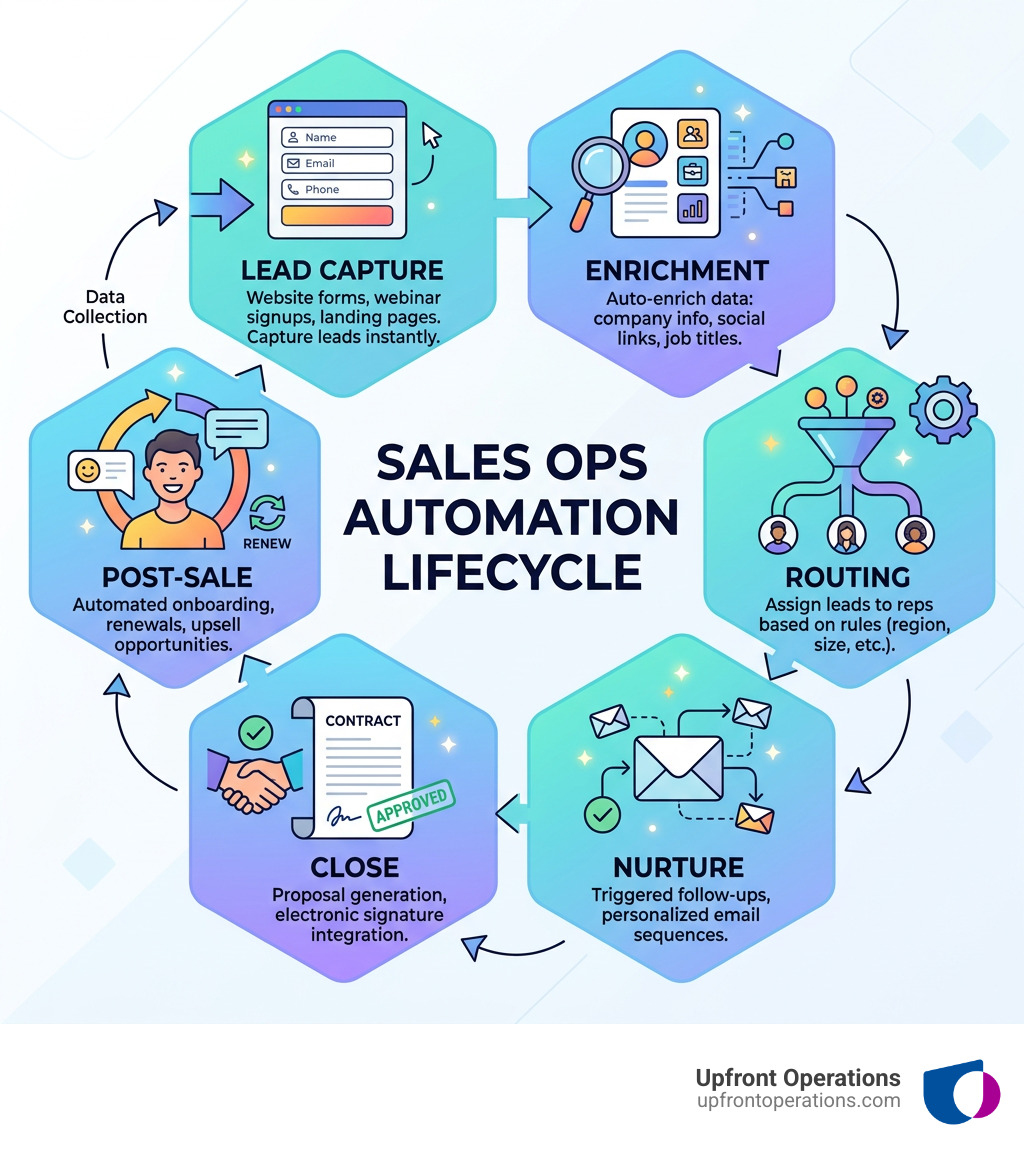
Sales ops automation is the use of software and AI to handle repetitive sales tasks — like data entry, lead routing, follow-ups, and CRM updates — so your team can focus on closing deals instead of managing admin work.
Here's what sales ops automation covers at a glance:
| Task | Without Automation | With Automation |
|---|---|---|
| Lead routing | Manual, delayed | Instant, rules-based |
| CRM data entry | Rep-handled, error-prone | Auto-logged, clean |
| Follow-up emails | Forgotten or late | Triggered, on-time |
| Pipeline reporting | Manual spreadsheets | Real-time dashboards |
| Quote generation | Slow, back-and-forth | Auto-generated on trigger |
Sales reps are already stretched thin. They toggle between disconnected tools, manually update records, and chase down leads that should have been followed up hours ago. Meanwhile, contact data decays at roughly 30% every year — meaning the CRM your team depends on is quietly becoming less reliable every single day.
The result? Missed opportunities, inconsistent revenue, and a team that's busy but not productive.
The good news: the right automation fixes all of this — without adding headcount or complexity.
I'm Ryan T. Murphy, founder of Upfront Operations, and over the past 12 years I've helped 32 companies implement sales ops automation strategies that shortened sales cycles by up to 28% and unlocked millions in new revenue. In this guide, I'll walk you through exactly how to do the same.
Related content about Sales ops automation:
At its core, sales ops automation is the engine room of a modern revenue organization. Imagine a world where your sales reps never have to manually type a phone number into a CRM or spend Sunday nights building "Monday Morning" reports. Instead, they spend their time where they are most valuable: talking to prospects and solving customer problems.
In the current market, especially in competitive hubs like New York, speed is the only currency that matters. "Speed-to-lead" isn't just a buzzword; it’s a survival metric. Research shows that following up with a lead within the first few minutes significantly increases the chance of a conversion. Manual processes simply cannot move that fast.
Furthermore, data integrity is a silent killer. With contact records decaying at a rate of 30% annually as people change jobs or companies get acquired, a manual CRM is a graveyard of bad information. Automation ensures that your data is enriched, cleaned, and updated in real-time. By unifying sales and marketing data, we eliminate the silos that cause leads to fall through the cracks.
In 2026, we are seeing a massive shift from traditional SalesOps to a more holistic approach: Revenue Operations (RevOps). While SalesOps focuses specifically on the sales team's execution, RevOps takes a bird's-eye view, aligning sales, marketing, and customer success into a single, unstoppable revenue engine.
RevOps automation ensures that the handoff from marketing to sales is seamless and that the feedback loop from customer success back to sales is data-driven. This alignment usually reports directly to the C-suite, providing a level of visibility that manual systems can't touch.
The Four Levers of RevOps Growth:
Modern buyers expect hyper-personalization. They don't want a generic "Checking in" email; they want a message that acknowledges their specific industry challenges, recent company news, and past interactions with your brand. Doing this manually for 100 leads is impossible. Doing it with sales ops automation is a Tuesday morning.

| Feature | Manual Process | Automated Sales Ops |
|---|---|---|
| Lead Scoring | Gut feeling/Subjective | Data-driven/Predictive |
| Personalization | "One size fits all" | Hyper-personalized at scale |
| Reporting | Periodic/Static | Real-time/Dynamic |
| Error Rate | High (Human error) | Low (Systematic accuracy) |
| Scalability | Linear (Requires more people) | Exponential (Requires better tech) |
To build a truly automated sales machine, you need to focus on the pillars that hold up the entire revenue structure. It isn't just about sending automated emails; it’s about data orchestration across your entire tech stack.
The "top of the funnel" is often the messiest part of sales. Automation cleans it up by implementing "enrichment waterfalls." When a lead enters your system with just an email address, automation tools can instantly pull their LinkedIn profile, company size, tech stack, and even recent funding rounds.
Prospecting triggers that can be automated:
By automating the follow-up to these triggers, you ensure that your reps are always striking while the iron is hot.
Beyond finding leads, automation must manage the "middle and bottom" of the funnel. This includes pipeline visibility and commission tracking. There is nothing more demotivating for a sales team than not knowing exactly how much they've earned in real-time.
Software like Qobra or Spiff automates commission calculations, providing reps with a "live" dashboard of their earnings. This transparency has been shown to increase objective achievement by 15-20%. When reps see they are only one deal away from a higher accelerator, they push harder.
The tech stack of 2026 is smarter, faster, and more integrated than ever before. We no longer look for "point solutions" that do one thing; we look for platforms that talk to each other. Whether you are looking for fractional sales ops experts or on-demand microservices, choosing the right tools is the foundation of your success.
AI is no longer just a chatbot on a website. Modern AI Sales Copilots are context-aware. They live across your entire sales funnel, from first touch to closed-won. These tools can:
While there are thousands of tools out there, a few heavy hitters lead the pack in 2026:
Check out our pricing page to see how we can help you integrate these tools into your workflow without the enterprise-level price tag.
Implementation is where most companies fail. They buy the "shiny new toy" but don't have a plan for how to use it. At Upfront Operations, we believe in a "crawl, walk, run" approach to sales ops automation.
How do you know if your investment is paying off? You look at the data.
It's not all rainbows and revenue growth. Adopting sales ops automation comes with hurdles.
"Tool fatigue" is real. When a rep has to log into seven different platforms to do their job, productivity actually drops. This is why a unified system is critical.
Sales process automation is a subset of sales ops. Process automation focuses on the "how" of a sale (like sending an email sequence), while sales ops automation focuses on the "infrastructure" (like lead routing, data enrichment, and commission tracking).
AI acts as a force multiplier. It can analyze thousands of data points in seconds to tell a rep which three deals they should focus on today, draft a personalized follow-up based on a prospect's recent LinkedIn post, and predict exactly when a deal is about to go "cold."
Start with the "low-hanging fruit." Automate your lead routing so that new leads are assigned instantly. Then, automate your data enrichment so reps don't have to research company sizes or titles manually. Once those are running, move on to more complex workflows like automated quote generation.
The future of sales isn't about working harder; it's about working smarter. Sales ops automation is the key to unlocking that efficiency. Whether you're a solopreneur looking for a simple business email setup or a growing company in need of elite fractional sales operations experts, we are here to help.
At Upfront Operations, we provide on-demand microservices that take the complexity out of scaling. We handle your CRM management, lead nurturing, and pipeline optimization so you can get back to what you do best: growing your business.
Ready to stop the manual grind and start scaling with momentum? Learn more about our services and let’s build your revenue engine together.