January 23, 2026

10
min read
Beginner's Guide to Go-To-Market Engineering
Unlock scalable growth. Discover Go-To-Market Engineering to build a powerful revenue engine and drive efficiency in your ...
Unlock scalable growth. Discover Go-To-Market Engineering to build a powerful revenue engine and drive efficiency in your ...

Go-To-Market Engineering uses automation, data, and systematic processes to build scalable revenue engines. Instead of just hiring more people, it combines technical expertise with business strategy to create repeatable systems that align sales, marketing, and product teams.
Quick Definition:
If your business struggles with manual follow-ups, inconsistent lead quality, or the need to hire more reps to grow, you're not alone. The traditional approach of throwing more people at the problem is expensive and ineffective. The tools GTM Engineers use can replace up to 70% of what a traditional SDR team accomplishes, allowing one person to do the work of an entire team.
This represents a shift from reactive maintenance to proactive system building. Instead of fixing broken processes, Go-To-Market Engineering creates intelligent workflows that improve over time.
As the founder of UpfrontOps, I've spent over 12 years helping companies implement these principles to cut waste and open up new revenue. My experience shows that smart systems, not just more headcount, drive remarkable growth.
Explore more about Go-To-Market Engineering:

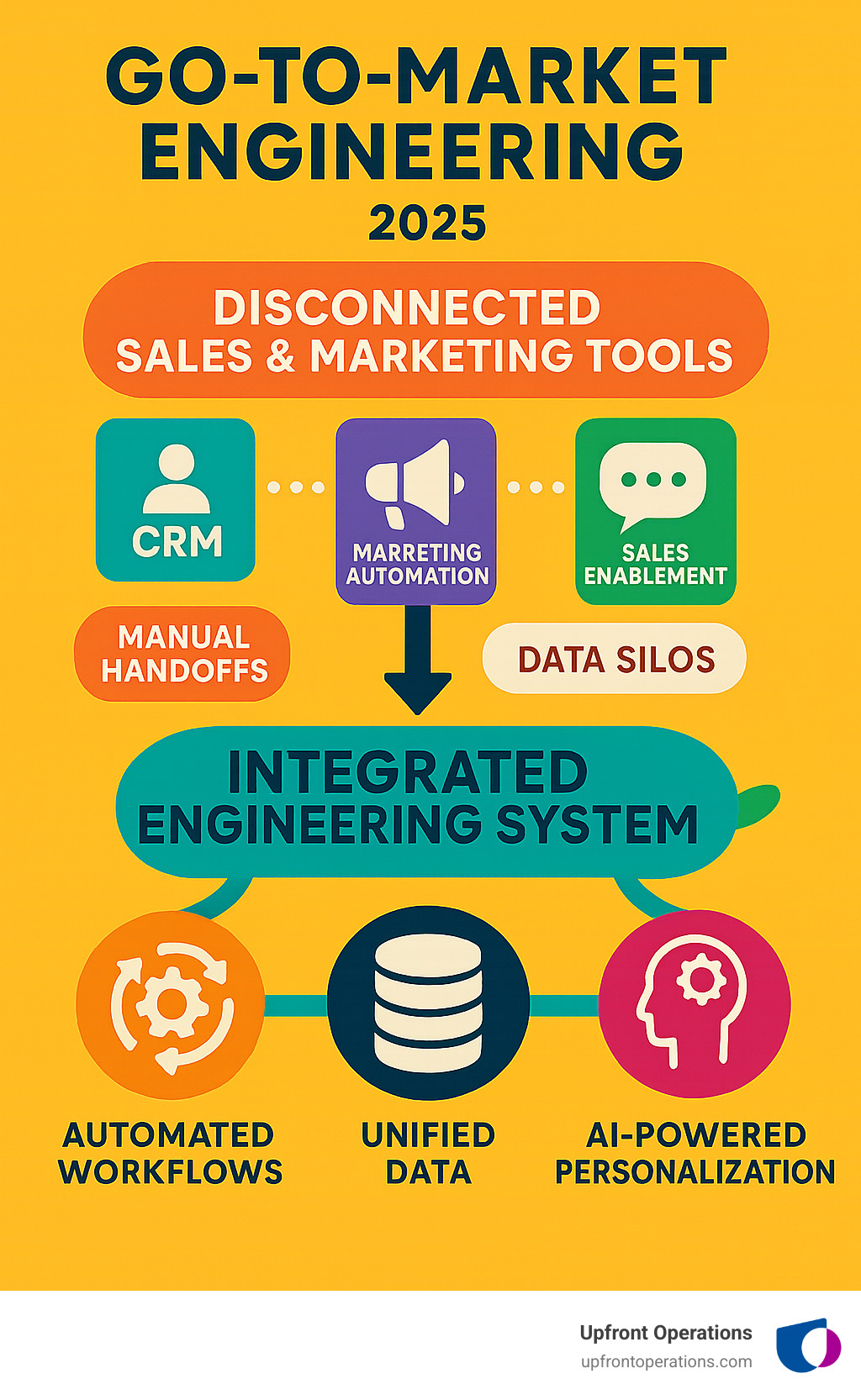
Instead of throwing more people at revenue problems, Go-To-Market Engineering builds an automated factory that generates customers. It applies an engineering mindset to your entire revenue process, creating an efficient machine to attract, nurture, and convert customers with minimal manual work. This hybrid role combines technical skills with business strategy, making it the ultimate growth operator position.
A Go-To-Market Engineer bridges the gap between product and market, blending systems thinking with hands-on execution. They are proactive builders who create new solutions rather than just maintaining existing ones, breaking down the silos that traditionally separate sales, marketing, and product teams.
Traditional growth models that rely on adding salespeople often lead to higher costs and diminishing returns. Go-To-Market Engineering flips this by scaling with systems, not headcount. The goal is to build a "revenue engine"—a smart, automated system that works 24/7 to generate leads, close deals, and retain customers.
This engine runs on automation, data integration, and AI-powered personalization. By creating repeatable processes that improve over time, you shift from being a "data plumber" fixing broken connections to a growth architect designing intelligent, self-improving systems.
Go-To-Market Engineering fosters cross-functional collaboration by creating a unified tech stack where all teams share the same data and goals. When your CRM, marketing automation, and analytics tools are connected, the finger-pointing between sales and marketing stops. Marketing sees which leads convert, and sales gets the context needed to close deals faster.
This integration extends to customer success, automatically flagging renewal and upsell opportunities, and creates product feedback loops so your development team builds features customers want. The result is a well-oiled machine where departments work together, making growth predictable and systematic.

The old sales playbook is broken because today's buyers have changed. They research solutions and are often 90% through their buying journey before ever speaking to a salesperson. Winning companies are no longer those throwing more bodies at the problem—they're the ones building smarter systems. Go-To-Market Engineering turns manual revenue generation into an intelligent, automated engine.
While competitors hire more SDRs, a single Go-To-Market Engineer can build systems that outperform an entire team. It's about engineering growth that scales without the associated growing pains.
The demand for GTM Engineers is exploding, with over 33% starting their roles in 2024 alone. This is driven by:
The most impactful statistic is that GTM tools can replace up to 70% of traditional SDR tasks. This eliminates mundane work, frees up teams for high-value activities, and dramatically increases ROI.
Implementing Go-To-Market Engineering delivers tangible results:

A Go-To-Market Engineer is a strategic partner who combines technical skill with business acumen. They see the big picture of revenue growth while handling the technical details to build systems that scale, ensuring automation efforts directly contribute to closing deals and retaining customers.
Successful GTM Engineers are curious problem-solvers. Their skills are a hybrid of technical and strategic capabilities:
This role appears under titles like GTM Systems Engineer, Revenue Operations Engineer, or GTM Automation Specialist. Salaries reflect the high value of these hybrid skills:
For businesses not ready for a full-time hire, freelance GTM Engineers charge between $50 and $150 per hour. At Upfront Operations, we provide this expertise through on-demand services, offering a flexible way to access specialized skills for specific automation projects or ongoing system optimization.
While Go-To-Market Engineering shares DNA with Sales Operations and Revenue Operations (RevOps), its function is distinct. Traditional ops roles maintain and optimize existing systems, while GTM Engineering builds entirely new ones.
Think of RevOps as the mechanic who keeps the car running smoothly, while the Go-To-Market Engineer is the inventor designing a new, more efficient engine.
Here's a breakdown of the key differences:
Primary Focus:
Approach to Problems:
Key Activities & Tools:
Outcomes:
RevOps provides the stable foundation that GTM Engineering builds upon. But for exponential growth without a proportional increase in headcount, you need an engineer, not just an operator. Services like our CRM optimization and automation can help bridge this gap, moving your business from traditional operations toward a true GTM Engineering approach.

You don't need to revolutionize your entire operation overnight. The best way to implement Go-To-Market Engineering is to start small. Focus on a single, high-impact bottleneck, measure everything to track your progress, and foster a culture of experimentation where quick wins and smart failures are both celebrated.
Choose a first project that delivers a quick win and proves the concept. Here are four proven starting points:
If these projects feel overwhelming, our on-demand services are designed to help. Our CRM setup and optimization service can build a rock-solid data foundation, while our lead nurturing automation can create personalized workflows for you.
As you scale your GTM Engineering efforts, you have several options:
At Upfront Operations, our model is built on this flexibility. Whether you need a one-time sales pipeline optimization or ongoing fractional sales operations support, we provide elite expertise on-demand. Explore our service costs and options to find the right fit for your budget and stage of growth.
Here are answers to the most common questions about Go-To-Market Engineering.
Yes, absolutely. Startups and small businesses may benefit the most. With a lean team and tight budget, efficiency is critical. Go-To-Market Engineering allows a small team to operate with the impact of a much larger one by automating manual tasks like lead research and follow-up.
For resource-strapped businesses, engineering your GTM motion is the key to scaling successfully without a proportional increase in headcount or budget. It's about maximizing impact with lean resources.
The most crucial skill is being a hybrid: part commercial thinker, part technical builder. A great Go-To-Market Engineer doesn't just understand technology; they understand how it drives revenue. They can identify a business problem (like low conversion rates), diagnose the commercial cause (poor lead quality), and then build the technical solution (an automated lead scoring system).
This ability to connect business strategy with hands-on technical execution is what transforms an operations person into a true growth architect.
Success is measured by tangible business outcomes, not just activity metrics. Key indicators include:
The ultimate goal is to create systems that consistently deliver better results over time, making growth a predictable outcome of your operations.
The traditional playbook of hiring more people to solve growth problems is broken. Go-To-Market Engineering offers a more intelligent, sustainable path by building automated systems that scale revenue without scaling headcount.
The GTM Engineer role is a strategic imperative, creating a competitive edge by building a resilient revenue machine that gets smarter over time. While competitors burn through budgets on hiring, you can build a moat that is difficult to replicate.
At Upfront Operations, based in New York, we help businesses realize their GTM motion isn't under-staffed—it's under-engineered. By building better systems, we've helped clients open up millions in new revenue.
Our flexible model is our selling point. We offer everything from on-demand CRM setup for small businesses to elite fractional sales operations experts for growing companies. We deliver the exact expertise you need, when you need it, surpassing the value of traditional agencies.
The future belongs to companies that engineer their growth. The question is whether you'll lead the shift or be left trying to catch up.
Ready to transform your revenue operations? Learn about our fractional sales operations experts and find how we can help you build the automated, scalable systems to drive your business forward.