February 18, 2026

10
min read
AI in Sales & Marketing: Everything You Need to Know to Get Ahead
Unlock growth with artificial intelligence sales and marketing. Learn how AI transforms customer journeys, boosts efficien...
Unlock growth with artificial intelligence sales and marketing. Learn how AI transforms customer journeys, boosts efficien...

Artificial intelligence sales and marketing is no longer a futuristic concept—it's the competitive edge redefining how businesses connect with customers, close deals, and grow revenue. Here's what you need to know:
The shift is happening fast. While 87% of sales leaders report a top-down push from CEOs and boards to implement generative AI, many teams struggle with where to start, how to integrate tools, and whether their data is ready. This gap between vision and execution is wider and more costly than ever.
The core challenge? Most mid-sized businesses are trapped between manual processes (leading to missed follow-ups and low conversions) and expensive, rigid agency solutions. AI offers a third path: intelligent automation that scales with your business, turning scattered data into actionable insights and changing how your sales and marketing teams collaborate.
What makes this moment different is that AI isn't just about efficiency anymore. Generative AI can now draft entire sales sequences, create landing pages, and even analyze competitor pricing in seconds. Machine learning improves lead scoring by learning from your team's wins and losses. Natural Language Processing enables chatbots that sound human, not scripted. And predictive analytics can tell you which prospects are ready to buy before your sales team even picks up the phone.
Research shows that successful companies don't just buy AI tools—they build strategies. They combine the right technology with clean data, smart workflows, and human oversight, investing in training and governance to align AI with business goals. And they're seeing results: revenue uplifts of 3-15% and sales ROI increases of 10-20% are becoming the new normal for those who get it right.
I'm Ryan T. Murphy, founder of Upfront Operations, and over the past 12 years, I've helped 32 companies implement artificial intelligence sales and marketing systems that work—cutting sales cycles by up to 28%, multiplying website traffic 10X, and turning messy CRM data into predictive growth engines. Whether you need to automate lead nurturing, optimize your pipeline with AI, or create on-demand sales assets like one-pagers and playbooks, the goal is always the same: use smart tools and clean processes to help your team do more with less.
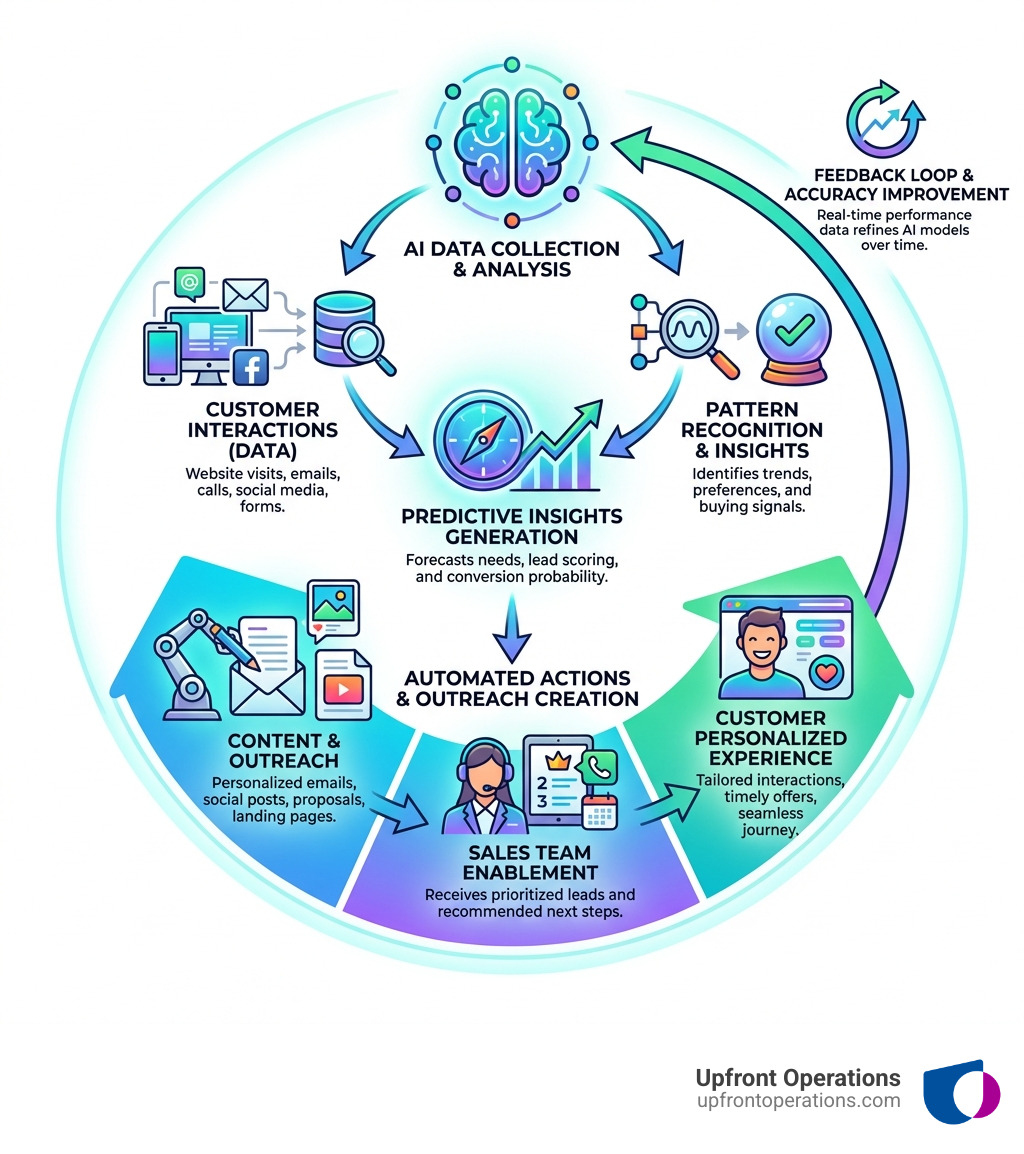
Before we dive into the exciting applications, let's clarify what we mean by artificial intelligence sales and marketing. It's more than just a buzzword; it's a suite of technologies that are changing the game.
At its core, Artificial Intelligence (AI) is technology designed to perform cognitive tasks as well as or better than humans. In sales and marketing, AI simulates human intelligence by processing data with algorithms and pattern recognition, making complex tasks easier by delegating them to computers.
The primary goal of AI in this field is to manage and analyze vast amounts of customer data in real-time, gaining deep insights and automating repetitive work. This allows businesses to predict customer needs, personalize interactions, and make more informed decisions. AI is incredibly efficient for tasks that would overwhelm a human team.
AI is not a monolith; it encompasses several specialized types, each with unique strengths. Understanding these is crucial for deploying the right tools for your artificial intelligence sales and marketing strategy.
| AI Type | Function in Sales & Marketing - Generative AI: Creates new content (text, images, video) based on the patterns it learned from its training data. Example: Generating personalized ad copy or product descriptions. - Predictive AI: Analyzes historical data to forecast future outcomes. Example: Recommending which customers to target with a promotion based on predicted buying habits. - Natural Language Processing (NLP): Enables computers to understand, interpret, and generate human language. Example: Chatbots that can answer customer questions naturally. - AI Analytics: Interprets complex data patterns to offer actionable business insights. Example: Identifying key demographics for a new product launch. - Smart Process Automation (SPA): Combines artificial intelligence (AI) with automation, often involving machine learning, to automate complex tasks and processes. Example: A sales team using SPA for automated lead qualification and nurturing. - These AI types often complement each other. Predictive AI might provide insights into consumer behavior, and then Generative AI can use that information to create hyper-personalized marketing content. Think of it as a detective (Predictive AI) uncovering clues, and then a brilliant storyteller (Generative AI) crafting a compelling narrative based on those clues.
Machine learning (ML) is a subset of AI that gives systems the ability to learn and improve from experience without being explicitly programmed. It's the "secret sauce" that allows AI to get smarter over time. Just like a human, AI requires significant training to learn a new task. The more data and practice it gets, the better it becomes.
In sales and marketing, ML is a powerhouse:
By leveraging machine learning, we can build purpose-built AI tools trained on specific or company-specific datasets, increasing their efficacy and ensuring they align perfectly with our business goals.
The customer journey is no longer a linear path; it's a dynamic, multi-touchpoint experience. Artificial intelligence sales and marketing tools are revolutionizing how we interact with customers at every step, creating more seamless, personalized, and efficient journeys.
From initial contact to post-purchase, AI provides real-time insights into customer behavior across the sales process. This enables hyper-personalization, effective lead nurturing, accelerated sales cycles, and stronger brand loyalty.
AI is changing marketing from a reactive to a predictive, hyper-personalized approach.
AI is equally transformative for sales, automating repetitive work and uncovering insights that humans can't scale, giving businesses the tools to grow smarter and faster.
At Upfront Operations, we deliver game-changing sales operations support, supercharging your CRM, lead nurturing, and pipeline optimization to help you close deals faster and scale. We offer on-demand microservices, including expert help with your sales tech stack and implementing AI-driven processes. More info about our services.
AI is blurring the lines between sales and marketing, creating a cohesive, customer-centric approach. Many AI tools serve both functions, creating synergy and efficiency.
Embracing AI isn't just about buying software; it's about strategic planning, overcoming problems, and ensuring responsible use.
The opportunities presented by artificial intelligence sales and marketing are immense:
However, challenges remain. The sales industry's hesitation to adopt AI could be costly. Over 80% of sellers cite inaccuracy and poor data integration as obstacles, requiring manual verification. Additionally, 75% of sellers feel under-supported, with inadequate training hindering their confidence.
This is where Upfront Operations helps. For small businesses and solopreneurs, we offer on-demand microservices like websites and business email to streamline operations and prepare your data for AI. For larger companies, our fractional sales operations experts provide strategic guidance and implementation support to overcome data integration issues and ensure proper AI training. We help you define a clear AI vision, integrate the right tech stack, and emphasize data quality. Learn more about us.
As we accept AI, we must also address the ethical considerations, particularly data privacy and algorithmic bias.
Successful AI integration requires more than tools; it demands a strategic approach and an AI-ready team.
The evolution of artificial intelligence sales and marketing is happening at an incredible pace, turning science fiction into reality.
AI's primary role is to automate time-consuming, data-heavy tasks and uncover insights at scale, freeing up human sellers to focus on complex problem-solving, relationship building, and closing deals. It improves efficiency by handling tasks like lead qualification, data entry, and sales forecasting. AI also helps improve forecasting accuracy by analyzing historical data and market trends, and it enables hyper-personalized outreach, tailoring messages and pitches to individual customer needs and behaviors. This augmentation allows sales teams to work smarter, not just harder.
Generative AI is used to create original content like blog posts, social media updates, email campaigns, ad copy, and even images or videos. It helps marketers scale content production, brainstorm ideas, and personalize messaging for different audience segments quickly. For example, it can draft multiple versions of an ad, write product descriptions, or even generate entire campaign narratives, significantly reducing the time and resources required for content creation while ensuring relevance and consistency.
The biggest challenges include poor data quality and integration, which can lead to inaccurate AI outputs and distrust among users. The high cost of specialized AI tools and the lack of in-house AI expertise also pose significant barriers. Many sellers feel under-supported with inadequate training, leading to employee resistance to change. Additionally, ensuring ethical use, particularly regarding data privacy and avoiding algorithmic bias, are critical concerns that organizations must proactively address to build trust and maintain a positive brand image.
The revolution of artificial intelligence sales and marketing is not just coming; it's already here. We've explored how AI, from machine learning to generative AI, is automating tasks, personalizing customer journeys, and providing unprecedented insights. The benefits are clear: increased efficiency, improved customer experience, and accelerated growth.
However, simply acquiring AI tools isn't enough. Success hinges on a thoughtful strategy, clean data, continuous training, and the crucial collaboration between human expertise and AI capabilities. The companies that thrive in this new landscape will be those that strategically accept AI as an augmentation tool, empowering their teams to focus on what humans do best: build relationships, innovate, and strategize.
If you're a small business or solopreneur in New York looking to streamline your operations and leverage AI for growth, we offer essential on-demand microservices, including professional websites and business email, to set a solid foundation. For larger enterprises, our elite fractional sales operations experts provide the strategic guidance and hands-on implementation to integrate AI seamlessly, optimize your pipeline, and develop a robust, ethical AI strategy.
Don't let the complexity of AI hold you back. Let us help you steer this exciting frontier. We're here to provide the expert guidance and practical solutions you need to make AI work for you, ensuring your sales and marketing efforts are not just keeping up, but getting ahead.
View our pricing and get started today.
Artificial intelligence sales and marketing terms to learn: