Why Email Marketing Automation is Your Growth Engine

Email marketing automation is using software to send targeted, personalized emails based on specific triggers or schedules—without manual effort.
- What it does: Automatically sends the right message to the right person at the right time based on their actions (like signing up, abandoning a cart, or making a purchase).
- Key benefits: Saves hours of manual work, increases sales, and keeps customers engaged throughout their journey.
- How it works: Triggers (like form submissions) activate pre-built email sequences, delivering personalized content based on customer behavior.
- Common uses: Welcome series, abandoned cart recovery, post-purchase follow-ups, and re-engagement campaigns.
If you're watching leads slip through the cracks, you're not alone. About 70% of e-commerce shoppers abandon their carts, and without automation, those sales disappear. The good news? Automated emails generate up to 30 times more revenue per recipient than one-off campaigns—and they work 24/7 while you focus on growing your business.
The real power of email marketing automation isn't just sending emails faster; it's about creating a customer journey that feels personal at scale. When someone visits your pricing page three times but doesn't buy, automation can trigger a targeted email with answers to common objections. When a customer makes their first purchase, a welcome series can introduce them to your brand story. This is marketing that responds to behavior in real-time, turning scattered touchpoints into a cohesive experience.
I'm Ryan T. Murphy, founder of UpfrontOps. Over the past 12 years, I've helped 32 companies streamline their marketing operations with smart automation, reducing sales cycles by up to 28% and multiplying website traffic 10X. My focus is turning marketing automation platforms into revenue-generating systems that work—without the chaos.
Relevant articles related to Email marketing automation:
What is Email Marketing Automation and Why Does It Matter?
At its core, email marketing automation sends emails automatically based on predefined triggers or actions. Think of it as a loyal assistant who sends a thank-you note, a follow-up, or a special offer at the perfect moment. The software detects specific customer actions—or inactions—and responds with a timely, personalized email.
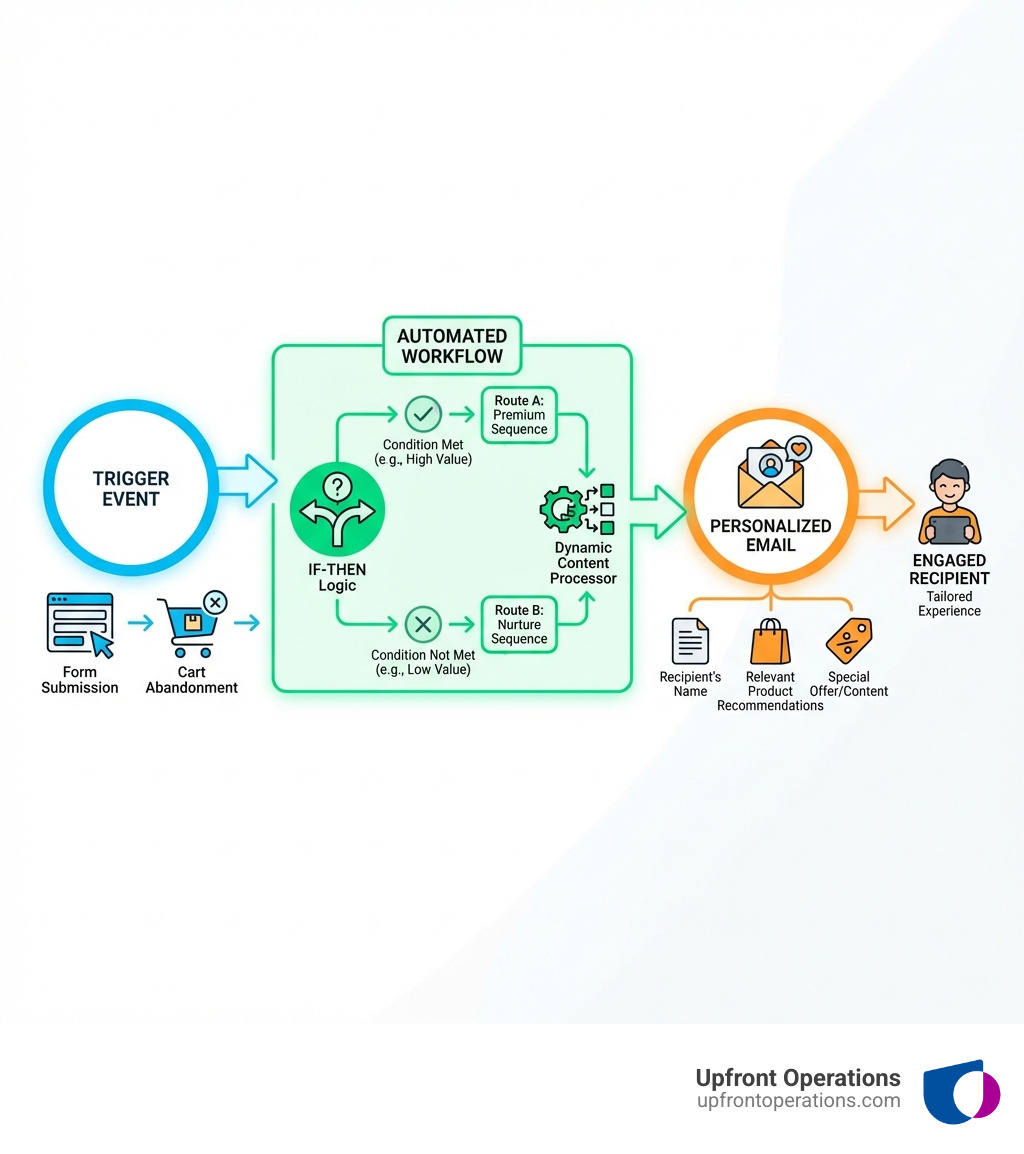
It works by setting up "if-then" scenarios. If a customer signs up, they get a welcome email. If they abandon their cart, they get a reminder. These predefined rules, linked to website analytics, allow you to target people based on behavior, preferences, and past purchases, enabling conversations at scale.
The beauty of email automation is its ability to handle repetitive tasks, freeing you to focus on strategic growth. This scalability means you can nurture more leads without a proportional increase in staff. The numbers are compelling: email marketing can deliver an impressive ROI of up to 4200%, with an average ROI around 122%. It's not just about sending emails faster; it's about making every email count, fostering customer relationships, and driving sales.
The Core Benefits for Your Business
For any business in New York and beyond, email marketing automation offers concrete benefits that impact your bottom line:
- Saves Time and Resources: Automating email sequences eliminates manual message crafting and sending. This frees your team to focus on higher-value tasks like creative strategy and customer interactions.
- Improves Marketing Team Efficiency: By automating routine communications, your marketing team can maximize output. They can design and run sophisticated campaigns instead of getting bogged down in repetitive sending, leaving more time for analysis and innovation.
- Increases Scalability: As your business grows, email automation ensures your communication strategy scales effortlessly. The system handles the workload whether you have 100 or 100,000 customers, allowing you to reach a larger audience without more manual effort.
- Boosts Customer Retention Rate: Consistent, relevant communication keeps your brand top-of-mind. Automated follow-ups and re-engagement campaigns make customers feel valued, improving loyalty and retention.
- Drives Higher ROI: Personalized and timely automated emails perform exceptionally well. They generate more engagement and conversions, directly contributing to a higher return on marketing investment.
- Personalized Experience: Automation truly shines with personalization. Since 90% of consumers find personalized content appealing, email is the perfect channel. Automation lets you tailor messages based on customer data and behavior, making every interaction feel unique.

How Automation Works: From Trigger to Inbox
The magic of email automation unfolds through a series of interconnected steps designed to engage and convert.
- User Actions as Triggers: It all begins with a trigger—an action a customer takes (or doesn't take) on your site or with your emails. Common triggers include signing up, viewing a product, abandoning a cart, or making a purchase.
- Website Analytics and Data Integration: Smart automation needs data. We link website analytics to your email platform to track visitor behavior, gathering insights on page visits and content engagement. This data fuels personalization.
- Audience Segmentation: With data, we segment your audience. Instead of one-size-fits-all emails, we divide subscribers into smaller groups based on demographics, interests, purchase history, or behavior to ensure high relevance.
- Pre-built Workflows and If/Then Logic: The core of automation is the workflow—email sequences sent based on triggers and conditions. Using "if-then" logic, we map out customer journeys, like sending a cart reminder after 30 minutes, followed by a discount offer after 24 hours.
- Dynamic Content and Personalization: Automation enables dynamic content, where parts of an email change based on individual data. An abandoned cart email can show the exact products left behind, while recommendations can feature complementary items.
- Strategic Scheduling: Timing is everything. Automation lets us schedule messages for optimal delivery times, ensuring your emails land when customers are most likely to open them.
- A/B Testing and Iteration: We continuously A/B test email elements—subject lines, content, CTAs—to see what resonates. Tracking performance metrics helps us iterate and optimize for better results, ensuring your automation performs at its peak.
Essential Automated Email Campaigns to Launch Today
Automated email campaigns are the workhorses of modern marketing, operating 24/7 to engage your audience. Let's look at the most impactful campaigns you can implement right away.

The Welcome Series: Making a Strong First Impression
A welcome series is your brand's digital handshake and a crucial first impression. Since 74% of people expect a welcome email, these messages are highly effective, getting 4 times more reads and 5 times more clicks than standard campaigns and generating up to 320% more income per email.
A great welcome series is a sequence designed to:
- Introduce Your Brand: Share your story and what makes you unique.
- Set Expectations: Inform subscribers about content frequency and type.
- Deliver Initial Value: Offer a discount, free resource, or exclusive content.
- Guide Next Steps: Direct them to popular products or resources.
This initial interaction builds brand affinity and sets the stage for a lasting relationship.
The Abandoned Cart Sequence: Recovering Lost Sales
With around 70% of shoppers abandoning their carts, a strategic recovery sequence is essential for capturing lost revenue. These emails are triggered when a customer leaves items in their cart without purchasing.
A typical sequence involves:
- A Gentle Reminder: Sent within an hour, reminding them what they left behind.
- Overcoming Objections: A follow-up addressing common concerns (like shipping costs) or highlighting product benefits.
- A Strategic Discount: A limited-time discount can provide the final nudge, but use them carefully to avoid devaluing your products.
Abandoned cart flows generate significant revenue per recipient, outperforming standard campaigns. Our lead nurturing services are designed as an on-demand microservice to help you implement these crucial recovery campaigns.
Post-Purchase & Feedback Emails: Building Trust and Loyalty
The customer journey continues after the purchase. Post-purchase and feedback emails are vital for building trust, fostering loyalty, and driving repeat business.
- Order and Shipping Confirmation: These essential transactional emails confirm the purchase and provide tracking details. With the highest open rates of any automated email (61.68%), they are a prime opportunity to reinforce your brand.
- Product Review Requests: After a customer receives their product, an automated email requesting a review provides powerful social proof for new customers. Incentivizing reviews can boost participation.
- Upselling and Cross-selling: Based on purchase history, automated emails can recommend complementary products (cross-selling) or upgrades (upselling). This increases average order value and shows you understand customer needs.
- Instructional Emails: For complex products, automated how-to guides can improve the customer experience and reduce support inquiries.
Engaging customers after the sale deepens their brand relationship, encouraging them to become repeat buyers and advocates.
How to Build an Effective Email Automation Strategy
Building a robust email automation strategy means creating a dynamic system that continuously engages, nurtures, and converts. It requires thoughtful planning, the right tools, and ongoing optimization.
Choosing the right email marketing automation platform is foundational. Consider your business needs, budget, and desired complexity.
Key considerations include:
- Ease of Use: Is the interface intuitive for designing workflows and emails?
- Integrations: Does it connect with your CRM (like HubSpot), e-commerce platform, and other tools?
- Scalability: Can the platform grow with your business regarding subscribers, sends, and cost?
- Features: Does it offer advanced segmentation, dynamic content, A/B testing, and analytics?
Many platforms offer free or affordable tiers. Popular options include:
- MailerLite: Great for beginners with a generous free plan (up to 1,000 subscribers).
- Brevo (formerly Sendinblue): A solid choice for high-volume senders (free plan with 300 emails/day).
- Omnisend: Strong for e-commerce with advanced automation on its free plan (up to 250 contacts).
- Sender: A low-cost bulk sending option (free for up to 2,500 subscribers).
- Kit (formerly ConvertKit): Designed for creators (free for up to 10,000 subscribers).
- Mailchimp: A popular option, though its free plan is more limited (500 subscribers).
Choosing and setting up tools can be daunting. We offer on-demand support to help you implement solutions that fit your unique business needs.
Step 2: Master Segmentation and Personalization
Next, master segmentation and personalization to resonate with your audience. After all, 96% of consumers are more likely to purchase when brands send personalized messages.
- Audience Segmentation: Divide your email list into specific groups based on:
- Behavioral Data: Page visits, link clicks, email opens.
- Purchase History: Products bought, purchase frequency, and recency.
- Demographics: Location, age, gender (with consent).
- Engagement Level: Active vs. inactive subscribers.
- Dynamic Content: Go beyond a first name. Change parts of your email based on individual data, like showing products related to a user's browsing history.
- Personalized Recommendations: Including personalized recommendations can increase sales per email opening by an average of 150%. Building detailed customer profiles ensures every email feels tailor-made.
The goal is to send fewer, more targeted messages. This respects your subscribers' inboxes and dramatically increases engagement.
Step 3: Ensure Your Emails Reach the Inbox
An email automation strategy is useless if your emails land in spam. Ensuring deliverability is paramount. Here are key best practices:
- Domain Authentication (SPF, DKIM, DMARC): This technical step is crucial. Authenticating your domain tells ISPs your emails are legitimate. With stricter rules from Google and Yahoo for bulk senders, proper authentication is mandatory.
- Opt-in Lists: Always get explicit permission before emailing recipients. Use double opt-in forms and ensure your practices comply with regulations like the CAN-SPAM Act. Sending to non-opt-in lists ruins deliverability.
- List Cleaning: Regularly remove inactive or invalid contacts. This improves your sender reputation, reduces bounce rates, and lowers spam complaints.
- Non-Spammy Subject Lines: Craft clear, relevant subject lines that avoid excessive capitalization, exclamation points, or trigger words like "FREE!!!".
- Easy Unsubscribe Link: Provide a clear, one-click unsubscribe link. Honoring opt-out requests promptly is essential for compliance and user trust.
Adhering to these practices helps ensure your emails consistently reach the inbox.
Frequently Asked Questions about Email Automation
We often get asked common questions about email marketing automation. Let's clear up some of the confusion and provide straightforward answers.
What's the difference between email marketing and email automation?
While often used interchangeably, there's a key distinction:
- Email marketing is the broad strategy of using email to communicate with an audience. This includes one-off campaigns like newsletters or holiday promotions, which you send manually.
- Email automation is the technology that sends emails automatically based on customer actions or triggers. A welcome email sent after a signup is an example of automation. The customer's behavior decides "when" the email is sent.
In short, email automation is a powerful tool within your overall email marketing strategy that enables personalized, timely communication at scale.
How can I automate emails for free?
Yes, many excellent email marketing automation platforms offer robust free plans, perfect for getting started without upfront costs. These tiers usually have limits on subscribers or monthly sends.
As mentioned earlier, platforms like MailerLite, Brevo, Omnisend, Sender, and Kit offer generous free plans to get you started. While these are great for new businesses, you'll likely need to upgrade to a paid plan as you grow. Paid tiers are often affordable and open up more powerful features and higher capacity.
How does email marketing automation help nurture leads and drive sales?
Email automation is a powerhouse for nurturing leads and driving sales by enabling relevant, timely communication throughout the sales funnel.
- Lead Nurturing: Automation uses drip campaigns to send sequences of useful content to new leads, preventing them from going cold. Nurtured leads can result in 50% more sales at a 33% lower cost.
- Lead Scoring: Advanced strategies use lead scoring to assign points to customer actions (like visiting a pricing page). High-scoring leads can trigger a targeted offer or an alert to your sales team, focusing efforts on the most qualified prospects.
- Sales Funnel Guidance: Automation delivers the right message at the right time, guiding prospects from awareness (welcome series) to decision (abandoned cart reminders) and efficiently toward conversion.
- Timely Follow-ups: Automation allows for immediate responses to customer behavior. If a potential client in New York shows interest in a service, a follow-up email with a personalized offer can be sent instantly.
This strategic approach builds relationships and guides leads toward a purchase, optimizing your revenue engine. For deeper insights, check out our sales operations experts.
Conclusion: Scale Your Marketing with On-Demand Expertise
As we've explored, email marketing automation is an essential strategy for any business looking to thrive. It frees up time, boosts marketing efforts, and builds deeper customer relationships. From welcome series to abandoned cart recovery, automation ensures your message is always on point and working for you.
At Upfront Operations, we empower businesses to achieve unstoppable momentum. We know not every business has the resources for a full-time marketing team, which is why we offer on-demand microservices, like setting up robust email automation, for small businesses and solopreneurs. For larger companies, our elite fractional sales operations experts can boost your CRM management, lead nurturing, and pipeline optimization. We deliver custom expertise exactly when you need it, surpassing the value of traditional agencies and freelance platforms.
Don't let manual tasks hold your marketing back. Harness the power of email marketing automation and watch your business soar. Whether you need help starting with a new platform or fine-tuning existing workflows, we're here to help. Ready to transform your HubSpot operations? Streamline your HubSpot operations and find out how our on-demand services can make a tangible difference.