February 11, 2026

10
min read
The Art of the Follow-Up: How CRM Nurtures Leads to Sales Success
Unlock sales success with CRM lead nurturing. Convert more leads, build loyalty, and scale your business with expert strat...
Unlock sales success with CRM lead nurturing. Convert more leads, build loyalty, and scale your business with expert strat...

CRM lead nurturing is the strategic process of building relationships with potential customers through personalized, automated communications delivered at the right time based on their behaviors and stage in the buying journey. Here's what you need to know:
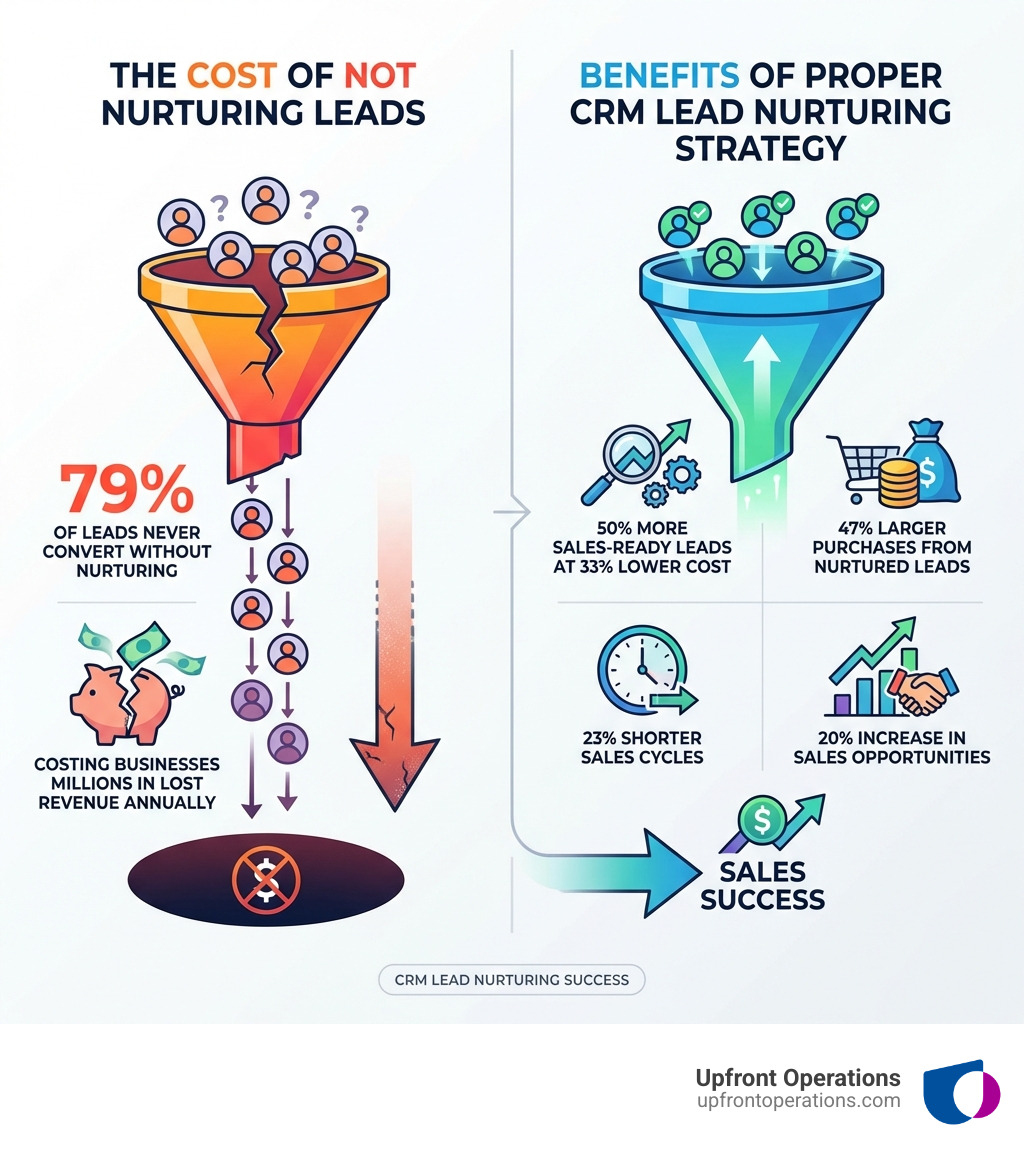
The numbers tell a stark story. Half of qualified leads aren't ready to buy immediately—but 80% of those "not now" prospects will purchase from someone within the next 24 months. Without a systematic approach to staying in touch and providing value, you're essentially handing those future customers to your competitors.
Think of lead nurturing like tending a garden. You wouldn't plant seeds and expect them to grow without water, sunlight, and consistent care. The same principle applies to your sales pipeline. A single cold call or generic email won't cultivate the trust needed to close deals. But a well-designed nurturing strategy—powered by your CRM—can transform lukewarm prospects into loyal, high-value customers.
The challenge? Most businesses are stuck in a cycle of manual follow-ups, inconsistent messaging, and missed opportunities. Sales reps forget to call back. Marketing sends the wrong content at the wrong time. Leads fall into a black hole between "interested" and "ready to buy."
Your CRM isn't just a database—it's your most powerful tool for building relationships at scale. When configured correctly with automated workflows, intelligent segmentation, and content aligned to each stage of the buyer's journey, it becomes the engine that turns casual browsers into committed buyers.
I'm Ryan T. Murphy, founder of UpfrontOps, and over the past 12 years I've helped 32 companies implement CRM lead nurturing systems that cut sales cycles by up to 28% and open up millions in previously lost revenue. I've seen how the right automation and clean data transform chaotic sales processes into predictable growth machines.
Simple guide to CRM lead nurturing terms:
Lead nurturing is more than just a buzzword; it's a fundamental necessity for modern businesses. When buyers are increasingly independent and conduct extensive research before engaging with sales, we need to meet them where they are and guide them through their decision-making process. This continuous process of building long-term relationships with prospects through consistent communication and relevant content is what CRM lead nurturing is all about. It empowers our sales teams to guide prospects through every stage of the customer journey with ease.
So, why is it so crucial for businesses?
Lead nurturing is about helping buyers along their educational journey, triggered by their activity or behaviors. It’s about being the "gardener" in the sales process, cultivating relationships, rather than just the "hunter" chasing immediate deals.
For many New York solopreneurs and small businesses, doing all of this manually just isn’t realistic. That’s why Upfront Operations offers on-demand microservices like conversion-focused website setup and optimization, business email configuration, and CRM clean-up that can be activated exactly when you need them—no long-term agency retainers, just targeted support that strengthens every touchpoint in your nurturing flow.
Turning your CRM into a lead nurturing machine requires a strategic approach. It's about collecting, analyzing, and organizing data on customers and prospects so we can successfully automate our communication and follow-up processes.

A well-defined lead nurturing process begins from the first point of contact. Here's how we approach it:
Before we can nurture, we must know who we're nurturing. This means defining our Ideal Customer Profile (ICP) by considering factors like target company's budget, revenue, size, industry, geographic area, and any product/service limitations. Once we know who we're looking for, the next step is effective lead segmentation.
Lead segmentation is crucial for personalizing communication and ensuring relevance. We can segment leads based on:
Dynamic segmentation, which uses real-time data and behavioral changes, allows us to refine our segments continuously. For example, a lead who has downloaded a guide and registered for an event may be ready for a findy call or demo.
Prioritizing leads based on both interest and revenue potential is key. We identify leads with high interest by observing their activity completion and speed. Revenue potential can be measured by specific sales metrics such as the dollar amount of the product, potential upsell opportunities, and the amount of time we expect to retain them as a customer. For these high-interest, high-potential leads, high-touch engagement is called for, delivering more frequent, personalized interactions and resources. This might involve researching their company and crafting a personalized email with unique insights on how we can help, or even creating ROI calculations to show long-term value.
When bandwidth is tight, this is where Upfront Operations’ on-demand CRM and data services shine. You can bring in fractional sales operations experts just for high-impact projects—like defining ICPs, building lead scoring models, or segmenting your New York pipeline—rather than hiring a full-time team.
Our CRM is the engine that makes effective CRM lead nurturing possible. It allows us to segment our audience, automate email sequences, track every interaction, and alert our sales team when a lead becomes "hot." Without it, nurturing becomes a manual, chaotic, and often unmanageable process.
Integrating marketing automation platforms with our CRM is crucial for feeding relevant lead interaction information into the system. This seamless flow of customer data allows us to track customer journeys through the sales pipeline and provides visibility into prospect positions.
Here are essential automated workflows we leverage:
These trigger-based emails ensure timely and relevant messages. Our CRM also allows us to assign tasks to sales reps based on lead behavior, such as a reminder to call a lead who has repeatedly visited our pricing page or downloaded a key case study. We use A/B testing to continuously optimize these workflows, ensuring our personalized messaging resonates and drives desired actions.
If you don’t have these journeys set up yet, Upfront Operations can build them as modular, on-demand microservices—for example, a "Done-For-You Welcome Series" or "Re-Engagement Campaign Build"—so you get working automation quickly without committing to a traditional agency retainer.
Content is the fuel for our nurturing engine. The right content, delivered at the right time, moves leads through the buyer's journey. We need to tailor our approach based on the prospect's stage in the funnel.
Awareness Stage: At this stage, prospects are just realizing they have a problem or need. Our content focuses on education, understanding pain points, and thought leadership.
Consideration Stage: Prospects are now researching potential solutions to their identified problem. Our content highlights our expertise and how our offerings can help.
Decision Stage: At this point, prospects are evaluating specific vendors and making a purchase decision. Our content aims to showcase our unique value proposition and remove any final doubts.
We understand that creating diverse and targeted content can be a challenge. That's why we offer on-demand microservices for content creation and strategy, such as sales email copywriting, landing page builds, and CRM campaign setup, ensuring you always have the right message for the right audience. For more information on how we can support your content needs and other operational aspects, you can find More info about our services.
Effective CRM lead nurturing isn't just about technology; it's about people working together, seamlessly. This means aligning our sales and marketing teams and leveraging technology to create a single source of truth for customer data.
About 25% of businesses describe their sales and marketing as either "misaligned" or "rarely aligned," which is a significant hurdle to effective lead nurturing. When these teams aren't on the same page, leads can fall through the cracks, messages can be inconsistent, and opportunities are lost.
Our CRM serves as the central hub, collecting all customer interactions, behaviors, and data. This unified view allows both sales and marketing to understand where a lead is in their journey, what content they've consumed, and what their next best step might be. It clarifies the lead handoff process, defining when a Marketing Qualified Lead (MQL) becomes a Sales Qualified Lead (SQL), ensuring that sales receives warm, engaged prospects ready for direct interaction.
To truly excel at CRM lead nurturing, we adhere to several best practices:
Artificial Intelligence (AI) is rapidly changing CRM lead nurturing, making it more intelligent, personalized, and efficient. AI and advanced technologies are no longer futuristic concepts but practical tools that improve our capabilities within a CRM.
These AI capabilities allow us to deliver hyper-personalized experiences at scale, making our CRM lead nurturing efforts more effective and our sales processes more intelligent.
To ensure our CRM lead nurturing strategies are truly effective, we must continuously measure their impact and be prepared to address common challenges head-on.
Measuring the success and Return on Investment (ROI) of our lead nurturing efforts is paramount. Our CRM's reporting dashboards are invaluable for this, providing real-time insights into campaign performance and lead progression. Key metrics we track include:
By consistently analyzing these metrics, we can identify what's working, spot bottlenecks, and continually adjust our programs for optimal performance. Marketers' most important objectives of a lead nurturing strategy are to increase conversion rates and increase sales opportunities, and our CRM data helps us prove that we're hitting these goals. For a broader perspective on how other B2B marketers measure performance, resources like HubSpot's State of Marketing provide useful benchmark trends. For insights into how our services align with your budget, you can Check our pricing.
Even with a robust CRM, lead nurturing isn't without its problems. Here are some common challenges we encounter and how we help overcome them:
For businesses facing these challenges, especially those needing to quickly implement or optimize their CRM lead nurturing strategies without the overhead of a full-time team, our fractional sales operations experts are a game-changer. We provide on-demand support, bringing elite expertise to streamline processes, improve data quality, and build effective nurturing campaigns. You can spin up focused engagements—like a CRM data clean-up sprint, funnel diagnostics, or nurture sequence build-out—precisely when you need them, then scale down once the system is running smoothly.
The art of nurturing doesn't end when a lead becomes a customer. In fact, post-purchase nurturing is just as critical for building long-term customer loyalty and driving repeat business. As 56% of consumers feel more loyal to brands that "get them," continuous engagement is key.
Our CRM lead nurturing strategies extend beyond the initial sale to focus on customer success and retention. This includes:
By continuing to provide value and maintain relationships post-sale, we ensure that our customers not only stay with us but become enthusiastic promoters of our brand.
In today's competitive landscape, mastering the art of the follow-up through strategic CRM lead nurturing is no longer optional—it's essential for sustainable growth. We've seen how a well-implemented nurturing strategy transforms casual interest into loyal advocacy, significantly boosting conversion rates, shortening sales cycles, and increasing customer lifetime value.
The key lies in understanding your leads, segmenting them intelligently, automating communications with your CRM, aligning content with their journey, and fostering seamless collaboration between sales and marketing. When done right, your CRM becomes more than just a database; it becomes the central nervous system of your growth engine, enabling personalized, timely, and relevant interactions at scale.
At Upfront Operations, we specialize in delivering game-changing sales operations support. Whether you're a small business or solopreneur in New York needing essential and simple microservices like websites and business email on-demand, or a larger company requiring elite fractional sales operations experts to boost your CRM management, lead nurturing, and pipeline optimization, we're here to help. We completely surpass the value traditional agencies and freelance platforms provide, offering custom solutions that empower you to close deals faster and scale with unstoppable momentum.
Don't let valuable leads slip through the cracks. Master your sales process and scale your business by exploring our game-changing sales operations support.